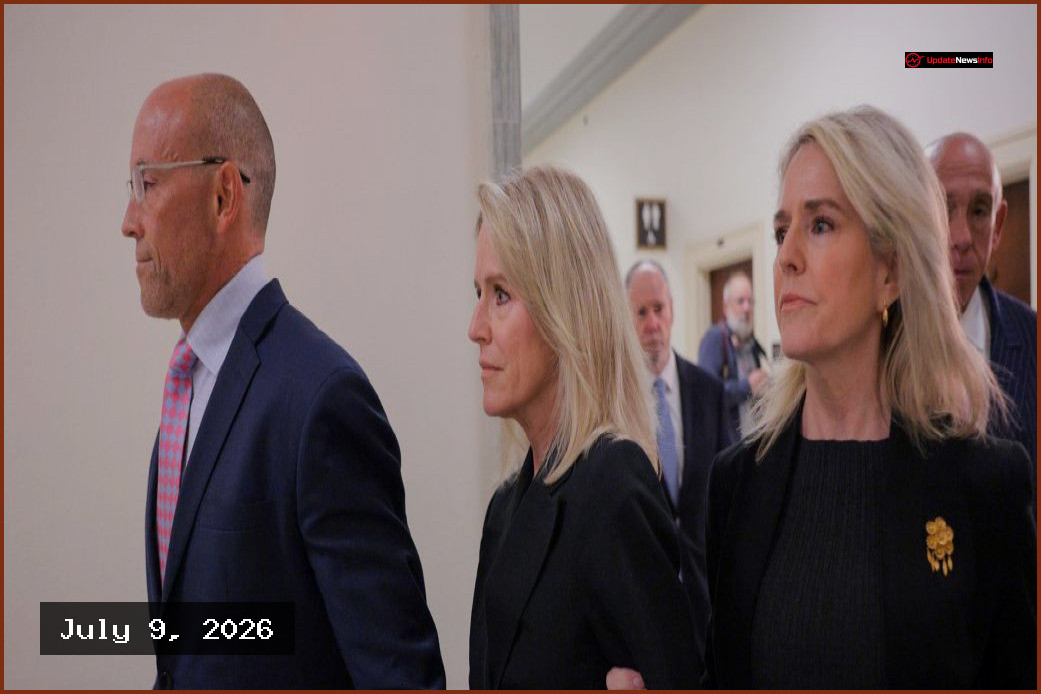
Several survivors of Jeffrey Epstein are challenging the congressional testimony of his long-time assistant, Lesley Groff, accusing her of lying to lawmakers about her involvement and awareness of his sex trafficking ring. During a transcribed interview with the House Oversight Committee on June 9, Groff asserted that she had never met any of the young women and girls who gave Epstein massages, and denied knowing details about their ages or backgrounds.
However, multiple survivors have strongly disputed these claims. In interviews, four women speaking on the record and two sharing their stories anonymously detailed their direct, in-person interactions with Groff. They described discussing their ages with her, receiving direct payments from her, and meeting her multiple times throughout her 18-year tenure as Epstein’s assistant.
Groff’s hourslong session with the House Oversight Committee is part of an ongoing congressional inquiry into individuals within Epstein’s inner circle. During her testimony, Groff portrayed herself as being completely deceived by Epstein, calling him a “master manipulator and deceiver.” She told lawmakers, “For 18 years, I worked for Dr. Jekyll but was never permitted to see the true Mr. Hyde.” While Groff was named as a potential co-conspirator in a controversial 2008 non-prosecution agreement with federal prosecutors in Florida, she has never been charged with any crime. Her attorney did not respond to requests for comment regarding the survivors’ allegations.
The House Oversight Committee is currently reviewing Groff’s testimony against available evidence, according to a committee spokeswoman, who invited anyone with additional information to come forward. Sara Guerrero, the communications director for the committee’s top Democrat, Representative Robert Garcia, expressed frustration that Groff was not required to testify under oath by Chairman James Comer, noting that lying to Congress is a federal crime that carries serious legal consequences.
The contradictions between Groff’s testimony and the survivors’ accounts span several key areas. While Groff repeatedly told lawmakers she never met any of the girls or women she arranged to give massages, all six survivors interviewed stated otherwise. Marina Lacerda, who first met Epstein in 2002 when she was nearly 14, said she saw Groff regularly and that Groff had met at least three or four of her friends. Sharlene Rochard, a former young model in New York, recalled meeting Groff multiple times in different locations. Lara Blume McGee, who was abused between 2001 and 2003, and Lisa Phillips both confirmed meeting Groff in person, with Blume McGee remembering at least two meetings at Epstein’s townhouse.
One anonymous survivor, who was 14 when she met Epstein, recalled seeing Groff frequently in a small office seating area located just to the left of the foyer inside Epstein’s New York City townhouse. A second anonymous survivor, who met Epstein in 2001 at age 20, also confirmed meeting Groff multiple times, including at his New York office.
Groff also claimed she never knew or asked about the ages of the girls, nor did she know some were minors or local high school students. Lacerda disputed this, stating that Groff would ask detailed questions over the phone about new girls, such as what they looked like, where they were from, and how old they were. Lacerda added that Groff eventually instructed her to tell her friends to bring school IDs to their sessions. Rochard and the second anonymous survivor both pointed out that Groff had access to their personal identification to arrange travel. The anonymous survivor recalled sitting with Groff in person so she could help apply for her first passport, noting that Groff obviously knew her age. When asked by a lawmaker if she handled passports, Groff denied it, though she admitted she “may have seen a picture of a passport.”
The first anonymous survivor, who attended a private Catholic school, was entirely certain Groff knew she was a minor, recalling that Groff frequently asked her to leave school early and saw her wearing her school uniform.
Furthermore, Groff told lawmakers she never distributed money on Epstein’s behalf. Survivors, however, described receiving payments directly from her. Lacerda said Groff frequently handed her white envelopes containing hundred-dollar bills at the New York City office stairs, particularly when Epstein was traveling. The first anonymous survivor also reported picking up cash envelopes from Groff regularly, while Phillips stated she went to Epstein’s office to collect checks for her school tuition directly from Groff, calling Groff’s denial of financial transactions “impossible.”
Other assertions by Groff have also been challenged. Groff claimed she “never stepped foot” in Epstein’s New York City townhouse between 2001 and 2013, a statement that both Blume McGee and the first anonymous survivor refuted, saying they saw her there multiple times during the early 2000s. Additionally, while Groff denied ever providing Broadway tickets to the girls, both Lacerda and the first anonymous survivor recalled picking up theater tickets from Groff in white envelopes on the office staircase. Lacerda even noted she once walked out of a performance of “Phantom of the Opera” because she did not enjoy it.
The situation has intensified the frustration of Epstein’s survivors, who worry that congressional investigations will yield little accountability. To date, Ghislaine Maxwell remains the only individual prosecuted in the United States in connection with Epstein’s crimes, despite the Department of Justice releasing millions of pages of documents. Lacerda voiced the shared fatigue of many victims, questioning why no one from Epstein’s circle will step forward, take accountability, and provide full transparency.