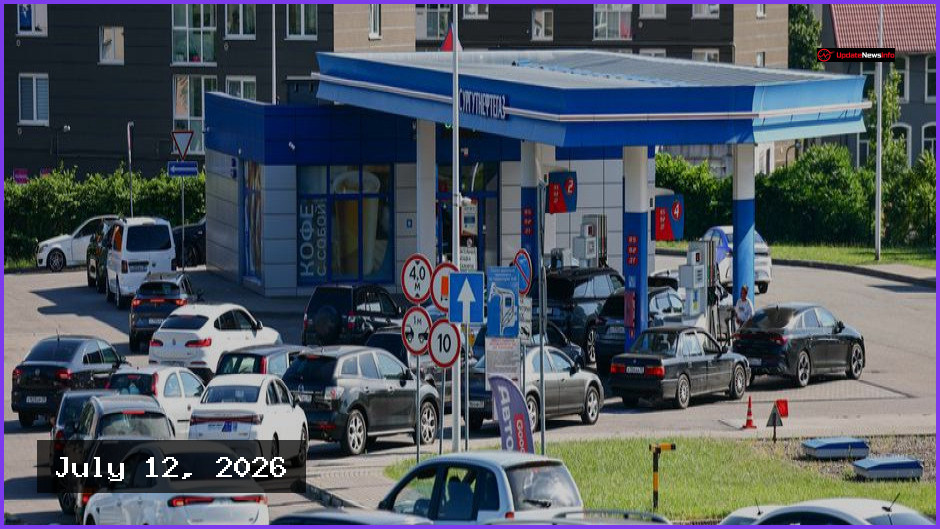
A targeted campaign of Ukrainian drone strikes on Russian energy infrastructure has triggered a severe fuel crisis across much of Russia, disrupting daily life and leaving motorists stranded in massive queues. Drivers in various regions are waiting hours, and in some cases days, to refuel. Many are traveling across entire cities in search of open stations, sleeping in their cars, and occasionally clashing in lines as tempers flare over the worsening shortages.
In recent months, Kyiv has intensified its aerial campaign against Russia’s oil infrastructure. On July 6, Ukrainian forces struck the Omsk refinery, located roughly 2,500 kilometers (1,550 miles) from the border. This attack means Ukraine has now successfully targeted Russia’s 10 largest oil refineries, stretching from the Leningrad region to Omsk, deepening a fuel deficit that is felt nationwide.
Reports from across the country indicate that many gas stations are shutting down entirely. The few stations that remain open are drawing queues that stretch for miles. In the resort town of Gelendzhik, one resident reported trying to refuel her car for three days. Despite arriving at a station at 5 a.m. and spending the night in her vehicle, she was still unable to purchase gasoline. She described the situation as “literally a fight for survival,” blaming both the shortage and opportunistic resellers who buy up fuel to sell at inflated prices.
The situation appears particularly dire in Chita, a city in Russia’s Transbaikal region, according to eyewitness videos shared on social media. Drivers there are reportedly waiting in line for up to 36 hours. Some have run out of fuel while waiting and have been forced to push their vehicles. Social media users also claim that desperate motorists are purchasing places in line for as much as 35,000 rubles (€400/$460).
The fuel deficit is forcing many Russians to alter their daily routines. Some are carpooling to run basic errands or transport children to school, while others have switched to public transit. In Irkutsk, a resident who repeatedly failed to refuel her car decided to rely on buses and taxis instead. However, the transport sector is also feeling the squeeze. The Kommersant newspaper reports that taxi drivers are working less frequently and are increasingly canceling longer trips in major cities, leading to a spike in fares.
In rural areas, some residents are reverting to traditional means of transport by purchasing horses instead of cars. The Telegram channel Mash cited horse breeders who reported a surge in demand for workhorses in recent weeks, with the animals being utilized for forestry, haymaking, and daily farm tasks.
Meanwhile, some stations are restricting sales. A resident of Krasnodar wrote online that she was “officially a pedestrian now” after a local station refused to sell her fuel, reserving it only for “special vehicles.” According to the independent Russian outlet 7×7, this category includes vehicles used by government officials. Journalists from the outlet documented cases in at least four regions where fuel was sold exclusively to individuals presenting official government identification.
Some social media users have accused the government of trying to downplay the severity of the situation. Despite reports indicating that nearly one-third of Russia’s oil refineries are currently out of operation, the government has remained largely silent. Nina Ostanina, a member of the State Duma, criticized this silence on her Telegram channel, asking why the agriculture minister and the deputy prime minister responsible for the sector have not addressed the public ahead of the harvest. Ostanina warned that the country could be left without grain, which she said would amount to a “death sentence” under international sanctions.
In contrast, national authorities deny any systemic fuel shortage, attributing the crisis instead to panic buying and speculators. Although nationwide demand has risen by 20% to 30%, Deputy Prime Minister Alexander Novak maintains that supply disruptions are confined to individual gas stations and can be resolved through structural adjustments, insisting there is sufficient fuel available.
Regional governors in Krasnodar, Irkutsk, and Pskov have similarly blamed retailers for stoking public panic. Pskov Governor Mikhail Vedernikov wrote on the state-backed messaging app Max that fear of losing mobility is driving the surge in demand. He noted that taxi drivers, small businesses, and farmers are stocking up on fuel out of concern over lost income and potential machinery failures that could lead to crop losses.
The domestic crisis appears to be impacting political approval ratings. According to a poll by the Russian Public Opinion Foundation (FOM) conducted from June 19 to 21, President Vladimir Putin’s approval rating fell from 74% to 69% within a single week. This represents the lowest approval level recorded since the beginning of Russia’s full-scale invasion of Ukraine, amid growing public concern over rising prices and the cost of living.
However, this shift in public sentiment has not translated into widespread demands to end the conflict. A June poll by the independent Levada Center indicated that support for the war in Ukraine actually increased to 30%, up six percentage points from March 2026. Conversely, the share of respondents who believe Russia should enter peace negotiations fell by seven percentage points since February 2025, landing at 60%. Sociologists at the Levada Center noted that a sustained decline in support for peace talks of this duration was last observed over a four-month period spanning late 2023 and early 2024.
To view this video please enable JavaScript, and consider upgrading to a web browser that supports HTML5 video
"Hooray! I'm officially a pedestrian now," one resident of Krasnodar wrote after she said she was unable to fill up her car because a local gas station was selling gasoline only to "special vehicles." According to the Russian independent outlet 7×7, that category also includes cars used by government officials. The outlet reports that its journalists documented cases in at least four regions where fuel was sold only to people with official government IDs.