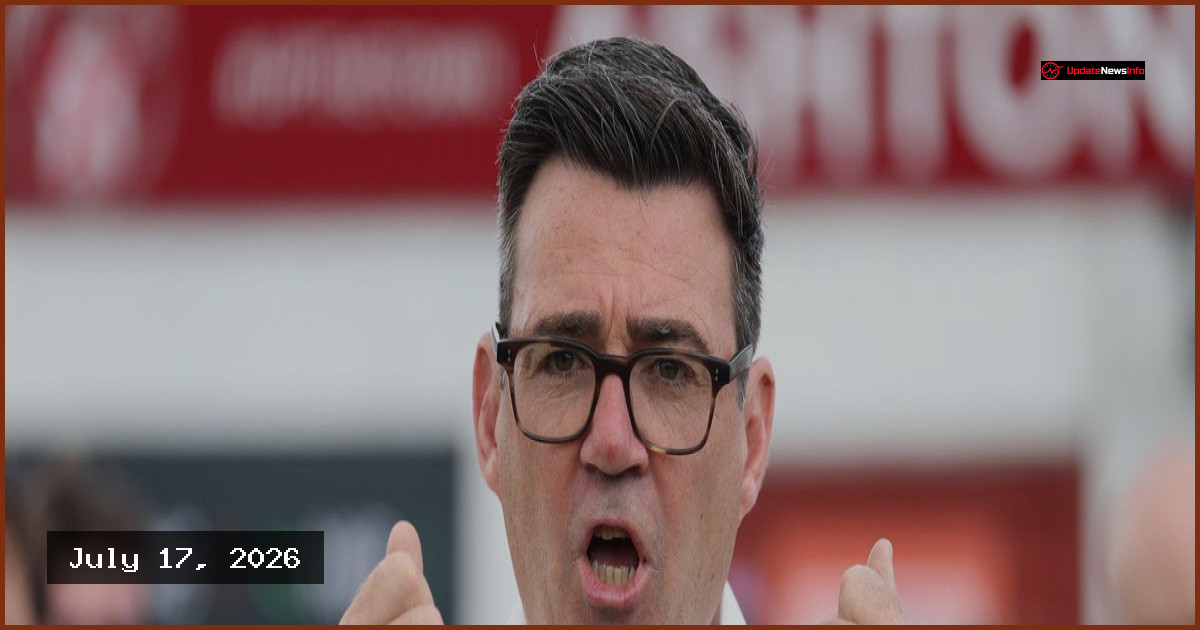
British Prime Minister Keir Starmer announced in June that he was stepping down from his role, less than two years after leading the center-left Labour Party to a commanding victory in the general election. Starmer, who promised an "orderly transition," faced months of mounting public dissatisfaction regarding the state of the economy and perceived slow progress in addressing illegal immigration. Attention has since shifted to his successor, Andy Burnham, who is set to take over the leadership.
Burnham, who served as the mayor of Manchester for approximately a decade, stepped down from that position to stand in a local by-election in June. He easily clinched the seat in Makerfield, Greater Manchester, to become the local member of Parliament in the House of Commons. While not a legal requirement, British party leaders have long been chosen from among sitting elected lawmakers, and Burnham's victory in the Makerfield by-election was significant as it cleared his path to the premiership.
The victory was particularly notable because Burnham won decisively in a constituency that Labour has struggled to hold in recent years. The seat is predominantly White British, traditionally working-class, post-industrial, and voted heavily to leave the European Union in the 2016 "Brexit" referendum. Communities like Makerfield were once considered Labour heartlands, but they have become increasingly contested as voters drift toward right-wing, populist parties such as Reform UK. Reform UK, led by Nigel Farage, an ally of President Trump, has made major gains over the last year, fueled by voter concerns over immigration and declining living standards. Burnham’s performance exceeded expectations, providing Labour strategists with hope that the party could reconnect with voters before the next national elections.
Burnham has spent years positioning himself as a viable alternative to Starmer, criticizing the Labour leadership at moments of weakness while carefully cultivating his own national profile. Whether he would differ from Starmer as a national and international leader remains unclear. A lawmaker from the Conservative Party, Labour's longtime chief rival, recently described Burnham as "Keir Starmer with a Northern accent." It also remains to be seen if he would adopt a different approach in dealing with President Trump, especially after Starmer found that keeping the American leader on-side brought limited advantages. During his campaign in Makerfield, Burnham warned the U.K. against adopting American-style politics, stating, "Politics is getting more polarized. And the path we're on, if we are not careful, is a path towards the politics of the United States of America. A polarized, poisonous politics where people in communities don't work together anymore."
Although he often presents himself as an outsider to London politics, Burnham has spent much of his career in the capital. He served as a member of the Cabinet under former Prime Ministers Tony Blair and Gordon Brown and spent 16 years as an elected Labour member of Parliament before becoming Manchester's mayor in 2017. He has also attempted twice previously to win the leadership of the Labour Party, failing on both occasions. As mayor of Greater Manchester, however, he built a reputation as a champion of northern England, particularly during the COVID-19 pandemic, when he publicly clashed with then-Prime Minister Boris Johnson's Conservative government over financial support for his city. Known as the "King of the North," he has championed a model of regional devolution and civic pride sometimes referred to as "Manchesterism."
Supporters argue this model is where he differs from Starmer, portraying him as an authentic voice for post-industrial Britain who understands communities that feel neglected by London. They suggest his "everyman" presentation and communication style contrast with the rigid, technocratic approach of Starmer. Critics, however, argue that Burnham has failed to clarify his views on defining issues. When speculation about his return to London intensified, he appeared to change his position on immigration and Britain's post-Brexit relationship with Europe. Earlier this year, he criticized tougher immigration policies ushered in by Starmer, but later suggested he would go further to reduce legal migration and expand detention capacity. He also previously supported Britain eventually rejoining the European Union, a position from which he has since distanced himself.
It is not yet clear what policies Burnham might implement to differentiate himself from Starmer, as he may be reluctant to make dramatic changes without a new mandate from a national election. Starmer brought the party to power with a resounding 2024 victory, and abandoning those policies could leave Burnham open to accusations of being undemocratic. Within minutes of Starmer's resignation, Reform party leader Nigel Farage demanded a new general election, stating, "Westminster wants to crown Andy Burnham off the back of a single by-election. It's ridiculous to pretend that Andy Burnham has any kind of meaningful mandate to lead the country."
Under the British system, citizens do not directly elect their prime minister; they elect local members of Parliament, and the leader of the party with a majority in the House of Commons typically becomes prime minister. A governing party can change its leader if a majority of its lawmakers believe the incumbent has become an electoral liability, a process that does not require a new general election. When Burnham takes office at Number 10 Downing Street, he will be the seventh person to do so in a decade. While a new national election must be called by 2027, the government can call one at any time, though doing so carries the risk of losing the party's parliamentary majority.