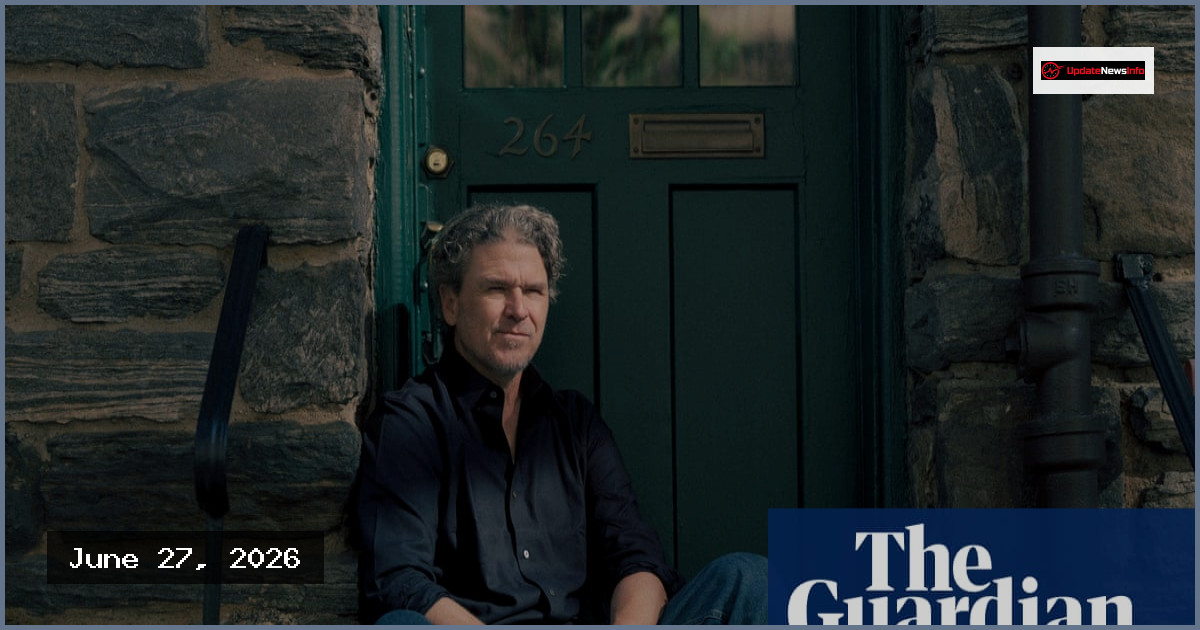
As his latest novel is released, acclaimed US author Dave Eggers recently engaged in a unique interview, beginning with a life drawing session. Eggers, who left art school but has been drawing for decades, organized the session in the book-lined offices of McSweeney’s, the San Francisco-based publishing house and literary journal he established in 1998. He believes figure drawing, which he has regularly hosted since the pandemic, helps cultivate empathy. Explaining this, Eggers noted, “I feel like in three hours of drawing a human, you learn so much about them and there is so much affection that comes from carefully trying to get them right.”
Eggers, 56, with his distinctive grey curly hair, black graphic T-shirt, jeans, and brown lace-up boots, has authored over a dozen novels, half a dozen nonfiction works, children’s books, and art books. He has also launched numerous non-profits aimed at lowering barriers to literature and the arts, often handing over leadership swiftly. His newest endeavor, Art + Water, is an arts center on the San Francisco waterfront, designed as a traditional artists’ atelier. It offers free studio space to 10 established artists who, in turn, mentor and instruct 20 local emerging artists, with the program being entirely free to attend. Eggers criticizes the “absurd” cost of a master of fine arts (MFA) degree, which can reach $100,000 annually, calling it an “arts industrial complex that makes everyone miserable.” He passionately states, “There’s nothing that makes me more crazy than an economic barrier to a creative writing class or a drawing class.”
Following the drawing session, the interview moved through a Narnia-esque wardrobe connecting McSweeney’s offices to the International Library of Youth Writing. This library showcases works by children who have attended the global network of writing centers Eggers co-founded nearly 25 years ago. The original center, 826 Valencia, is located across the street inside a pirate-supply shop, a whimsical choice Eggers made because local planning laws required a commercial space, and he believes children need more fantasy in their lives.
Inside the library, amidst oriental rugs and a quirky portrait of Queen Elizabeth I, local schoolchildren can read, write with pens or typewriters, or create their own zines. A hidden door behind a grandfather clock leads to a Marie Antoinette-style boudoir, where students can explore replicas of famous writers’ juvenilia. A pink chest of miniature drawers serves as postboxes for neighborhood children, who exchange letters and often receive jokes from the library’s curator. Eggers observes that children adore this tangible interaction. “It’s not like a digital mailbox, it’s a box with a real person that’s putting a letter in every day,” he explains. “If you give them a real, tangible choice, they will always choose the person, the typewriter, the tactility, as opposed to another screen. But we assume that they want more screens, and we give them more screens, and we serve nobody. It’s just a tragedy.”
Eggers proudly displays a pamphlet illustrating a story by children set in “the fluffy pizza beetle desert of doom,” noting that many books in the room are “bonkers.” He emphasizes, “We don’t question the weirdness, as long as it’s original. That’s the only requirement, it can’t be about you know, SpongeBob or something. It has to be their original thoughts.” After two decades of working with children, Eggers believed he had encountered every educational challenge, until AI entered classrooms. He describes the AI challenge as “beyond an existential one,” finding it particularly concerning when a “smart 10-year-old will say, ‘well, I don’t use it to write, I just use it to generate ideas,’ which is far, far worse.”
He frequently reminds students of their unique potential, telling them, “You’re one of one. You’re unprecedented in the entire line of human history. Only you have your brain. Only you can think of what you can think of. Only you can tell a story in a particular way. Why would you cede that to a machine?” Eggers’s usually quiet voice intensifies as he elaborates, “Once you have a machine think for you and write for you, you’re cooked as a species. That’s it. That’s the worse dystopian outcome there could ever be.” He finds nothing more alarming than “the idea of us willingly, without any overlord telling us so, saying ‘I think my voice would be better expressed by an unthinking machine who has plagiarised all of the world’s authors and has come up with this terrible soup of bad writing.’”
Despite the disheartening news surrounding AI-written books and reviews, Eggers anticipates a future countermovement, akin to the growing resistance against providing teenagers with smartphones and social media. He suspects most teachers recognize the issues with technology in schools, attributing the core problem to policymakers. He cites a speech by US education secretary Linda McMahon, who, while discussing the benefits of introducing AI to children as young as five, repeatedly mispronounced AI as “A-one.” Eggers laments, “This is who we have leading the department of education. We’re in such a comical place right now…”
Eggers and his wife, writer Vendela Vida, are involved in two class action lawsuits against Anthropic, an AI firm, for the unauthorized use of their books to train large language learning systems. He believes the company likely didn’t perceive their actions as theft, viewing the material merely as “content.” Eggers calls “content” the “world’s worst word,” arguing it dehumanizes writing and implies it “has no real value inherently, and it doesn’t matter if humans made it or not.”
Eggers’s nonfiction often carries a strong political engagement, with books like *The Monk of Mokha*, a story of immigration and the American dream, and *Zeitoun*, about a Syrian-American businessman during Hurricane Katrina. He notes these works “all started with outrage and just being aghast at some recent moment in American history and wanting to illuminate it.” He recalls his journalism professors at the University of Illinois, whom he described as “hardcore old Chicago newspaper guys,” warning students they wouldn’t earn higher than a B-minus. Eggers finds nonfiction writing a “slog” due to the rigorous fact-checking, and has many unwritten stories from reporting trips. He contrasts this with fiction, which, while not “pure joy,” is “infinitely more fun.”
His dystopian novels, *The Circle* (2013) and *The Every* (2021), depict a monopolistic big tech firm aiming to control all aspects of human life. Eggers finds reality increasingly outpaces his imagination, citing examples like a president communicating in emojis or AI sanitizing novels rather than creating them from scratch. He recently participated in an “interesting, open conversation” with Sam Altman of OpenAI on campus about AI-written novels. Eggers credits the attendees, noting that “the maniacal illusions of a few of the people at the very top are not always shared by the rank-and-file.” He delivered the “bad news” that “there’s no such thing as AI art. Only humans can create art,” describing machine output as, at best, “computer generated imagery.”
During the interview, Eggers used an old-fashioned flip phone. He writes first drafts by hand, then transfers them to a Mac computer from 1998 that has never been connected to the internet and is held together with duct tape. He has never understood the appeal of social media, admitting, “I’ve never seen Facebook. Like, I don’t know what exactly happens on Facebook.” However, he finds ESPN sports news and watching old concerts on YouTube to be significant temptations, confessing to spending two and a half hours watching a Sinéad O’Connor concert or a Kate Bush show from 1981. He only installed internet access at home during the pandemic, a change that led him to now write on a boat in San Francisco Bay “to escape the internet,” where he has no phone reception and is only interrupted by passing fishers, porpoises, or harbor seals.
Born in Boston and raised in Chicago, where his mother was a teacher and his father a lawyer, Eggers gained literary prominence in 2000 with his tragicomic memoir, *A Heartbreaking Work of Staggering Genius*. The book chronicles how, at 21, he became the acting parent to his eight-year-old brother, Toph, after both parents died of cancer within weeks. A year later, his sister Beth died by suicide. Reports suggest he later became estranged from Toph. In a 2010 Guardian interview, he called the memoir an “aberration.” Eggers rarely grants interviews, avoids using the first-person “I” in his writing, and no longer discusses this painful period of his life.
His new novel, *Contrapposto*, began about 20 years ago, with notes on random copy paper slowly accumulating in a box. The novel, set in the art world, spans six decades and explores the friendship and thwarted romance between Cricket, a reclusive, art-loving nine-year-old, and Olympia, a worldly 10-year-old who commissions Cricket to create ornate, pornographic graffiti. This marks the first of many artistic collaborations. While a box of notes usually becomes a book in about five years, Eggers says it took turning 50 to fully grasp how to write *Contrapposto*, realizing that people are surprisingly consistent. “Most of my friends I’ve had since first or second grade, and none of us changed much. We have the exact same relationship,” he notes.
Eggers quickly dismisses similarities between himself and Cricket, though he loved drawing as a child. He describes himself as an “active, antsy kid” who befriended “naughty boys.” He briefly studied art at his local state university and interned at a “snooty gallery” that saw no visitors for a week, but the parallels end there. Unlike Cricket, who struggles to make a living in art due to his refusal to compromise and inability to meet deadlines, Eggers is pragmatic. He sells prints of his art, including animal drawings with amusing captions like “Oh God the beauty will kill me,” to cover the library’s rent, finding satisfaction in meeting monthly financial targets.
A central theme in *Contrapposto* is the intricate relationship between talent and success. One character observes that the most talented guitarist might be playing in a Journey cover band in Reno, a sight Eggers himself claims to have witnessed. He suggests that talent alone isn’t enough; sometimes individuals lack the right ideas, or their skills aren’t valued for esoteric reasons, such as the overlooked artistic merit of streetside portrait artists. “I’m astounded when I see some of them, what they can do,” he remarks.
Before concluding the interview, Eggers reviewed their sketches, offering generous praise for the interviewer’s work. He decided to keep one of his own drawings: a sketch of the model, Prudence, facing away and playfully tugging at one of her dark braids, an image that conveys a sense of motion and demonstrates his ability to achieve looseness while maintaining total control.