Another disappointing World Cup performance has led to Germany questioning its footballing identity, with some advocating for sweeping changes throughout the sport in the nation.
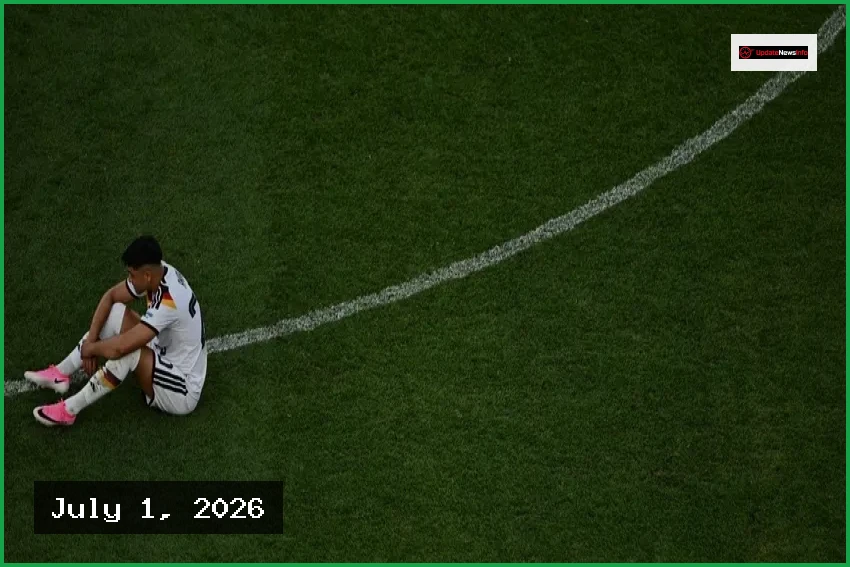
Germany’s unexpected defeat to Paraguay in the last 32, marking their first-ever penalty shootout loss in a World Cup, signifies a continued decline for the four-time champions from the sport’s elite. This marks the third consecutive World Cup where Germany has been eliminated in the early stages.
Since their World Cup victory against Argentina in 2014, Germany has not only failed to win an elimination match but has also been unable to maintain a clean sheet in these crucial games.
The pressure is mounting on coach Julian Nagelsmann, with speculation about former Liverpool manager Jurgen Klopp potentially being a successor. However, Klopp himself and others are pushing for more profound structural changes within German football.
Despite lowered expectations following a decade of mixed results, the German media has been highly critical of Nagelsmann’s team after their loss to the 41st-ranked Paraguay, a team that had previously suffered a significant defeat against the tournament hosts, USA. The Munich daily Süddeutsche Zeitung described the outcome as “a new humiliation,” stating that the German team was “heading home with a thoroughly deserved return ticket.” German football magazine Kicker characterized the result as a “damning indictment and proof that Germany is drifting further and further away from the world’s elite.”
Historically known for producing top talent, Germany’s ability to develop quality players has reportedly fallen behind rivals like France, Spain, and England over the last ten years. Despite being Europe’s most populous country and having football as its dominant sport, Germany faces challenges with player depth.
While injuries to key players such as teenage forward Lennart Karl, veteran striker Serge Gnabry, and first-choice centre-back Nico Schlotterbeck have impacted the team, other major European nations can still afford to leave prominent players out of their squads. Kicker highlighted players like France’s Eduardo Camavinga, Christopher Nkunku, and Randal Kolo Muani, England’s Phil Foden, Trent Alexander-Arnold, and Cole Palmer, and Spain’s Dean Huijsen as examples of the depth available to other nations.
This limited talent pool places immense pressure on Germany’s few remaining world-class players. Kai Havertz, Florian Wirtz, and Jamal Musiala, who all had challenging club seasons leading up to the tournament, have struggled to replicate their best form in North America, despite occasional flashes of brilliance.
Nagelsmann has borne the brunt of the criticism. His appointment, seen as a significant achievement for the German FA (DFB) given interest from top European clubs, has come under fire. With his highest achievement being a quarter-final exit at Euro 2024 on home soil, there are growing calls to avoid prolonged managerial tenures following World Cup disappointments, similar to the experiences with predecessors Joachim Loew and Hansi Flick.
Lothar Matthaeus, a 1990 World Cup winner, wrote in his Bild column that Nagelsmann lacked “imagination” and that Germany “have to move forward with a new coach.”
Nagelsmann acknowledged that “big changes” are necessary but expressed his commitment to staying, stating, “I’m not one to run away. I’m ready to continue if the DFB wants me to.” The DFB reportedly postponed a press conference scheduled for Tuesday, intending to issue a statement later in the day.
Jurgen Klopp, serving as a television pundit, has cast a significant shadow over Nagelsmann and the German team since the tournament began. Earlier in the competition, Klopp faced criticism for a remark suggesting Nagelsmann was merely a temporary placeholder. However, on Monday, Klopp adopted a more serious tone, dismissing any notion of him taking over as coach and instead emphasizing the need for fundamental changes in German football, starting from the under-10 level.
Observing Paraguay’s emotional celebrations, Klopp commented, “They’re all in tears; that’s how much the Round of 16 means to them.” He suggested that Germany has become too complacent, resting on its past achievements. “We are Germany? No, we were Germany. To be football Germany again, we need to really change things,” Klopp stated. He clarified that the issue was not about individuals, including himself or Nagelsmann, adding, “Julian is right. The team wanted it, but they were unable to do it in some areas. And now we need to ask why is that?”