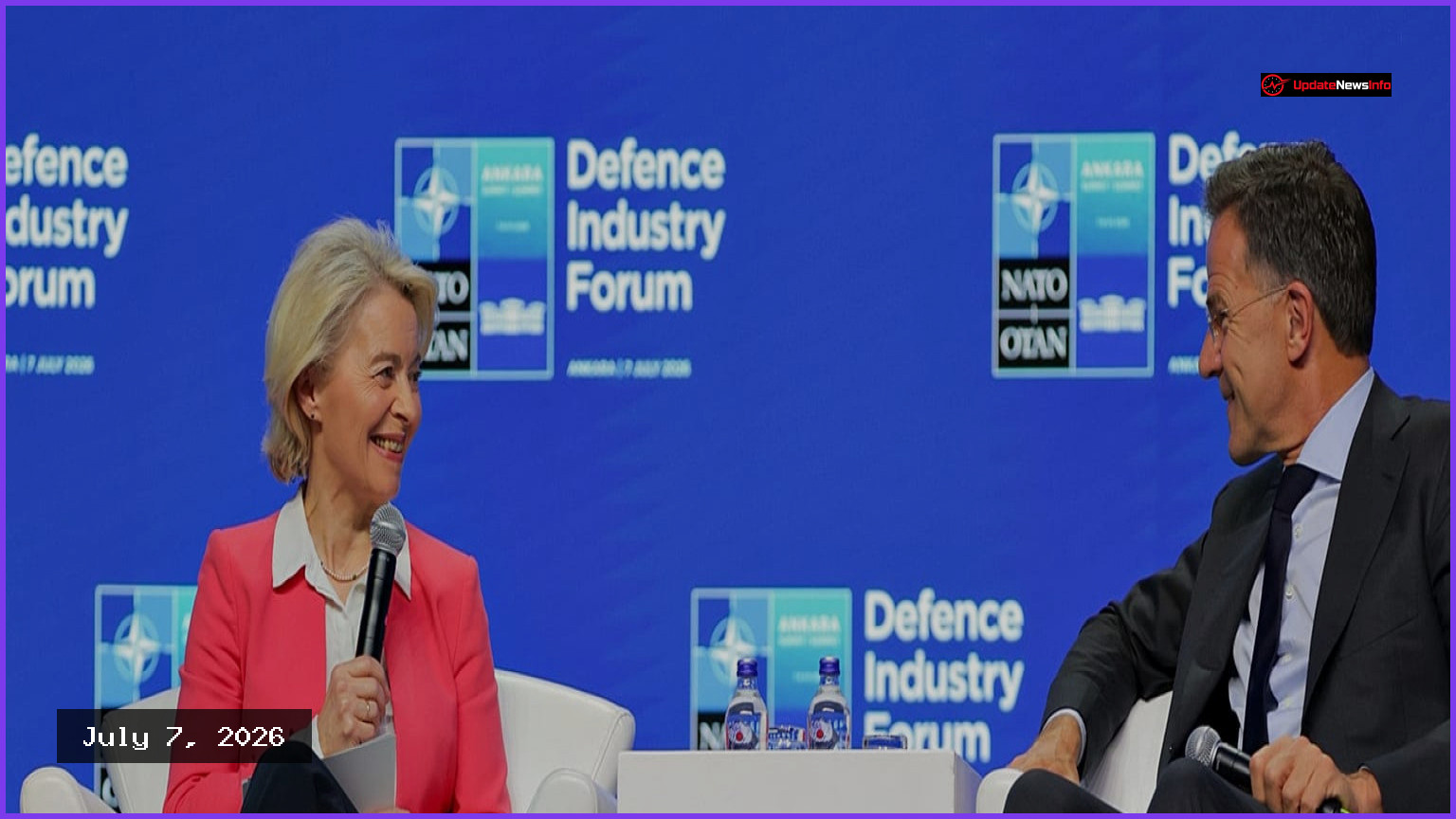
As leaders of the 77-year-old alliance assembled in Ankara, Turkey, for their annual summit, European Commission President Ursula von der Leyen and NATO Secretary General Mark Rutte underscored the urgent need for NATO to become more European. The move aims to decrease the alliance’s long-standing reliance on the United States for its security needs.
Speaking at an industrial forum held prior to the summit, von der Leyen emphasized the necessity of close cooperation between the European Union and NATO, stating that interoperability is the key to achieving this goal. Rutte supported this perspective, noting that there is a clear division of labor between the two organizations: NATO focuses on command structures, standards, and capabilities, while the EU manages industry, investment, and regulation. Notably, 23 of the 27 EU member states are also part of NATO.
Rutte acknowledged the need for a fundamental shift, asserting that the alliance cannot maintain its previous level of over-reliance on the United States. He described the current transformation driven by closer EU-NATO collaboration as unparalleled, stressing that to remain a transatlantic organization, it must become more European. This push for the “Europeanisation of NATO” comes amid rising tensions across the Atlantic, exacerbated by the White House’s unilateral decision to strike Iran and a gradual reduction of US military assets stationed in Europe.
While nations like the Baltics, Poland, and the Nordic countries have aggressively increased their military spending to meet the 5% of GDP target, others including Belgium, Spain, the Czech Republic, and Luxembourg are still lagging. To bridge this gap, von der Leyen highlighted the Commission’s financial initiatives, such as the €150 billion SAFE loan program and a provisional €135 billion allocation in the upcoming EU budget, intended to ramp up domestic defense capabilities.
Von der Leyen argued that in the current geopolitical environment, a massive surge in defense investment is essential. She noted that the goal is to ensure a strong return on investment for taxpayers, create quality jobs within Europe, and bolster regional research and development. Rutte added that a significant increase in the defense industrial base is required on both sides of the Atlantic to counter Russia’s war machine. He warned that Russia has shifted its entire economy to a war footing, with even the automotive industry contributing to the conflict, and urged allies not to be naive regarding the threats posed by Russia’s cooperation with China, Iran, and North Korea.
Twenty-three of the EU's 27 member states are also members of NATO.
Rattled by the deepening fractures, Europeans are determined to show US President Donald Trump that they are pulling their weight and stepping up their defence investment at a rapid pace, a trend often described as the "Europeanisation of NATO".