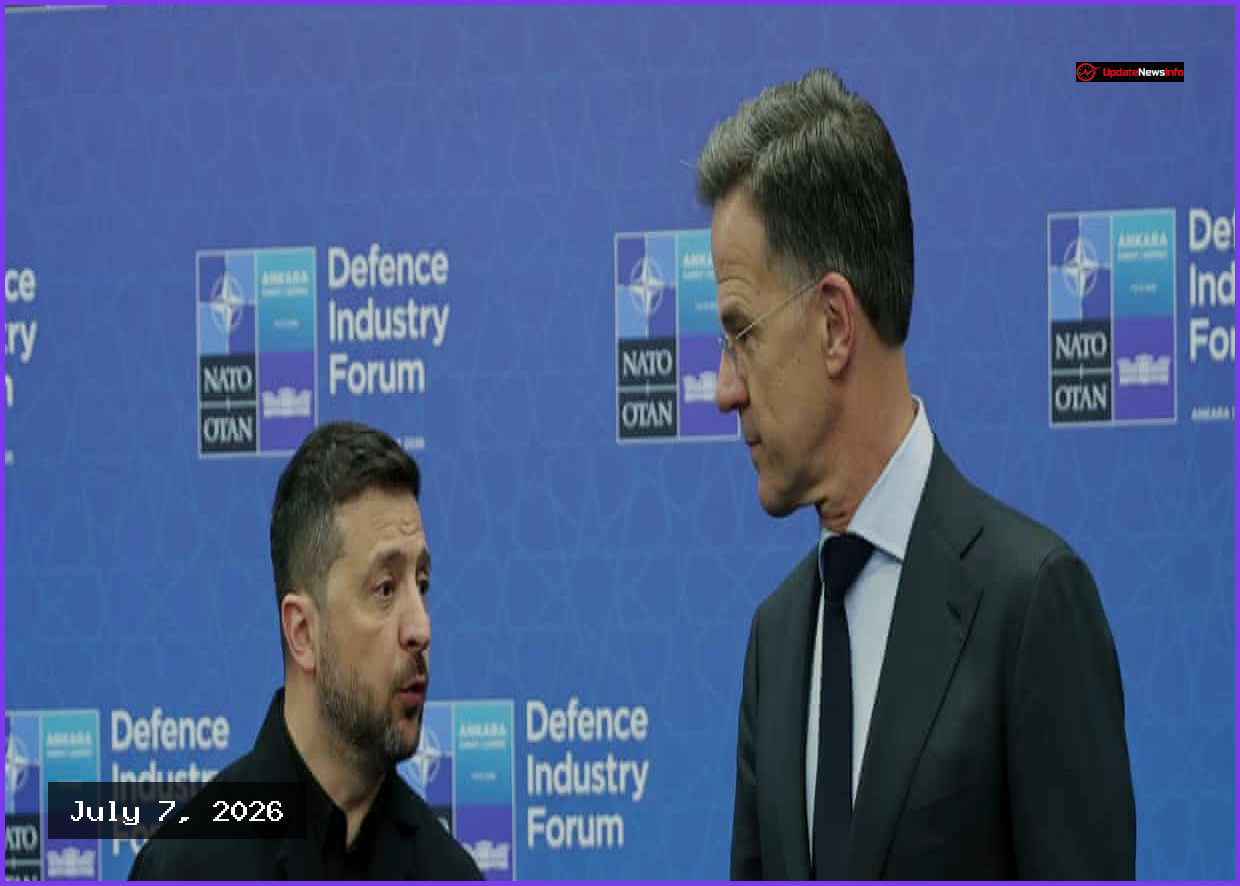
Volodymyr Zelenskyy, President of Ukraine, has advocated for his country’s admission into Nato, asserting that excluding a nation with robust defensive capabilities, developed through years of conflict with Russia, would be a misstep. Speaking at Nato’s defence industry forum, Zelenskyy questioned the rationale of keeping out a country and people possessing such a high level of defensive strength.
Zelenskyy stated that Ukraine has developed nearly all the necessary weapons and now primarily seeks European assistance to create an alternative to US Patriot systems for protection against ballistic missile attacks. He argued that if Ukraine already possesses these capabilities and its people know how to fight effectively, integrating these strengths into Nato’s collective defence would enhance the security of all member nations.
The Ukrainian president noted that the protracted war, now in its fifth year, has transformed his country’s industrial capacity. He pointed to recent Ukrainian drone strikes that penetrated Russian defences and hit an oil refinery in Omsk, Siberia, located approximately 1,680 miles (2,700km) from Ukraine’s border. This, he contended, has eliminated the notion of Russia having a secure rear area, as previously assumed due to its vast size.
He described Ukraine’s new long-range missiles and drones as a revolutionary change in warfare, emphasizing that this development was a necessity for national defence rather than a source of pride. Zelenskyy also reported that Ukraine has achieved over a 90% interception rate for Shahed drones and is improving its ability to counter cruise missiles, though he acknowledged that Russia’s most powerful weapons remain a challenge.
The issue of ballistic missile defence was underscored by a recent attack on Kyiv, where 23 Russian ballistic missiles killed at least 15 people. None of these missiles were intercepted due to a scarcity of US Patriot interceptors, a situation exacerbated by the US attacking Iran in the spring, leading to a Middle East war and a significant depletion of these interceptor stocks. The Center for Strategic and International Studies estimates that 1,060 to 1,430 Patriot interceptor missiles were used in that conflict, with Lockheed Martin producing about 600 PAC-3 versions annually, each taking two years to manufacture.
Zelenskyy stressed Europe’s urgent need to develop its own capacity to produce anti-ballistic systems and associated missiles, given the insufficient supply of US Patriots. He also mentioned that Russia has been escalating its missile and drone production, with a senior Nato official reporting that Russia launched approximately 8,150 drones and 211 missiles at Ukraine in May alone, while Ukraine responded with 10,000 long-range drones targeting Russia. A senior Nato official also briefed that Russian forces had advanced 3.79 sq km a day in June, a quarter the rate a year ago, and that the invaders were continuing to take 30,000 to 35,000 casualties a month.
The Nato official further indicated that Ukraine’s deep strike campaign has disabled about 20% of Russia’s oil-refining capacity and that the use of medium-range drones against Russian logistics has weakened Moscow’s control over Crimea, leading to reports of a state of emergency in the region.
“If we already have these capabilities, if Ukrainians already know how to fight like this, then it does make sense for these capabilities to become a part of the alliance’s collective defence that would make all of us stronger,” he added.
The Ukrainian president will be a guest at a leaders’ dinner on Tuesday evening at the Turkish presidential palace compound in Ankara, and is due to meet Donald Trump on Wednesday lunchtime for a bilateral meeting.