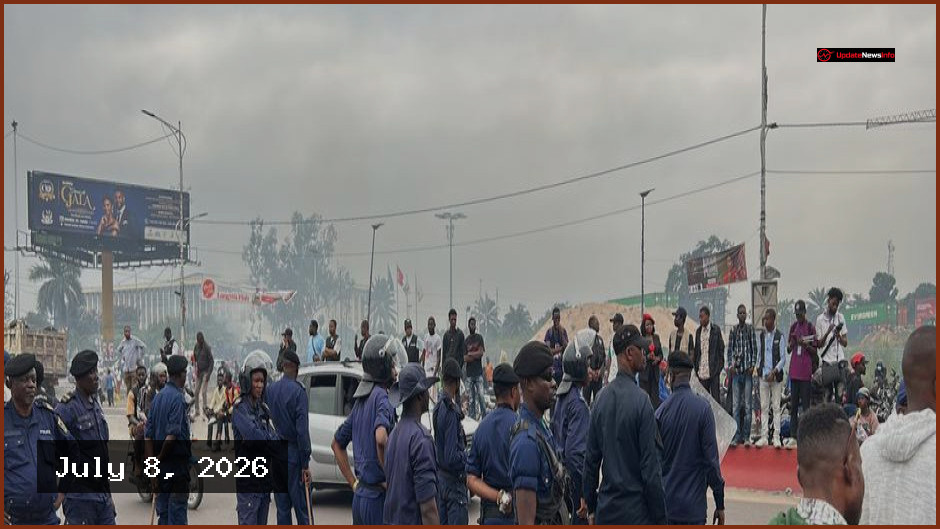
The Congolese opposition coalition C64 has announced a two-week postponement of nationwide protests, originally scheduled for July 8. This decision comes after a mediation initiative led by Burundian President Evariste Ndayishimiye, who currently chairs the African Union.
Formed in May and named after Article 64 of the DRC constitution—which empowers citizens to resist unconstitutional power grabs—the C64 coalition unites prominent opposition figures including Martin Fayulu, Moise Katumbi, Jean-Marc Kabund, and Delly Sesanga. The coalition vehemently accuses President Felix Tshisekedi of orchestrating a referendum on a new constitution to pave the way for an unconstitutional third presidential term, demanding his immediate resignation.
Observers are increasingly concerned about potential renewed unrest, especially following violent clashes that erupted during demonstrations on June 12.
In June, the DRC parliament adopted legislation to establish the legal framework for a constitutional reform referendum. Shortly thereafter, the Senate approved a related measure that the opposition claims would effectively remove existing presidential term limits. On June 30, the DRC’s Independence Day, President Tshisekedi stated that he would first refer the bill to the country’s constitutional court for a review of its compatibility with the current constitution. However, critics have raised doubts about the court’s independence.
Should the process align with Tshisekedi’s objectives, a referendum on a new constitution could be held, potentially resetting presidential term limits. Under such a scenario, Tshisekedi’s previous terms would no longer be counted, thereby enabling him to seek re-election.
The political maneuvering at home contrasts with the DRC’s growing international profile, as it has served as a non-permanent member of the UN Security Council since the beginning of this year. Since July 1, the DRC has also held the rotating presidency of the Security Council for a one-month term. Just one day prior, Tshisekedi outlined the country’s priorities for its Security Council tenure, emphasizing the regulation of mineral resource extraction.
Domestically, however, Tshisekedi’s political credibility faces mounting pressure. Many Congolese citizens oppose the proposed new constitution, which they fear would allow him to remain in power beyond his current mandate, set to end in 2028. Prince Epenge, spokesperson for the opposition platform Lamuka, asserted to DW that "[t]he constitutional amendment serves the interests of one man only: Felix Tshisekedi. He wants a third term." Epenge added, "We cannot accept that millions of dollars are spent simply to keep one man in power," warning that the proposal fundamentally threatens the country’s constitutional order.
Nobel Peace Prize laureate Denis Mukwege, a Congolese physician and human rights activist, also voiced strong criticism in an exclusive interview with DW. Mukwege highlighted constitutional constraints, stating, "When you are facing a public health emergency that has been declared an international emergency, or when you are confronted with a security crisis in which your country is under attack and partially occupied, and parallel administrative structures are being established, there are constitutional constraints that explicitly prohibit amending the Constitution."
A central point of contention revolves around whether a referendum can legally be used to replace the constitution, with critics citing Article 5 of the current constitution to support their argument. Conversely, supporters of the ruling UDPS party defend the proposed reform and the referendum. Christian Lumu, a member of the party’s youth wing, argued to DW that the current constitution is inadequate for addressing the country’s challenges and that "[t]he people want to change the constitution." He further stated, "We know this because we are in constant contact with ordinary citizens. We promised that we would change this constitution — which was imposed from abroad — once we came to power."
The opposition, however, firmly rejects this stance, with Lamuka describing the initiative as an illegitimate attempt to rewrite the constitution. Epenge warned, "The UDPS wants to force through constitutional change by unconstitutional means. That will never succeed."
The political dispute has increasingly spilled onto the streets. Since parliament passed the referendum law, the opposition has worked to unite resistance against the government’s plans. The C64 coalition has labeled the constitutional reform a "constitutional coup" and hopes that protests now scheduled for July 22 will intensify pressure on the government. Demonstrations on June 12 already escalated into violence, with local media reporting serious clashes between protesters, ruling party supporters, and security forces.
Lamuka has accused authorities of a brutal crackdown during the June 12 events. Epenge told DW, "It was a black day for the Congolese people. It was a massacre. Several peaceful protesters were killed." He further alleged, "They fired live ammunition. Hundreds of activists were arrested, beaten and taken to prison."
The Catholic Church has also taken a clear position, questioning the necessity of constitutional reform. Cardinal Fridolin Ambongo painted a grim picture of the country, citing ongoing armed conflict in the east, widespread poverty, insecurity, and recurring epidemics. He sharply criticized the government’s political agenda, asking, "Do we really believe that changing the constitution is the most appropriate response to the suffering of the Congolese people?" The cardinal concluded, "Given the seriousness of the current situation, we see neither the need nor the urgency for constitutional change. The priority for the Democratic Republic of Congo is peace."
This constitutional dispute unfolds amid continued instability in eastern DR Congo, where government forces are still battling the M23 rebel movement and the Alliance Fleuve Congo (AFC), and have yet to regain full control over several areas. International observers warn that the political crisis could further weaken state institutions, potentially allowing armed groups to exploit eroding trust in the government. The opposition shares this fear, arguing that a constitutional referendum under current conditions could not be genuinely inclusive, as large segments of the population in conflict-affected areas would be effectively excluded from participation.
The debate also carries potential consequences beyond the DRC’s borders. While European governments and multilateral organizations emphasize upholding democratic standards, other international actors appear to be driven primarily by strategic interests, particularly in security and critical minerals, exemplified by Rwanda’s support of M23.