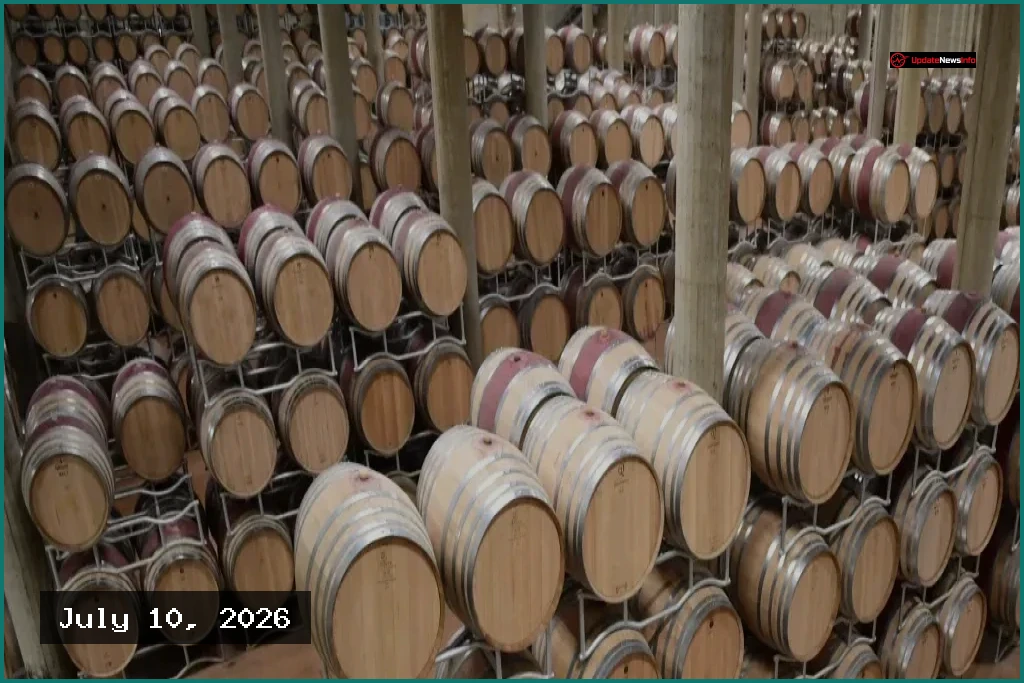
Italian winemakers are grappling with a massive surplus of inventory, with more than 5.3 billion litres of wine currently sitting in cellars as of May. This figure, representing a 7.3 percent increase year-on-year, is equivalent to an entire harvest, according to data presented by the Unione Italiana Vini (UIV) at their annual congress in Rome this Wednesday. Producers are now actively reclassifying wines into lower quality tiers in an attempt to offload stock, while simultaneously lobbying for restrictions on the upcoming 2026 harvest.
The current crisis is driven by a dual decline in both international and domestic demand. Exports to the United States, which remains Italy’s primary market outside of Europe, plummeted by 15.4 percent during the first four months of 2026. UIV secretary general Paolo Castelletti cited a combination of factors for this drop, including the strength of the dollar, a general reduction in American consumption, and tariffs imposed by President Donald Trump. Castelletti noted that while the industry hoped to sustain sales despite tariffs, they have ultimately become the final blow to export viability.
Domestic consumption has also weakened, with UIV figures indicating that supermarket sales volumes in Italy fell by 2 percent between January and May compared to the previous year. This lack of demand has led to a roughly 6 percent decline in bulk wine prices over the first five months of 2026. In response, producers are downgrading bottles to move them into more accessible market categories. UIV president Lamberto Frescobaldi stated that one in five bottles is now being downgraded, with three-quarters of those ending up in the generic table wine category.
Practically, this means wines originally intended for DOCG or DOC status are being marketed as lower-tier IGT or generic table wines. While this strategy helps clear shelves, it comes at a significant cost; the UIV estimates these downgrades will result in losses of approximately €516 million throughout 2026. Castelletti warned that this creates an “avalanche effect” where prices are eroded as volumes accumulate at the lowest tier of the quality pyramid.
To prevent further market destabilization, the UIV has officially called for a temporary halt on new vineyard planting permits and a reduction in yields for the 2026 harvest. Having warned as early as September 2025 that the sector would struggle to absorb high production levels, the organization is now urging immediate action. Frescobaldi emphasized the necessity of these measures at the Rome congress, arguing that the industry must accept responsibility for bold, even unpopular decisions to avoid greater long-term financial damage.
The UIV explained that producers were moving stock into the categories most easily sold on the market. But Castelletti warned the practice risked triggering “an avalanche effect: the wine drops a category, volumes pile up at the base of the quality pyramid, and prices get swept away.”
“Better a wrong decision than none at all,” Frescobaldi told the congress. “It’s time to take responsibility and make some bold choices, even unpopular ones, because doing nothing is already costing the sector far more than any rebalancing would.”