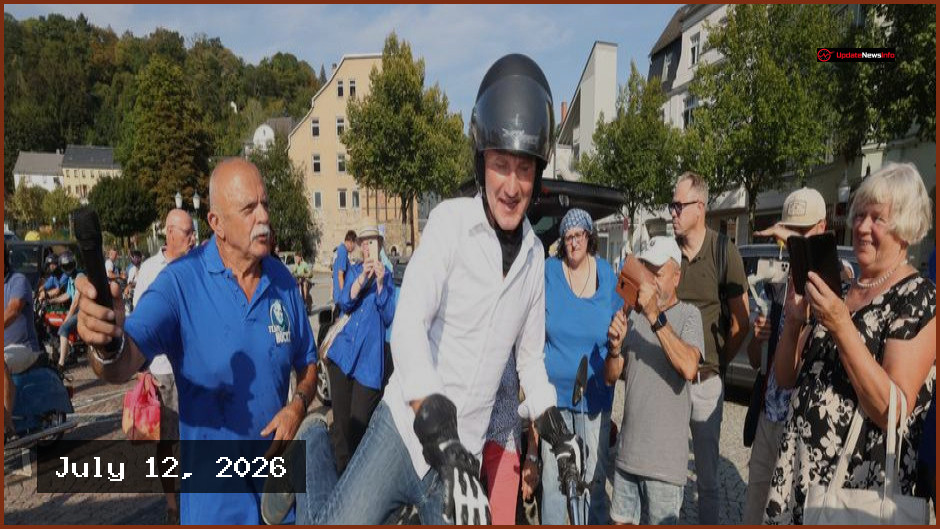
Dennis Baum, an 82-year-old heir to the Jewish family that founded Germany’s historic Simson company, has traveled from his home in New York to Germany to challenge the far-right Alternative for Germany (AfD) party. Baum is fighting to protect his family’s legacy against the AfD’s use of the iconic Simson moped in its political campaigns, particularly given the party’s stated antisemitic views.
The AfD, which enjoys significant support in Germany’s eastern states, has incorporated the retro-looking Simson moped, a cultural icon from the former Communist-ruled East Germany (GDR), into its campaigning. A central image in one of the party’s campaign videos features a convoy of these mopeds roaring through the forests of Thuringia, a state where the AfD’s branch has been classified as a confirmed right-wing extremist organization by the domestic intelligence agency.
Styled like a 1970s road movie, the video heavily relies on nostalgia, with a soundtrack designed to evoke a lost era. Leading this two-wheeler rally is Björn Höcke, a prominent AfD hard-liner. Although Höcke was born and raised in West Germany, he has built his political career in the east by positioning the AfD as a defender of East German identity and grievances. Höcke himself has twice been convicted for publicly using a banned Nazi slogan.
For Dennis Baum, whose grandmother belonged to the Jewish family that founded the Simson company in Suhl, Thuringia, in 1856, the AfD’s appropriation of the brand is deeply personal and historically resonant. The company grew to become a leading German manufacturer of firearms and later vehicles, but the Nazi regime forcibly seized the family’s ownership in 1935. After World War II, the factory continued operations in the German Democratic Republic, producing the mopeds that became one of the GDR’s most recognizable consumer brands.
Baum explained his mission to DW, stating, “The mission is to defend ourselves against the use of the family name, the Simson name, by the AfD.” He is one of five heirs to the Simson family, and while the trademark is held by another company, the family retains a voice regarding the brand itself. The family’s concern arose earlier this year when the Simson name began appearing as part of AfD branding on T-shirts and posters alongside Höcke’s or the AfD’s name.
“Well, it’s a far-right party with the premise of intolerance, and particularly because they have stated quite clearly that they are antisemitic and we are a Jewish family,” Baum articulated. “That certainly doesn’t fit.” His demand is straightforward: “The bottom line for us is: Get the Simson name out of politics, all politics.”
The Simson moped, particularly the “Schwalbe” (swallow) scooter, was an integral part of everyday life in the GDR until reunification with West Germany in 1990. It was affordable, sturdy, easy to repair, and, thanks to a special exemption, could travel at 60 kilometers per hour (35 mph), often serving as a car substitute due to vehicle shortages. Historian Ulrike Schulz, who has researched the Simson company, noted that for decades, the affection for the Schwalbe was largely unpolitical. She observed that “The AfD takes precisely this unpolitical thing and gives it a political charge.”
Political scientist Hillje commented that the brand’s Jewish roots highlight the party’s instrumental approach to cultural symbols, describing it as “a tactic to cover the nativist and radical character of the party.” This strategy, where far-right parties across Europe wrap themselves in regional traditions and local symbols, is not unique to Germany. A 2026 study by political scientist Jan Philipp Thomeczek of the University of Potsdam showed similar appeals to regional identity by the conservative Christian Social Union (CSU) and the Free Voters in Bavaria.
However, political scientist Hajo Funke highlighted a distinction, stating that unlike parties such as Le Pen’s Rassemblement National in France or Meloni’s post-fascist party in Italy, the AfD is “not becoming more moderate or pragmatic, but are radicalizing.” Funke added that this radicalization makes familiar cultural symbols especially useful to the AfD, as it helps soften the edges of a more radical political message.
Baum believes the AfD campaign aims to manipulate not only those who remember East Germany but also younger generations, encouraging them to associate regional pride with the AfD’s politics. When asked what message he would convey to that generation, Baum responded unequivocally: “Beware of false friends.” This dispute underscores the persistent political, economic, and cultural differences between eastern and western Germany, over three decades after reunification, with many eastern Germans still feeling disadvantaged and overlooked.
To view this video please enable JavaScript, and consider upgrading to a web browser that supports HTML5 video