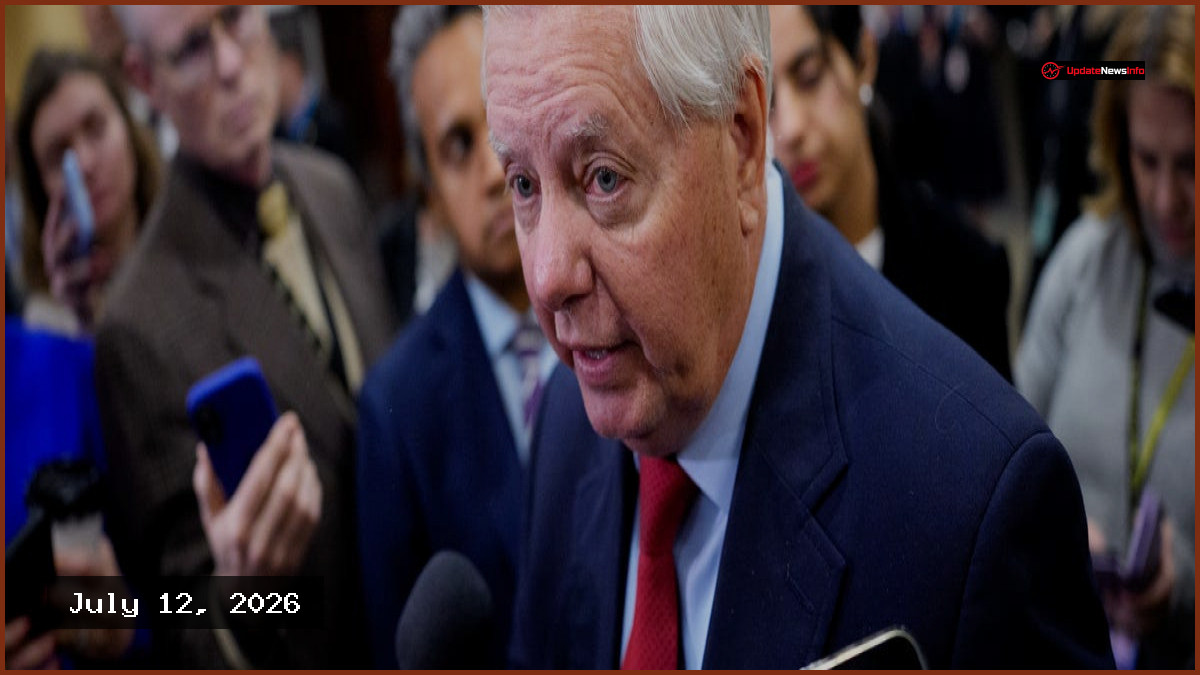
Capitol Hill is reeling following the sudden death of South Carolina Republican Senator Lindsey Graham over the weekend. His passing, which occurred on July 11, has triggered an immediate vacancy at the helm of the Senate Budget Committee, a role that has become increasingly central to the passage of major legislative initiatives.
While the committee is often viewed as a technical corner of Congress, it serves as a critical engine for President Donald Trump’s second-term legislative agenda. Because budget bills can be passed with a simple majority—bypassing the 60-vote threshold required for most other legislation—the panel has become a primary vehicle for party-line policy. Utilizing a process known as “reconciliation,” Republicans have successfully cut federal spending by hundreds of billions and directed $70 billion in funding to ICE and Border Patrol.
The committee is currently tasked with high-stakes objectives, including a recently directed $350 billion Pentagon cash infusion and efforts to pass voting restrictions. Whoever succeeds Graham will be responsible for steering these GOP priorities through the chamber. Potential successors on the committee include long-serving members such as Mike Crapo of Idaho, Chuck Grassley of Iowa, and Roger Marshall of Kansas, alongside other members like John Cornyn, Ron Johnson, Mike Lee, John Kennedy, Pete Ricketts, Bernie Moreno, and Rick Scott.
Before his death, Graham was instrumental in finalizing two major policy achievements. The first, originally dubbed the “One Big, Beautiful Bill Act” and later rebranded as the Working Families Tax Cuts Act, implemented broad domestic changes ranging from Medicaid and food-stamp cuts to student loan overhauls. Democrats have frequently criticized the legislation as the “Big, Ugly Bill.”
Graham also steered the Secure America Act through Congress earlier this summer, which provided $70 billion to immigration enforcement agencies despite a Democratic boycott. During the final approval of that legislation, Graham defended the GOP’s reliance on the budget process, arguing that Democratic obstruction of normal appropriations left the party with no alternative. “Why are we here? Through the normal appropriations process, Democrats would not give the Border Patrol or ICE one dime,” he stated on the Senate floor. “It just didn’t work.”
It also opened up an important vacancy atop a key Senate committee – one that's increasingly an architect of some of the most consequential legislation affecting Americans' lives.
Zachary Schermele is the congressional correspondent for USA TODAY. You can reach him by email at zschermele@usatoday.com. Follow him on X at @ZachSchermele and Bluesky at @zachschermele.bsky.social.