In the wake of the death of Iran's supreme leader, Ayatollah Ali Khamenei, the Islamic Republic has seen a sharp escalation in aggressive rhetoric from its political and military leadership. Senior figures, state-controlled media outlets, and the country's new supreme leader have all publicly demanded retaliation to avenge the death of the late leader. This increasingly harsh rhetoric is being used by the regime to mobilize its supporters at home while simultaneously warning opponents abroad.
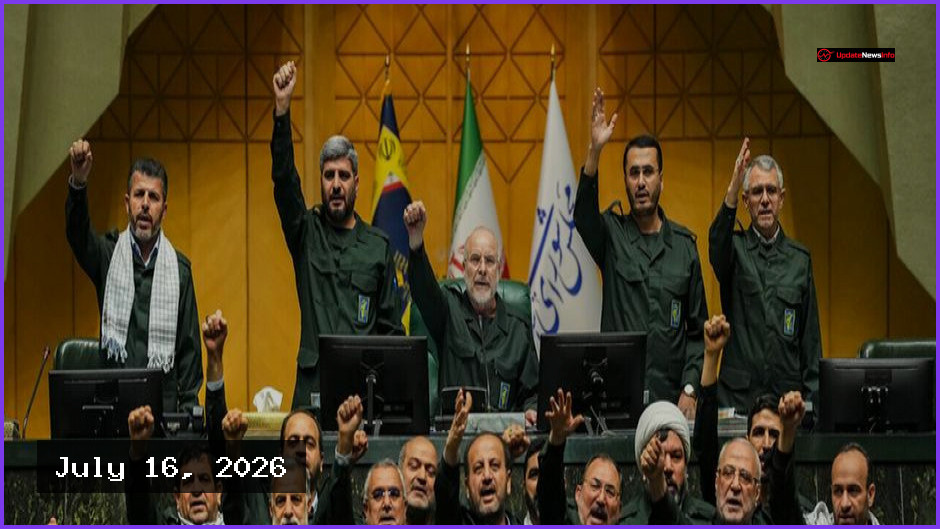
The legislative branch has played a prominent role in this campaign. On July 14, during the first in-person session of the Iranian parliament since the start of the war, lawmakers were seen waving red flags that bore calls for revenge. According to images circulated by Iranian media, more than 180 of the 290 members of parliament formally endorsed these demands for retaliation.
This sentiment has been aggressively promoted by pro-government media outlets as well. On Saturday, the conservative daily newspaper Hamshahri, which is owned by the Tehran municipality and maintains close ties to the Islamic Revolutionary Guard Corps (IRGC), published a list of 13 Western politicians and military officials under the headline, "Retaliation Is Inevitable." The list included various foreign and defense ministers, the commander of US Central Command (CENTCOM), and German Chancellor Friedrich Merz.
Legal scholar and human rights researcher Moein Khazaeli told DW that these threats should not be dismissed simply as political rhetoric. Khazaeli noted that it is important to distinguish between the capability, the intention, and the actual possibility of carrying out such threats. He explained that the Iranian government is pursuing several objectives with this rhetoric, including psychological warfare and a strategy of deterrence. The regime is attempting to portray its military and security apparatus as strong and operational despite recent setbacks. Furthermore, Khazaeli warned that the regime is signaling it could resort to terrorist methods if international pressure continues—a threat that he noted cannot be dismissed given the Islamic Republic's history of overseas operations.
The newspaper Hamshahri is considered part of the conservative camp that strongly opposes negotiations with the United States. Political activist Reza Alijani argued that the mourning ceremonies for Ali Khamenei were also instrumentalized by the leadership for political purposes. Speaking to DW, Alijani suggested that these events were intended to demonstrate support for the ruling establishment, divert public attention from military setbacks, and legitimize the continuation of the conflict under the banner of revenge.
The new supreme leader, Mojtaba Khamenei, reinforced this message immediately following the conclusion of the week-long mourning ceremonies. Rather than focusing on reconciliation or reconstruction, he emphasized retaliation. A statement issued in his name vowed to continue the path of the slain leader, stating, "We swear to avenge your pure blood and the blood of all the martyrs of these two wars against the criminal and dishonorable murderers."
Khazaeli emphasized that one of the most important target audiences for these threats is the regime's own supporters. For years, the Islamic Republic has responded to military defeats or security setbacks with heightened threats to create the impression that the regime remains determined and capable of exacting revenge. For a portion of its support base, this narrative remains credible and is reinforced by state propaganda. At the same time, these messages are directed toward an international audience, including Western governments and opponents of the Islamic Republic abroad, such as Iranian journalists, political activists, human rights defenders, and exiled dissidents.
The impact of this rhetoric on public discourse was further highlighted by reactions to the recent death of Republican US Senator Lindsey Graham. Iranian state television and several pro-government Telegram channels commented on his death with expressions of satisfaction and, in some cases, congratulations. Graham had been a vocal supporter of the "maximum pressure" policy against the Islamic Republic and had called for military strikes and bombing raids against Iran for years.