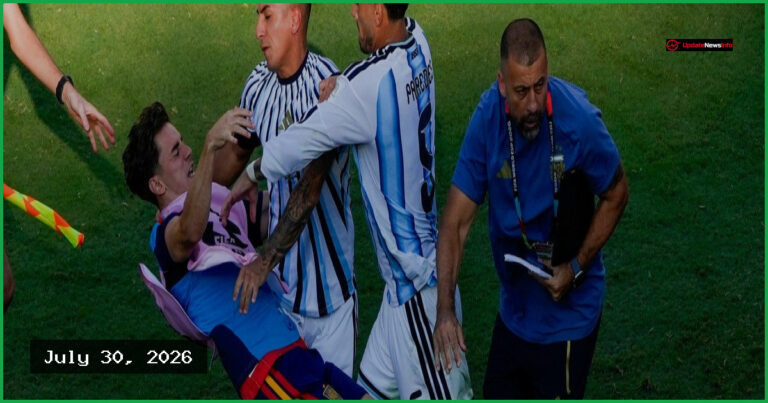
The British government has officially urged FIFA to launch an investigation into the Argentine national soccer team following a controversial display during post-match celebrations in Atlanta. Following Argentina’s 2-1 victory over England in the World Cup semifinal on Wednesday, July 15, 2026, players were photographed holding a banner provided by fans that read “Las Malvinas son Argentinas,” or “The Malvinas are Argentine.” The term refers to the Falkland Islands, a British overseas territory that remains the subject of long-standing political tension. The islands are located approximately 8,000 miles from the U.K. and 300 miles from Argentina.
A spokesperson for Prime Minister Keir Starmer emphasized that self-determination belongs solely to the islanders, stating, “The World Cup might not be ours, but the Falkland Islands definitely are. Our commitment to the Falklands will never waver.” The Prime Minister’s support for a FIFA inquiry follows comments from U.K. Business Secretary Peter Kyle, who labeled the players’ behavior as “entirely inappropriate.” Kyle told the BBC that politics needs to be separate from football, noting that the World Cup has one of its central tenets that politics is separate from the sport, and that the matter is now for FIFA to decide.
FIFA’s disciplinary code explicitly prohibits political, ideological, or offensive messaging within stadiums. Potential fines for such violations range from $5,000 to $20,000. FIFA was approached for comment on Thursday regarding the incident. The governing body has previously taken action in similar cases. During the 2012 London Olympics, a South Korean player was banned for two World Cup qualifying matches after displaying a banner regarding a territorial claim against Japan. Additionally, at the 2022 World Cup, the Serbian federation was fined 20,000 Swiss francs for displaying a political map in their locker room that included the territory of Kosovo with the slogan “No Surrender.” In 2014, Argentina was fined 30,000 Swiss francs after players displayed the same “Las Malvinas son Argentinas” slogan at a warmup game.
The rivalry between the two nations is deeply rooted in the 1982 war over the South Atlantic archipelago, which was triggered by an invasion under orders from Argentina’s then-military dictatorship. The 10-week conflict resulted in the deaths of 649 Argentine troops, 255 British service personnel, and three islanders. Britain maintains a territorial claim dating back to 1765 and sent a warship to the islands in 1833 to expel Argentine forces who sought to establish sovereignty. Argentina argues the islands were illegally taken from it in 1833.
Addressing the controversy, Argentine player Leandro Paredes remarked in Atlanta that the conflict remains a painful part of the country's history, stating, “Sadly, it is a sad part of our history, for everyone involved in that chapter of, I repeat, our history. And it hurts. We knew we were playing for them, too.” Teammate Lisandro Martínez, who has played in England for four years with Manchester United, was asked if the banner could have stirred deep emotions for a veteran of the conflict, responding, “We couldn’t let the Argentine people down.”
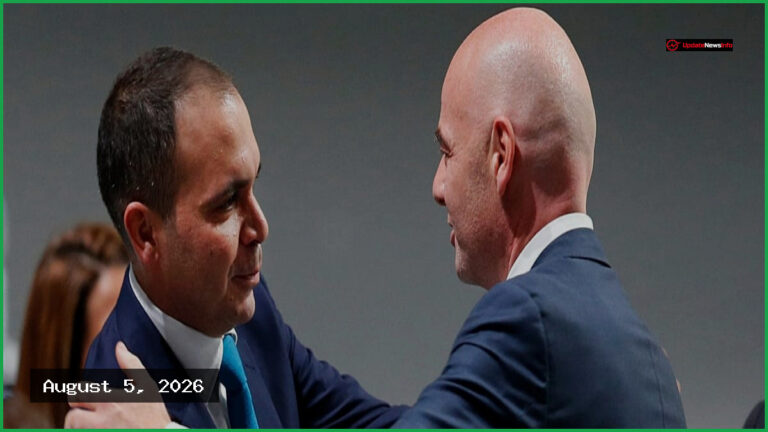
Argentina is scheduled to face Spain in the World Cup final this Sunday in East Rutherford, New Jersey. FIFA is currently facing scrutiny regarding its political neutrality, particularly following a controversial decision to grant probation to U.S. player Folarin Balogun after he received a red card, allowing him to play against Belgium. FIFA president Gianni Infantino is expected to sit with U.S. President Donald Trump and Argentina President Javier Milei at the final. The 1982 war ended during the World Cup in Spain, where British networks declined to broadcast Argentina’s opening game.