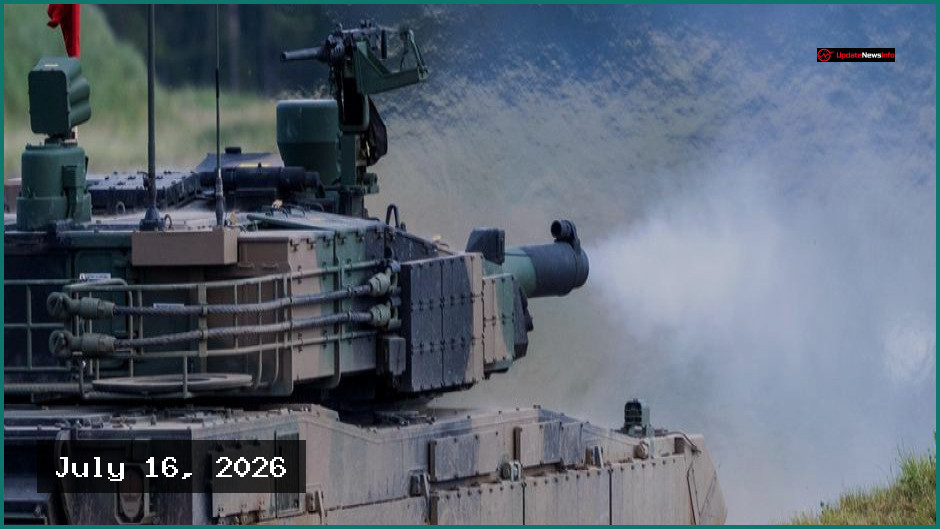
South Korean military equipment and weapons have become increasingly sought-after on the global stage, characterized by their reliability, relatively low costs, and notably speedy delivery times. This surge in demand follows the geopolitical instability triggered by Russia's full-scale invasion of Ukraine in February 2022. While South Korea has long maintained a robust defense sector to protect itself from the unpredictable regime in North Korea, successive governments in Seoul have spent the last decade aggressively developing international export markets for their military hardware.
According to Park Saing-in, an economist at Seoul National University, South Korea occupies a unique geopolitical position. The nation relies heavily on the United States military presence for security, yet it has simultaneously pursued greater independence in the equipment provided to its own armed forces. This has been achieved through significant government spending on research and development at domestic defense companies, allowing them to catch up with other nations. While South Korea still purchases high-end items from the U.S., such as F-35 Lightning II stealth fighters, its manufacturers have become highly adept at producing mid-range systems that are delivered rapidly because production lines are already in place.
A prime example of this efficiency is the Cheongung-II medium-range surface-to-air missile system, which is designed to intercept aircraft and ballistic missiles at ranges of up to 40 kilometers, or 24.8 miles. In 2022, South Korea sold 10 batteries of this system to the United Arab Emirates. The system gained significant attention from defense analysts after achieving a 96% interception rate during early missile attacks in the ongoing Middle East conflict. Each interceptor costs an estimated $1.1 million, or €970,000, which is substantially cheaper than the U.S.-made Patriot interceptors that can cost several million dollars each. Furthermore, South Korean manufacturers can deliver a complete system in about one year, whereas delivery times for a Patriot battery are a minimum of four years.
As a result of these advantages, South Korea has emerged as one of the world's top arms-exporting nations. Data from the Defense Acquisition Program Administration, as quoted by the Seoul Economic Daily, indicates that weapons exports reached $15.4 billion in 2025, following a peak of $17.3 billion in 2022. South Korean firms have also successfully diversified their offerings. While the nation previously relied on its shipbuilding heritage to deliver warships, it has expanded into armored vehicles, missiles, and advanced air defense systems.
European nations, shocked by Russian aggression and weakened by years of underinvestment in their own defense, have become key markets. Poland has been the largest buyer, accounting for more than 40% of total South Korean exports. Warsaw has ordered 364 customized K9 Thunder 155mm self-propelled howitzers and 360 K2 Black Panther main battle tanks, which are recognized as some of the most capable tanks in the world. Additionally, Poland is purchasing K239 Chunmoo multiple rocket launchers, 48 FA-50 light combat and training aircraft, and 1,266 "Legwan" four-wheel-drive combat vehicles. This dramatic overhaul of Poland's military hardware has enabled the country to transfer its older, Soviet-era equipment to Ukraine.
In May, South Korean President Lee Jae-myung attended a rollout ceremony for the first domestically developed KF-21 fighter jet. Indonesia has been involved in this project and is expected to purchase a number of the aircraft. Chun In-bum, a retired South Korean army general and senior fellow at the National Institute for Deterrence Studies, noted that South Korean firms have successfully identified and improved upon technologies in the same way they previously dominated the consumer electronics market. He emphasized that being a strong manufacturing nation, open to foreign technology, has been a national imperative given the threat posed by North Korea. While not every homegrown system has been a success—with Chun pointing to shortcomings in South Korean-built helicopters—foreign nations have quickly identified the systems that provide a battlefield edge.
Despite the current boom, Park Saing-in offers a cautionary note, observing that the sector cannot rely on global uncertainty to last forever. He anticipates that European and other NATO countries will eventually attempt to build up their own industries to meet future demand. Consequently, he argues that it is vital for South Korea to push ahead with partnerships that extend beyond simple sales, expanding into joint research, development, production, and deployment to ensure long-term stability in the defense sector.
To view this video please enable JavaScript, and consider upgrading to a web browser that supports HTML5 video
"And that has been important for the economy as a whole because South Korea for a long time relied too heavily on six or seven sectors," he said. "And while South Korea is still strong in semiconductors, cars and ships, we have lost other sectors — such as chemicals — to China."