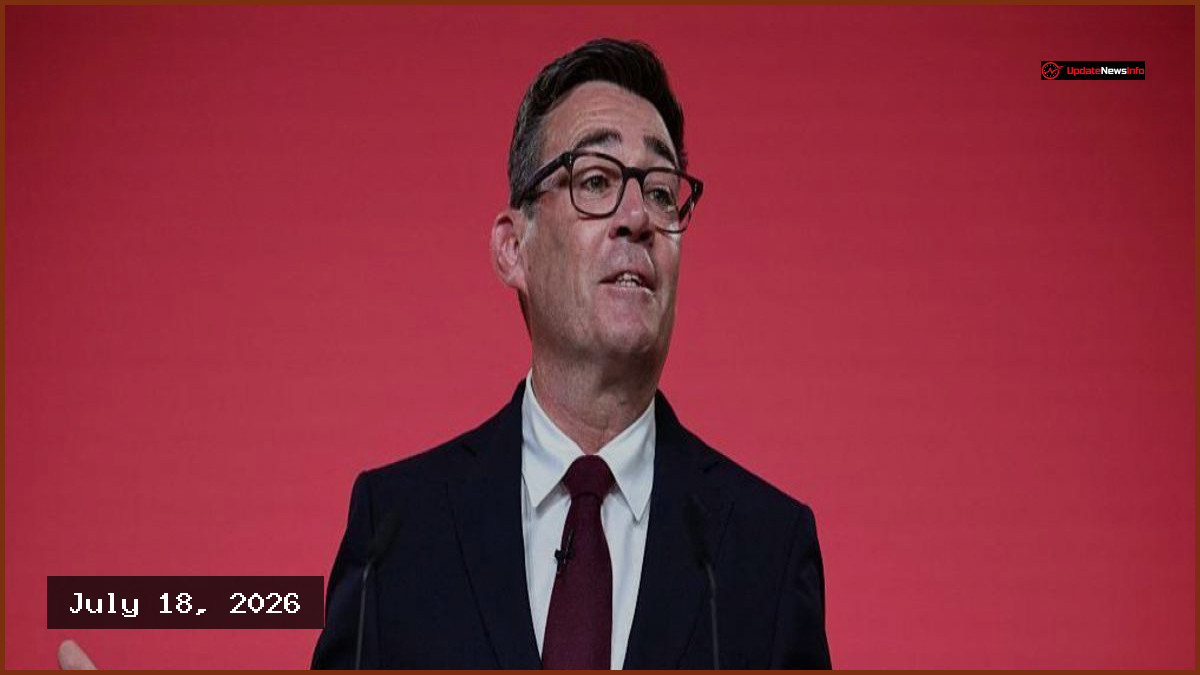
Andy Burnham announced he is in the process of finalizing his cabinet selections ahead of taking over as Prime Minister from Sir Keir Starmer on Monday. When asked why his top team had not yet been announced, Burnham stated, "It would be somewhat premature and would, I think, cause complete chaos if you start half a reshuffle before you're in the position." He later confirmed to reporters, "I am finalising those decisions, and I will come to conclusions very shortly, and then I will announce those on Monday."
There has been considerable speculation about Burnham's potential cabinet picks, with Ed Miliband and Shabana Mahmood reportedly considered for the role of Chancellor, to replace Rachel Reeves.
In his first speech as the new Labour leader, delivered at the TUC headquarters in central London, Burnham outlined his vision for government. He pledged that his cabinet appointments would reflect "all parts of our party" and "all communities." He also vowed to restore "hope" to working-class communities that he believes have been neglected by the political establishment, reiterating his commitment to devolving power away from Westminster to the regions. Devolution has been a central theme of Burnham's platform since he announced his bid to succeed Sir Keir.
Burnham declared his government would enact the biggest change in decades, rejecting the "neoliberal" policies of the past 40 years, including those from his own time in government, and vowed to reindustrialise the country. He urged Labour MPs to foster a culture of "one Labour team," stating, "We won't beat Britain's new right if we are consumed by infighting and pulling in different directions." He characterized his approach to governing as one of "problem-solving rather than point-scoring." Burnham expressed confidence in his agenda, telling the audience, "I have a plan."
While his speech offered few specific policy details, which are expected to emerge as he moves into Downing Street next week, Burnham identified reforming the social care system as a top priority. He pledged to expend significant "political capital" on what he described as a long-neglected sector. It was noted that any reforms Burnham implements would only apply to England, as social care is a devolved matter.
The challenge of social care provision and funding has long been a difficult issue for governments. Unlike the NHS, social care is not free at the point of use, and high costs can force individuals to sell their homes to pay for necessary care. Burnham has a history of advocating for reform; as health secretary under Gordon Brown, he published a white paper calling for a National Care Service, free at the point of use, shortly before the 2010 general election. Reflecting on the current situation, he told reporters, "My dad has Alzheimer's, and you see what the staff have to put up with. It's not their fault. The system's broken." He added, "You can't leave social care like this. And this is part of my criticism of Westminster. It has flinched over the years from these big decisions."
Conservative Party chairman Kevin Hollinrake called for Burnham to recall Parliament, which is in recess until September, to explain his plans to MPs. "It's not too late for Andy Burnham to do the right thing, make a statement, and answer questions from members of Parliament on Monday about his 'plan'," Hollinrake said.
Linda Hobson, from the trade union Unison, which is affiliated with Labour, stated that Burnham "must get this right and bring back the hope he promises."
Burnham's successful bid for leadership follows two previous attempts and comes after his recent by-election win in Makerfield last month. He cemented his status as the sole leadership candidate after receiving backing from 379 Labour MPs and all 11 affiliated trade unions earlier this week. This transition occurs as Labour has trailed Reform UK in opinion polls for nearly 18 months, with supporters hoping Burnham's premiership will reverse the party's fortunes.
Sir Keir Starmer resigned as Labour leader last month, stating he accepted he was not best placed to lead his party into the next general election. His departure followed heavy Labour losses in local elections and Burnham's by-election victory, which intensified calls from his own MPs for him to step aside.
Burnham paid tribute to Sir Keir's record, highlighting achievements such as improved rights for workers and renters, a fall in NHS waiting lists, and the renationalization of rail services.
Liberal Democrat leader Sir Ed Davey welcomed Burnham's call for more collaborative politics, stating, "my door is open." He indicated that the Lib Dems would seek changes in the water industry, support for the NHS, and reforms to social care, including more help for family carers.
Reform UK leader Nigel Farage criticized Burnham's impending premiership, asserting that he "comes in with absolutely no mandate of any kind at all" and called for "an immediate general election so the country can decide the future."
Burnham's 'Manchesterism' got him to No 10 – but will it work for the UK?
Who is the frontrunner to be the UK's next chancellor?