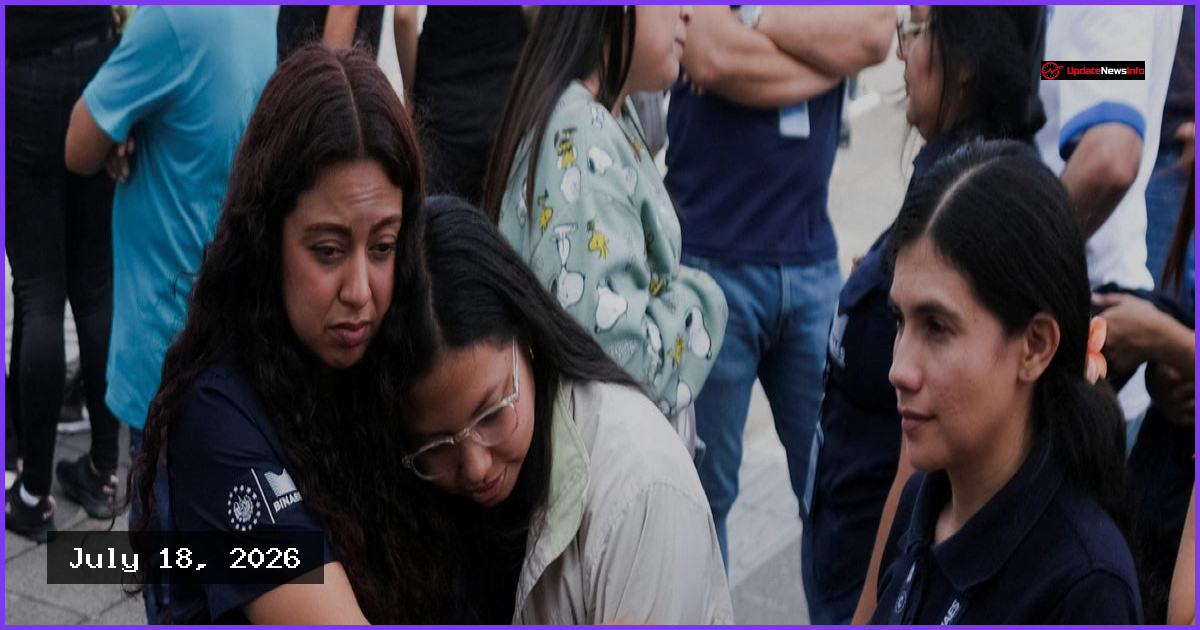
A powerful 7.3 magnitude earthquake struck the southern Pacific coast of Mexico on Friday, centered directly on the border with Guatemala. According to the U.S. Geological Survey (USGS), the epicenter was located 30 miles southwest of Aquiles Serdan, near the coast of Chiapas, at a depth of 9 miles. The significant tremor was preceded by a smaller earthquake that occurred further out in the ocean. Following the main event, the USGS recorded at least 10 aftershocks ranging in magnitude from 4.9 to 6.
The shaking was felt across a vast region, extending from Mexico City to El Salvador. In Tapachula, the primary city on Mexico's southern border, the tremor began mildly before intensifying. Alejandra Mendoza, an administrative employee at a local public hospital, described the experience: "We were upstairs on the second floor when it started shaking; we thought it would pass, but then it got stronger, so we all went downstairs and evacuated in an orderly manner to the front courtyard."
Demetrio Martínez, head of the city's Civil Protection agency, confirmed that a Haitian migrant woman in her 30s suffered a nervous breakdown and jumped from a height of approximately 13 feet from an apartment building. She was transported to a hospital with fractures, though officials stated her life is not in danger. A second minor injury was reported involving a broken window at a nearby business. Meanwhile, in Tuxtla Gutierrez, the state capital of Chiapas, the quake triggered panic among those in the city's few tall buildings. Araceli Sanchez, a government employee, described the experience in a 15-story building as "horrible," noting that some people were crying as they fled down the emergency stairs.
In Guatemala City, the long duration of the earthquake frightened residents during the morning rush hour, leading many to pour into the streets. While the National Coordinator for Disaster Reduction reported no immediate damage, social media users shared videos of landslides, particularly on roads heading west. Consequently, the Ministry of Education suspended in-person classes in the departments of San Marcos, Quetzaltenango, Suchitepéquez, and Retalhuleu, all located near the epicenter.
The U.S. Tsunami Warning System initially issued a warning for hazardous waves along coasts within 186 miles of the epicenter, but later declared the threat had passed. The Meteorological Service of Chiapas had initially warned of potential waves up to 3.3 feet. Mexican President Claudia Sheinbaum stated that preliminary reports showed no damage, though the navy recommended that residents stay away from beaches for six hours. In the town of Suchiate, Mayor Elmer Vázquez Gallardo confirmed that coastal areas remain under monitoring.
In Mexico City, the earthquake alert system did not sound. The government explained that the energy radiated during the first few seconds of the quake did not exceed the necessary activation thresholds, even though buildings in certain areas creaked and shook. In San Salvador, the tremor was felt strongly, but no deaths or damage were reported, despite the Ministry of Environment noting a separate, less intense earthquake off the coast of the Usulután department.
The region is historically prone to earthquakes. Earlier this year, a strong quake in southern and central Mexico resulted in two deaths, and a 7.1 magnitude earthquake in 2017 killed hundreds in Mexico City. This latest event occurs as Venezuela continues to recover from twin tremors on June 24, which killed over 4,800 people and caused hundreds of buildings to crumble in the coastal state of La Guaira.
"It feels horrible up there," Araceli Sanchez, a government employee who was in a 15-story building, told AFP.