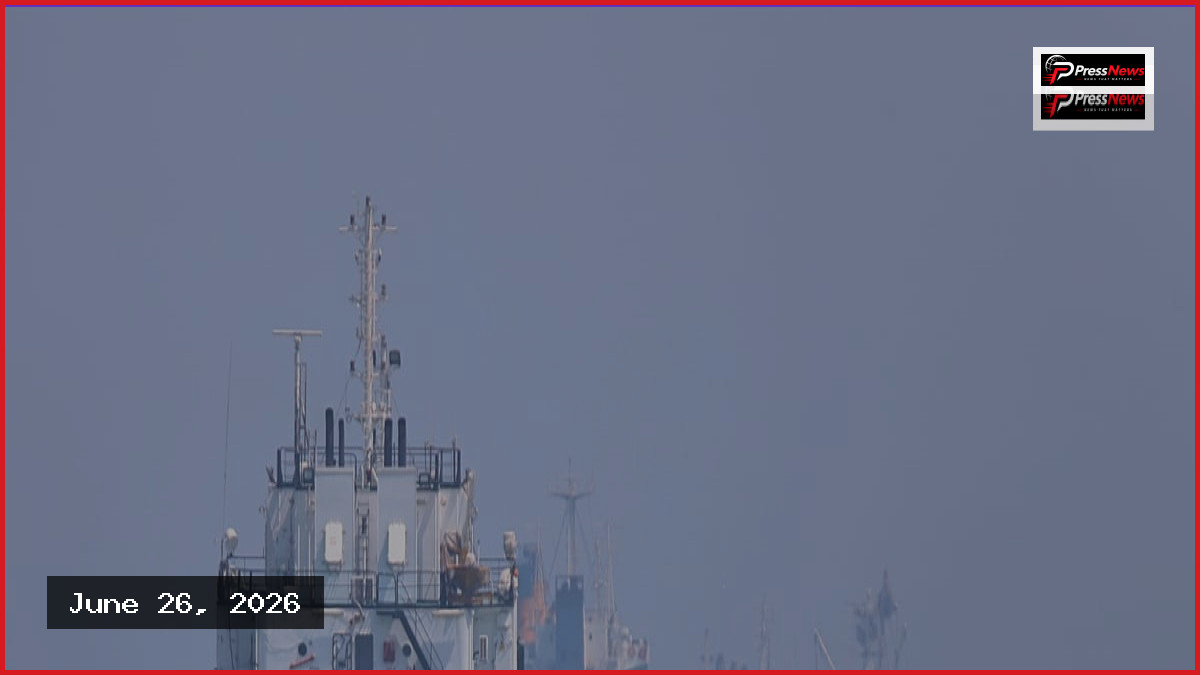
A cargo ship navigating through the Strait of Hormuz on a newly established, UN-supported route via Oman was struck by a projectile this Thursday. According to reports from the British military, the vessel sustained damage to its bridge, although there were fortunately no casualties reported and no signs of environmental damage. The strike occurred approximately 7.5 nautical miles off the Omani coastline, happening just hours after Iran’s Islamic Revolutionary Guard Corps (IRGC) issued threats against any vessels attempting to traverse the strait without explicit permission from Tehran.
Evidence of these tensions surfaced on social media through a video captured on a ship’s bridge, which allegedly featured an IRGC Navy radio broadcast. The message warned that vessels were only permitted to pass if they had Iranian authorization and adhered to designated routes. The broadcast stated that any ship moving without permission, with AIS turned off, or drifting off-course would face the consequences.
Maritime tracking data revealed a significant uptick in vessel traffic through the Strait of Hormuz leading up to the incident, utilizing the alternative route recently announced by Oman in coordination with the International Maritime Organisation (IMO). Statistics indicated that 70 separate crossings were recorded on this Omani path, despite the ongoing warnings from Iranian authorities. Leading the transit, oil tankers such as the Stoic Warrior sailed close to the coast of the UAE and Oman, navigating past the Musandam Peninsula. This route serves as a bypass to the central corridor of the strait, a vital artery through which nearly one-fifth of the world’s oil and natural gas supplies typically flow.
International efforts to assist trapped vessels have continued, with companies like Maersk reporting that their container ship, the Maersk Baltimore, successfully cleared the area on Thursday alongside another chartered vessel. Richard Meade, editor-in-chief at Lloyd’s List, noted that many opportunistic operators have been attempting to clear the backlog of trapped cargo, encouraged by the perceived reduction in transit risk.
Responding to the increased traffic and the establishment of the new shipping corridor, the IRGC naval command issued a formal warning through Iran’s state-run IRNA news agency. They characterized the Omani route as dangerous and unacceptable, arguing that it was created without proper coordination with Tehran. The IRGC reiterated that the only authorized passage is the one declared by the Islamic Republic of Iran, warning that any traffic outside these designated zones is prohibited and that violators would face firm action.
In a related diplomatic move, US Secretary of State Marco Rubio met with foreign ministers from the Gulf Cooperation Council to reassure them that their national interests would remain protected. Rubio emphasized that the United States and its regional allies are committed to ensuring that no transit fees are imposed on ships and that the Omani route remains accessible. Expressing hope for the region, Bahrain’s Foreign Minister Abdullatif bin Rashid al-Zayani thanked the US for its support while stressing the critical importance of Iran adhering to its international obligations.