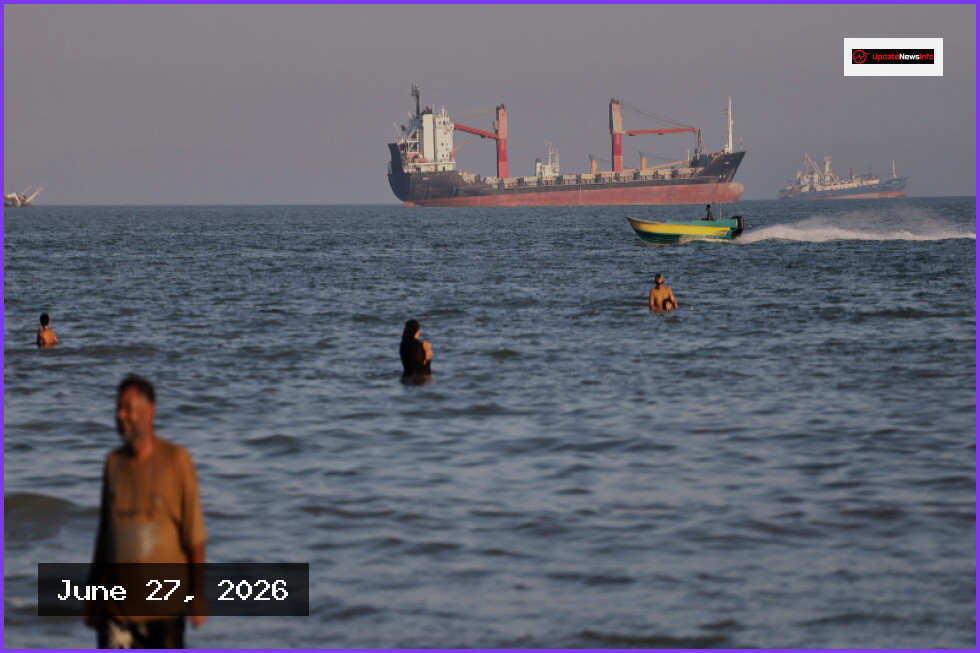
The United States military conducted strikes against Iran on Friday in direct response to a drone assault on a cargo ship in the Strait of Hormuz that occurred the previous day. This military action marks the most significant test yet of an interim understanding reached just one week ago, through which the two countries had begun working to conclude their months-long war and reopen the critical waterway. U.S. President Donald Trump stated that the drone attack represented a violation of the ceasefire, telling reporters shortly before the retaliatory operation that they would soon find out if the U.S. would respond. U.S. Central Command confirmed that the military targeted missile and drone locations, along with coastal radar sites, within Iranian territory.
Speaking at the White House before the strikes, President Trump noted that Iran had fired four shots at the ship, stating, “I don’t like the fact that they took a shot yesterday, actually four of them.” When asked why the U.S. would resort to strikes despite his assertions that talks with Tehran were progressing well, Trump remarked that Iran is “a little bit different” before abruptly ending the session. Ebrahim Azizi, head of the Iranian parliament’s national security commission, responded on social media by stating the Strait of Hormuz is governed by Iran and urged the U.S. to “respect the rules.” He characterized the development as “ceasefire management” rather than a violation.
Vice President JD Vance stated on social media that if there are disagreements over the ceasefire, Iran should use diplomatic communication, adding that “violence will be met with violence.” A U.S. official confirmed that the military operation concluded about an hour after U.S. Central Command announced the action. The initial attack occurred when a container ship was hit by a projectile off the coast of Oman, following Iranian threats toward vessels using the route. The United Kingdom Maritime Trade Operations center reported no injuries from the incident.
The strikes occurred during a fragile period as the U.S. and Iran negotiate a permanent peace. A United Nations maritime agency had been leading an operation to move stranded ships out of the strait via an alternative route hugging the coast of Oman. The International Maritime Organization halted these evacuations after the attack, stating they would not resume until security guarantees are provided. Secretary-General Arsenio Dominguez noted that about 115 ships had successfully exited in recent days, with approximately 500 still remaining in the area. The alternative route was designed to relieve global economic pressure and mitigate Iran’s leverage in the ongoing peace talks.
Under the interim 60-day deal, the U.S. and Iran are negotiating details regarding vessel transit and the future of Iran’s highly enriched uranium stockpile. Marine data company Windward noted that while the strait remains operationally open with 43 transits recorded following the incident, the “pace of normalization has slowed.” Prior to the attack, on Wednesday, 78 vessels had transited the strait, which was the highest volume since the war began, though still below prewar averages of 130 or more per day. Lloyd’s List Intelligence reported that at least two tankers reversed course after Iran insisted vessels use only Tehran-approved routes, while over two dozen ships continued to use the southern path after the attack. Separately, ambassadors from Israel and Lebanon announced a framework agreement aimed at de-escalating their own ongoing conflict, which Israeli Prime Minister Benjamin Netanyahu called a “great achievement,” noting that Israel will maintain a security zone in southern Lebanon until Hezbollah is disarmed.