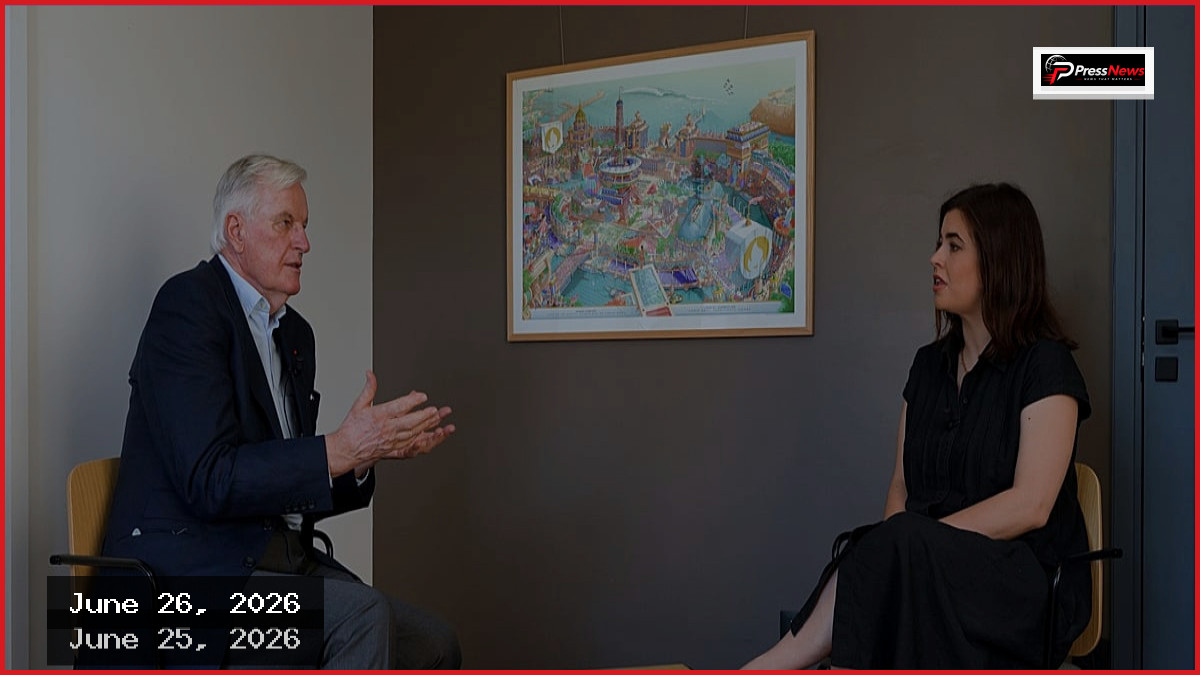
Former European Union Brexit negotiator Michel Barnier has stated that the EU’s door remains open for the United Kingdom to rejoin the bloc, though Brussels has clearly outlined its conditions. His remarks were made during an appearance on Euronews’ programme “12 Minutes With,” coinciding with the tenth anniversary of the UK’s vote to leave the EU, a decision made by 52% to 48% of voters. Current polling indicates that a significant majority of the British public, across various political affiliations, now perceives this decision as a mistake.
“Brexit decided by a sovereign vote 10 years ago is done, but the future is open, and the door is open,” Barnier, a prominent centre-right politician who served as Prime Minister of France from September to December 2024, told Euronews. He emphasized that the UK government and its political parties are well aware of the prerequisites for rejoining, making it clear that London “cannot have its cake and eat it” when shaping its future relationship with Brussels. Barnier described Brexit as a “lose-lose game.”
Barnier clarified that the UK could, for instance, join the single market—the EU’s borderless economic area—without becoming a full member of the Union, a path taken by countries like Iceland, Liechtenstein, and Norway. However, he stressed that the conditions for any country entering the single market are “very clear,” including “respecting the four freedoms”: the free movement of goods, services, people, and capital.
Despite this, full single market membership is currently considered unfeasible by the Labour government under outgoing Prime Minister Keir Starmer. This stance was a crucial “red line” for Starmer, aimed at adhering to his party’s pre-election manifesto commitments and appeasing Leave voters, while simultaneously working towards a “reset” in relations with the EU. Starmer’s strategy involved integrating the UK further into the market in specific sectors. Historically, however, the EU has not been receptive to such partial or “à la carte” arrangements, a sentiment echoed by Barnier, who advised against the UK attempting to cherry-pick from EU policies.
The position of Andy Burnham, currently an MP and the leading candidate to succeed Starmer in Number 10 following his resignation on Monday, on the single market and customs union remains uncertain. Liberal Democrats and pro-EU Labour MPs have already urged Burnham to “drop the red lines” on these issues, which Brussels views as a significant obstacle to improved relations.
Barnier also suggested that a fast-tracked process for the UK could be possible if regulatory alignment is maintained, thereby avoiding the lengthy, complex, multi-phase accession process typically faced by candidate countries such as Ukraine, Moldova, and the Western Balkan states. He noted that the duration of this process “is in the hands of the UK.” Should the UK create “a huge divergence from the standards, the norms for food, for security” before new negotiations begin, it would lead to problems and take “much more time.” Conversely, “if there is no divergence, no crucial divergence, it will be very rapid,” as the process for former member states cannot be compared to that for new countries seeking EU access.
In the interim, Barnier highlighted numerous areas where Brussels and London can collaborate, including defence, security, cooperation between services, and investment in artificial intelligence and new technologies. To facilitate such cooperation, he proposed establishing a new entity, “a kind of European Council for Defence and Security,” which would operate “alongside the current institutions.” This body, he suggested, would be open to countries no longer or not yet part of the EU, specifically mentioning the UK, Norway, and Ukraine.
The UK and EU are currently engaged in “reset talks,” with hopes of finalizing an agrifood agreement (aimed at reducing barriers through aligned sanitary and phytosanitary rules), an emissions trading deal, and a youth mobility scheme (offering special visas to young Europeans and Britons) at a summit scheduled for July 22. However, European Council President António Costa confirmed earlier this week that this meeting, whose date was only set last week at the G7 summit in France, has been postponed due to Prime Minister Starmer’s resignation.