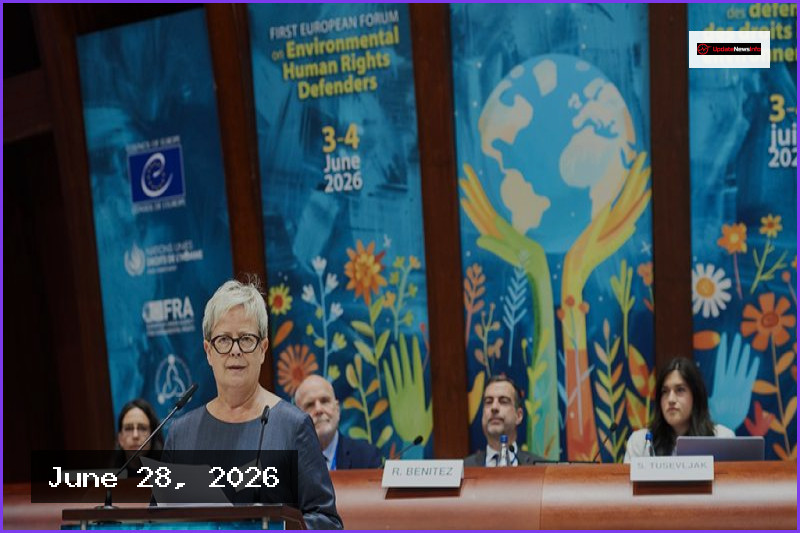
On Wednesday (24 June), Sirpa Rautio, the director of the European Agency for Fundamental Rights (FRA), arrived in Brussels from Vienna to present the annual 2025 Fundamental Rights Report to the European Parliament. Prior to her address before the parliamentary committee on civil liberties, justice and home affairs (LIBE), she addressed the ongoing challenges facing the bloc regarding rights protection.
Marking 25 years since the proclamation of the Charter of Fundamental Rights of the European Union, Rautio maintained that the document itself is robust. She argued that the Charter effectively consolidates existing human rights, making its content sufficient. The core struggle remains the uneven implementation of these rights across member states. Furthermore, Rautio warned that legislative processes at both the EU and national levels can be flawed if they lack rigorous fundamental rights assessments or essential legal safeguards.
The FRA functions as a knowledge hub for the Charter, and Rautio noted a significant increase in its recognition. She highlighted that because 70 percent of laws possess an EU dimension, understanding the scope of EU law is vital. While she expressed skepticism about the Charter’s influence 10 years ago, she now observes its growing relevance, largely due to jurisprudence from the Luxembourg Court. She cited a personal example from Finland, where national lawmakers utilized the Luxembourg Court’s specific guidance on surveillance and privacy when drafting internal security legislation.
Reflecting on the shifting political landscape, Rautio described a transition from the “happy marriage” of the 1990s and early 2000s to a more hostile environment following 9/11 and the subsequent rise of populist narratives. She noted that attacks on gender equality and civil society have become increasingly frequent. Recent data from the March Civic Space Update underscores this trend: 67 percent of organizations reported online threats, 60 percent faced negative media coverage or smear campaigns, 39 percent dealt with politically motivated funding cuts, and 36 percent reported excessive administrative controls or legal harassment like SLAPPs.
Rautio suggested that the primary motivation for these attacks is that governments simply do not want to be scrutinized. She observed a trend where ruling majorities question the legitimacy of any opposition, including NGOs, social organizations, and trade unions, if they challenge the state’s agenda. Despite these systemic risks, which include rising racism, hate speech, and the pressures of AI, Rautio remains optimistic. She drew inspiration from activists like an 85 or 90-year-old woman she recently met in the Netherlands, who has been fighting for racial equality since the 1960s and 1970s. Ultimately, she emphasized that while treaties and independent courts are foundational, the resilience of civil society and the active mobilization of citizens remain the most powerful tools against democratic backsliding.