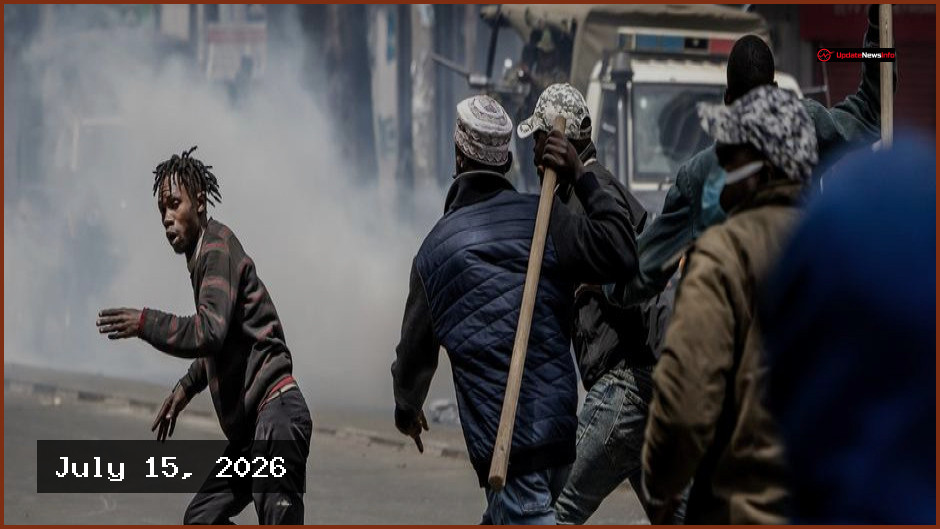
Violent disruptions of political and civic events are raising significant concerns about the use of hired gangs as Kenya moves toward its next general election, scheduled for August 10, 2027. For residents in the capital, Nairobi, such as Brian Ongore, the frequent sight of groups of young men in public spaces has become a source of profound anxiety.
Ongore described a feeling of constant panic, noting that the general sense of safety in the city has deteriorated to a point where he feels like he is living in a jungle. He told reporters that whenever he sees a group of youths, he is in a state of panic because he never knows what will happen next.
These anxieties are shared by many across the country, particularly following recent violent incidents in the towns of Kisumu and Nyahururu. Reports indicate that these groups, often referred to as "goons," are being recruited in large numbers—sometimes dozens or even hundreds at a time—to intimidate political rivals or disrupt public gatherings.
In a notable incident in June, a civil society and church forum held at Nairobi's All Saints Cathedral was interrupted during discussions on public finance management.
Amnesty International Kenya published a statement on Monday noting that the individuals involved in the attack publicly confessed to having been sent by powerful government officials to carry out the assault.
The situation has sparked a heated debate regarding the influence of politically linked gangs. According to the Agence France-Presse (AFP) news agency, some Kenyan politicians are hiring armed thugs for as little as $4 per day, a trend driven by poverty and intense political competition. Critics, including university student Paul Mwai, have questioned the response of security agencies.
Mwai noted that police have been seen protecting the gangs, and he expressed frustration that he has not seen a single individual dealt with decisively by the government, despite the authorities issuing threats against such behavior.
President William Ruto addressed the issue during the funeral of Zipporah Kosgey, the wife of veteran politician Henry Kosgey, last month. He acknowledged the growing presence of political gangs and warned that such violence could undermine the democratic process. President Ruto described the participants as innocent children being exploited by "bankrupt politicians." He stated that these groups go around causing chaos, assaulting people, and causing destruction.
He further demanded that all such individuals be dealt with firmly and that those paying these young people should be tracked down.
Security analyst Byron Adera noted that while the use of hired thugs for political power is not a new phenomenon in Kenya, it appears to be becoming more organized in the run-up to the 2027 election. He described the practice as "political enterprise propped up by goonism," adding that unemployed young people are particularly vulnerable to recruitment.
Adera warned that political violence and perceptions of partisan policing could ultimately undermine democracy, forcing citizens to question whether the outcome of the election will reflect the will of the people or the will of the politicians behind the gangs.
Political economist and governance analyst Sheila Owigo Olang observed that the recent wave of attacks appears more open and organized than in previous election cycles. She noted that the faces of the individuals involved suggest they have strong sponsors because there are no consequences for their actions. Olang, who stated that she has personally experienced political intimidation, warned that these attacks have spread beyond campaign rallies to churches and other public spaces.
She expressed concern that this creates fear among women seeking political office, noting that women are the biggest voting demographic and that their withdrawal from the process could lead to illegitimate outcomes.
As East Africa’s largest economy and a key regional democracy, Kenya’s elections are closely watched across the continent. With just over a year until the August 2027 general election, analysts emphasize that preventing political violence is essential to ensuring that political competition is decided by voters rather than intimidation.
Nairobi businesswoman Priscilla Njoroge urged young Kenyans not to allow themselves to be exploited for political violence. "I would like to tell the goons who are being misused not to play with the peace we have because violence destroys everything. The losses are much greater," she said.
To view this video please enable JavaScript, and consider upgrading to a web browser that supports HTML5 video