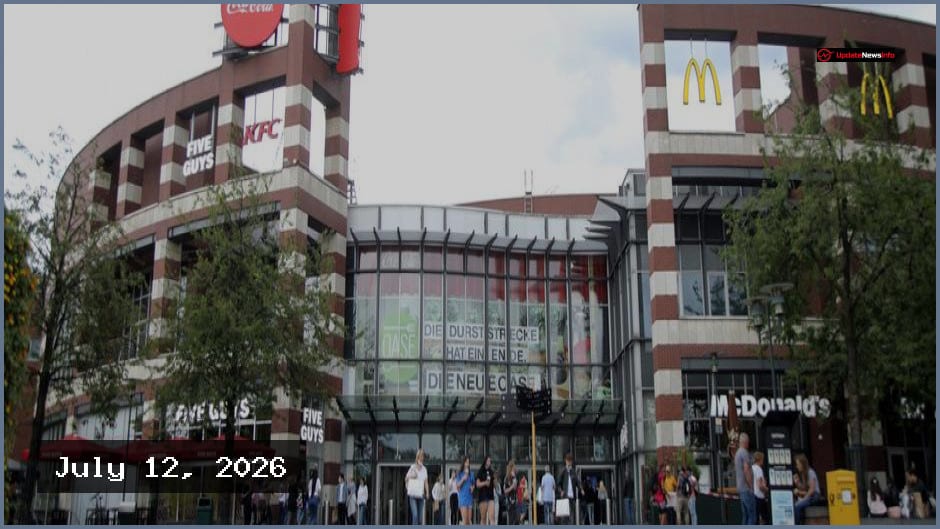
Oberhausen, a city nestled in Germany’s historic Ruhr Valley, finds itself on the precipice of financial collapse, burdened by an €800 million debt. This dire situation is indicative of a wider crisis affecting numerous cities and towns across the Ruhrgebiet, where declining tax revenues clash with surging social spending, making it increasingly difficult for local governments to balance their budgets.
Apostolos Tsalastras, Oberhausen’s City Treasurer since 2010, paints a grim picture from his City Hall office. The city operates with an annual budget of €1.2 billion but faces a revenue shortfall of approximately €100 million each year. By the end of 2025, Oberhausen had accumulated a staggering €2 billion in debt, which was subsequently reduced to €800 million thanks to a cash injection from the state government of North Rhine-Westphalia.
The roots of Oberhausen’s economic woes trace back to the decline of its once-dominant steel industry. The Ruhr Valley, located in the western state of North Rhine-Westphalia, was a powerhouse of the 19th-century coal-powered industrial revolution, crucial for Germany’s armament production during both World Wars. After the wars, factories were rebuilt to fuel Germany’s 1950s economic miracle. However, a severe crisis hit in the 1970s, marked by inflation and overcapacity, leading to a sharp drop in raw steel production, plant closures, and widespread structural unemployment.
While some remnants of the steel industry persist in Oberhausen, such as a company manufacturing turbines for ships and power plants, Tsalastras notes their scale is minuscule compared to the past. The city’s economic landscape shifted dramatically in the mid-1990s with the construction of the Centro complex on a site that once employed 32,000 people in steel. “Thanks to the Centro, we’ve created almost as many jobs again, but they’re all in the service sector, where people don’t earn as much,” Tsalastras explained. Consequently, Oberhausen’s average income and gross domestic product are now among the lowest nationwide.
Mayor Thorsten Berg of the center-left Social Democrats (SPD) describes the situation as “truly dire.” He highlights that the primary financial burdens stem from payments to youth welfare and long-term care. “The municipalities are expected to pay, but we don’t get the money to do so. That’s the flaw in the reasoning,” Berg stated. In Oberhausen, a significant 50% of expenditures are allocated to social services, mandated by federal and state decisions that compel municipalities to cover costs like housing for welfare recipients or social assistance for people with disabilities.
The costs for long-term care are escalating as more older individuals cannot afford nursing home care, forcing the city to intervene. Similarly, youth welfare expenditures have surged, driven by an increasing number of children and adolescents needing removal from families due to struggles, often involving mental health issues, affecting either the children or their parents. Tsalastras points to the COVID-19 pandemic’s lasting impact and expresses particular concern over the influence of social media.
To mitigate the crisis, Oberhausen has implemented drastic measures. Cultural programs, including the renowned local theater, have faced continuous budget cuts, with urgently needed renovations now being carried out while the theater remains open, requiring audience members to sit on the stage. Parking fees have been increased by 50%, and traffic checks have intensified to collect more fines. The city administration is also slated for further cuts, with 5% of jobs to be scrapped, which will likely result in longer wait times for citizens at government offices. “Local citizens find this absolutely dreadful, but they know we have no other choice,” Tsalastras acknowledged.
Oberhausen’s predicament is not isolated. Mayors across Germany are increasingly questioning how long their municipalities can sustain services without deeper cuts, as expenditures now outstrip revenues in nearly all local governments. Germany, with its approximately 10,700 municipalities, saw local governments collectively accrue nearly €30 billion ($34 billion) in new debt by 2025—a historic record. The existing national municipal debt now exceeds €200 billion, with similar levels of new debt projected annually through 2028.
Mayor Berg issued a stark warning, linking the financial crisis to the stability of democracy. “We can forget about all other efforts to safeguard our democracy if we don’t ensure that people on the ground see that our state and our democratic system actually work,” he said, referencing the rise of the far-right Alternative for Germany (AfD) party.
This warning has resonated in state capitals and Berlin. Chancellor Friedrich Merz of the center-right Christian Democratic Union (CDU) acknowledged the “very precarious financial situation” of municipalities at the end of June. He announced an agreement with state premiers to reorganize the distribution of public responsibilities. Starting September 1, new laws will only be passed if they provide appropriate remuneration to municipalities and, where applicable, the states, adhering to the principle: “Whoever commissions the work pays for it.” While Berg welcomed this decision, he noted its limited impact, as it only applies to future laws and does not alter the fundamental situation. He stressed that for real change, “the federal government really has to put money on the table.”