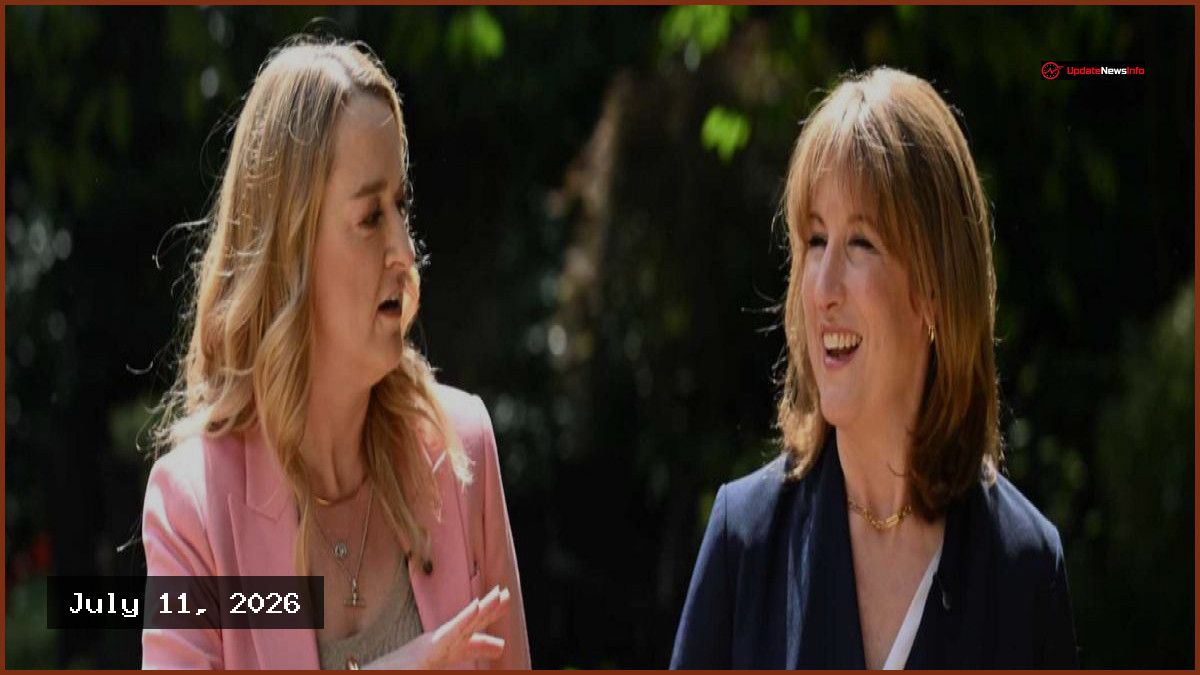
Outgoing Chancellor Rachel Reeves has issued a stark warning to incoming Prime Minister Andy Burnham, emphasizing the critical need for a “worked-through plan” as he prepares to enter Downing Street in just over a week. In what is likely her final major interview as Chancellor, Reeves told Laura Kuenssberg of the BBC that governing Britain is inherently difficult, and Burnham must be ready for numerous challenges and shocks.
Reeves stressed that Burnham and his team must possess absolute clarity on their objectives and remain “laser-focused on those things that have always motivated him, have always driven him.” Reflecting on the impending end of Sir Keir Starmer’s time in office, she acknowledged the public’s desire for rapid change, stating, “People are impatient for change – I’m impatient for change and I totally get that people want to see their lives changed faster.”
Speaking from one of the lavish 17th Century state rooms in No 11 Downing Street, the same location where she gave her first full interview as Chancellor in July 2024, Reeves indicated her expectation to leave the residence. She had previously described being Chancellor as her “dream job” but refrained from explicitly naming her preferred successor or confirming her desire to stay, amidst the incoming No 10 team’s silence on their cabinet appointments.
Reeves asserted that she had restored “stability and trust” to the economy over the past two years, claiming that Burnham would inherit an economy “much stronger than the one I inherited from the Conservatives just two years ago.” She highlighted what she termed the “big picture” improvements, including reduced government borrowing costs, significantly lower inflation from its peak, increased investment in infrastructure like roads and railways, and an economy growing faster than the UK’s closest competitors.
However, the economic landscape still presents significant challenges by other measures. Inflation remains above target and is projected to rise, growth has been sluggish, and the Bank of England recently cautioned that interest rates might need further increases.
Criticism of Reeves’ tenure has also emerged from within Labour ranks. A former senior minister suggested she had “spent a lot of time and energy painting a picture of her grim inheritance in the expectation things would brighten up quickly and she could claim credit.” This source added that by the time she realized the true extent of “tight public finances, mushrooming welfare, and the economy stuck in a low-growth trap,” she had exhausted her political capital and failed to win key arguments on welfare reform, concluding it was “sad because I think her instincts are generally OK, but by the time she figured out the right things to do, it was too late.”
Many Labour MPs believe that errors made in No 11 contributed to souring the prospects for Starmer’s government shortly after he and Reeves took office. Starmer himself cited the decision to remove the winter fuel allowance from millions of pensioners, a move later partially reversed, as one such governmental error. A senior Labour figure commented that Reeves “underestimated the desire for radical change, and lacked political nous on key decisions like winter fuel.”
Reeves, a close political ally of Starmer who became shadow chancellor in 2021 leading to Labour’s landslide victory two years ago, did not acknowledge these specific problems. She also avoided admitting that her relationship with business had deteriorated following a hike in National Insurance tax for employers. A City source confirmed the immediate negative impact of increasing business costs, leading to staff layoffs, stating, “There was so much goodwill, but it was genuinely staggering – it just went in a few weeks.”
Despite the criticisms, Reeves credited her decisions as the first female chancellor with establishing a “rock of stability and trust.” She did, however, acknowledge tough moments, recalling her tears in the House of Commons during a Prime Minister’s Questions session in July last year. “Don’t cry on national television. That was probably my toughest moment, or perhaps even tougher, seeing the photos of me crying on national television on the front page of pretty much every newspaper the following day,” she recounted.
Addressing the revelation that Burnham had been planning his time as PM for a year, Reeves stated, “I think it is perfectly reasonable for people to have ambition. Andy has never shied away from the fact that he wanted at some point to lead the Labour Party. And I want him to be ready for that, because I want it to be a success and I am sure he will be,” reiterating her initial message of preparedness.