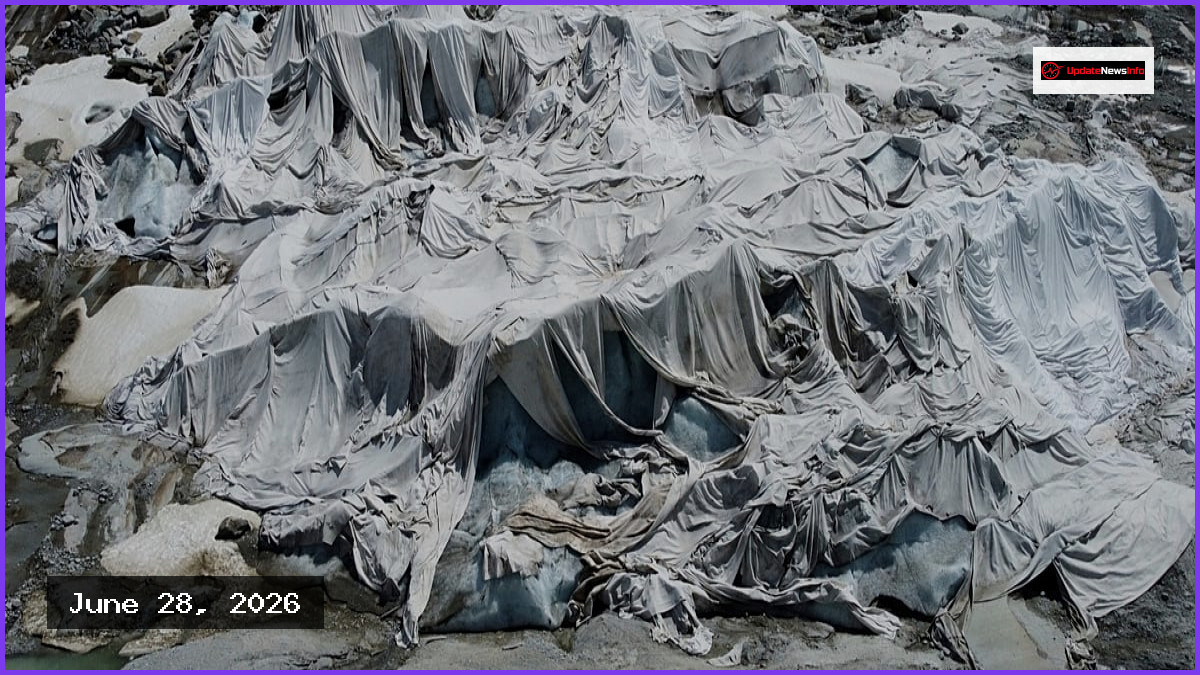
Snow and ice reserves built up by Swiss glaciers during the winter months are projected to be completely depleted by this coming Monday, according to reports from Glacier Monitoring in Switzerland (GLAMOS). This significant loss is primarily attributed to an intense heatwave that has gripped much of Europe. Following this date, every subsequent day of warm weather through October will further reduce the overall mass of the glaciers.
This crucial tipping point, frequently referred to as “glacier loss day,” has occurred much earlier in the season than historical data suggests. In more than two decades of monitoring, this date has only been eclipsed once before, when it fell on June 26 in 2022. During this century, the tipping point typically arrives around the middle of August.
Matthias Huss, the chief of GLAMOS, described the situation on Friday as one involving “enormous ablation” with ice and snow melt rates affecting regions across the entire Alpine range. Huss cautioned that the nation’s glaciers are currently in a precarious state, experiencing shrinkage at an unprecedented speed that is being exacerbated by the ongoing heatwave. He noted that the region is currently three months ahead of where it would be in a healthy climate scenario.
While glaciers throughout the Swiss Alps began their retreat roughly 170 years ago, the rate of melting was considered relatively moderate until recent decades. This accelerated loss of ice and snow stems from rising temperatures across Europe combined with reduced winter snowfall. Huss explained that Swiss glaciers received approximately 25% less fresh snow this year compared to the average recorded between 2010 and 2020.
Furthermore, warmer-than-average temperatures throughout May and June, punctuated by an extraordinary heatwave, caused snow cover to vanish earlier than usual. This process exposes the darker glacier ice underneath, which absorbs solar radiation more rapidly than reflective snow, thereby accelerating the melting cycle. Huss warned that if warming trends observed over recent decades persist, only minor remnants of ice will remain by the year 2100.
Across Europe, record-breaking temperatures have soared past 40°C this week, causing widespread disruption and placing immense strain on emergency responders and medical facilities while leading to multiple fatalities. Scientists warn that the extreme heat currently impacting the continent would have been near-impossible just a few decades ago, noting that the effects of climate change are becoming increasingly severe.