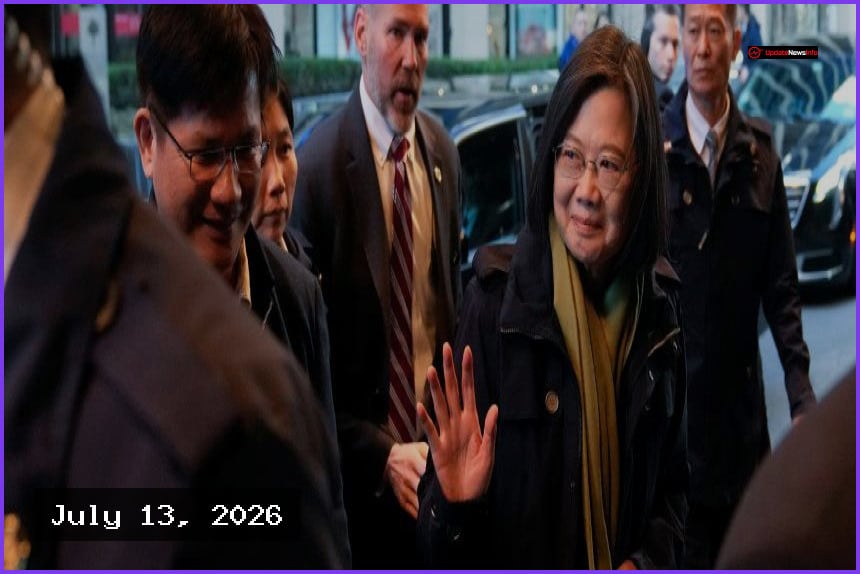
Taiwanese President Tsai Ing-wen is set to meet with US House Speaker Kevin McCarthy in California this week, a highly anticipated encounter that has prompted Beijing to threaten a “resolute fight back.” The meeting has raised concerns about a potential repeat of the intense pressure campaign China launched last year following then-Speaker Nancy Pelosi’s visit to Taipei.
China has already voiced strong opposition to the meeting, which McCarthy’s office announced would take place on Wednesday. Beijing criticized Washington for allowing President Tsai to make a stopover in the US while en route to and from official visits in Central America, warning that such actions could lead to “serious” confrontation between the two global powers.
Last August, in retaliation for what it deemed a violation of its sovereignty after Speaker Pelosi’s trip to Taipei, Beijing encircled the island democracy with unprecedented military drills. These included firing multiple missiles into Taiwan’s surrounding waters and sending dozens of warplanes across the sensitive median line dividing the Taiwan Strait. China also severed contact with the United States on various issues, from military matters to combating climate change.
However, analysts suggest that Beijing might tread more carefully this time, or at least avoid further escalation. The meeting’s location in California, rather than Taiwan, and its timing — amidst a complex period in China’s foreign relations and ahead of Taiwan’s presidential election in January — are seen as factors that could influence China’s response. Yun Sun, director of the China Program at the Stimson Center, noted, “This puts the burden on China not to overreact, because any overreaction is only going to push China further away from the world.” She added that in the current situation, China “have to consider the consequences of overreaction.”
President Tsai, for her part, remained defiant as she embarked on her 10-day trip, pledging not to allow “external pressure” to prevent Taiwan from connecting with the world and like-minded democracies. Taiwan’s official Central News Agency also reported Monday that Tsai would meet with McCarthy, citing Tsai’s presidential office.
The expected meeting occurs at a precarious moment for US-China relations, which are already strained over issues like a downed suspected Chinese surveillance balloon and semiconductor supply chains. Any aggressive response from Beijing could further damage these fragile ties. Taiwan continues to experience the aftermath of last August’s events, with Chinese military forces now regularly making incursions over what was previously an informal but largely respected border in the Taiwan Strait.
Several other factors contribute to Beijing’s potential caution. A fierce reaction could alienate voters from Taiwan’s main opposition party, Kuomintang (KMT), which is generally perceived as more friendly toward Beijing, ahead of the upcoming presidential election. Such a response could also undermine a high-profile tour of mainland China by former Taiwan president and senior KMT member Ma Ying-jeou, the first visit from a current or former Taiwan leader since the end of the Chinese Civil War in 1949. Wen-Ti Sung, a political scientist at the Australian National University’s Taiwan Studies Program, described Ma’s tour as a “once in a half a century opportunity to send a conciliatory message between the two sides, Beijing shouldn’t want to tank that.”
Globally, China’s actions toward Taiwan are under increased scrutiny following Russia’s invasion of Ukraine, given President Vladimir Putin’s close diplomatic partnership with Chinese leader Xi Jinping and the echoes in their rhetoric. Beijing has recently sought to project itself as a peace broker in the Ukraine conflict, aiming to repair strained ties with Europe. This week, as Tsai meets McCarthy, French President Emmanuel Macron and European Commission President Ursula von der Leyen are also heading to China, an important opportunity Xi may not wish to overshadow with military posturing.
An aggressive response also risks escalating confrontation with the US, less than six months after President Xi and US President Joe Biden met in Bali to enhance communication. Steve Tsang, director of the SOAS China Institute in London, commented that a “less overtly aggressive response would imply that Beijing does not wish to escalate tension with the US to a level that can risk getting out of hand.” He added, “A reset in US-China ties is not on the agenda, but an easing of tension is not beyond the realm of possibility.”
For President Tsai, who is in the final year of her two-term presidency, this meeting with the leader of the Republican majority in the US House of Representatives — who ranks second in line to the Presidency — is a significant symbolic moment. Wen-Ti Sung called it “clearly a capstone event,” highlighting Tsai’s image as the Taiwanese president who has elevated US-Taiwan relations and given Taiwan “almost unprecedented international visibility.” This enhanced cooperation with the US has occurred amid China’s increasing pressure on the self-governing island, which lies fewer than 110 miles (177 kilometers) from the mainland coast.
China’s Communist Party claims Taiwan, an island of 23 million, as its own territory despite never having controlled it, and has vowed to take it by force if necessary. Under leader Xi Jinping, the party has significantly expanded its military capabilities over the past decade and intensified its economic, diplomatic, and military pressure on Taiwan. While some in Washington worry Beijing is preparing for an invasion, China’s official language still suggests force is not its preferred option for achieving “reunification.”
These pressures, and how to support Taiwan against unilateral actions by Beijing, are likely to be key topics when Tsai, McCarthy, and a bipartisan group of US lawmakers convene on Wednesday. Congress has been a crucial pillar of growing American support for Taiwan, with lawmakers regularly visiting the island and driving bipartisan legislation to enhance support and cooperation. The US maintains unofficial ties with Taiwan and is legally bound to provide the democratic island with the means to defend itself, despite switching diplomatic relations to Beijing decades ago. Under Washington’s longstanding “One China” policy, the US acknowledges China’s position that Taiwan is part of China but has never officially recognized Beijing’s claim to the island.
Speaker McCarthy, while not having the decades-long record of advocacy on China that Pelosi possessed, is a leading voice advocating for closer scrutiny of Beijing. Meeting Tsai could bolster this image. Last month, McCarthy stated that meeting Tsai in the US would not affect his future plans to travel to Taiwan, a trip he had previously expressed interest in making. A meeting on US soil is widely considered less likely to provoke Beijing than a direct visit to Taiwan. So far, domestic conversation in China’s heavily controlled media sphere regarding this meeting has been significantly muted compared to the nationalist and anti-US rhetoric that followed Pelosi’s 2022 trip.