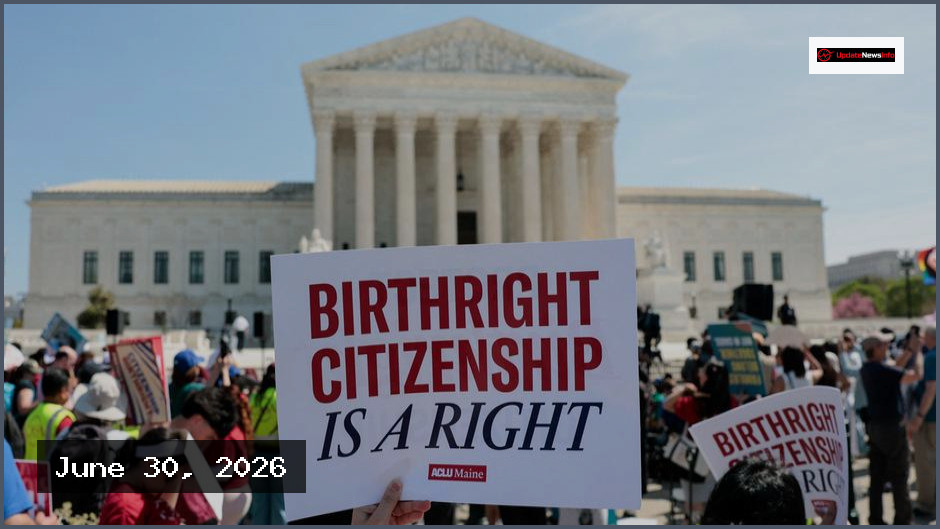
The United States Supreme Court delivered a significant ruling on Tuesday, declaring that President Donald Trump’s executive order aimed at restricting birthright citizenship is unlawful. In a major decision announced on the final day of its term, the justices voted 6-3 to maintain the standing right to US citizenship for nearly everyone born on American soil. President Trump had issued this order on the very first day of his second term last year, as part of a series of policies intended to tighten controls on both legal and illegal immigration. Justices had previously shown skepticism toward the order during oral arguments in April, an event attended personally by President Trump in a highly unusual move for a sitting leader.
The executive order had instructed government agencies not to recognize the citizenship of children born in the United States if neither parent was a US citizen or a legal permanent resident, commonly known as a “green card” holder. Critics argued that this directive violated the 14th Amendment, which is widely understood to grant automatic citizenship to anyone born on United States territory. In its decision, the court upheld this broad interpretation of birthright citizenship. Chief Justice John Roberts wrote, “Citizenship, then and now, was the right to have rights… to freely participate in our political community. The Framers of the Fourteenth Amendment extended that promise to ‘every free-born person in this land.’ We keep that promise today.”
The provision at the center of the case is the Citizenship Clause, which states that all persons born or naturalized in the United States, and subject to its jurisdiction, are citizens. The Trump administration argued that simply being born in the country is not enough to be considered “subject to the jurisdiction thereof.” The administration contended that this category includes children of immigrants who are present illegally or those here on temporary visas, such as students. Solicitor General D. John Sauer argued that birthright citizenship “demeans the priceless and profound gift of American citizenship” and rewards those who bypass immigration laws. Despite these arguments, the American Civil Liberties Union (ACLU) praised the ruling, noting, “No matter who your parents are, if you’re born here, you belong here.”
While many nations, particularly outside the Americas, follow the principle of jus sanguinis, or “right of blood,” where citizenship is inherited from parents, the United States relies on the principle of jus soli, or “right of soil,” derived from English common law. Notably, even the United Kingdom abolished jus soli via the British Nationality Act of 1981, requiring at least one parent to have settled status. Beyond the citizenship ruling, the Supreme Court also issued decisions regarding campaign finance and transgender athletes. The court ruled 6-3 that caps on election campaign spending violate First Amendment free speech protections, a development coming just before the November midterm elections. Financial data as of May indicated Republican committees held $256 million with no debt, compared to $126 million and $18 million in debt for Democratic counterparts. Additionally, the court ruled that state bans in Idaho and West Virginia on transgender girls and women in school sports do not violate federal anti-discrimination laws, a decision that has drawn strong criticism from advocates for the LGBTQ+ community.