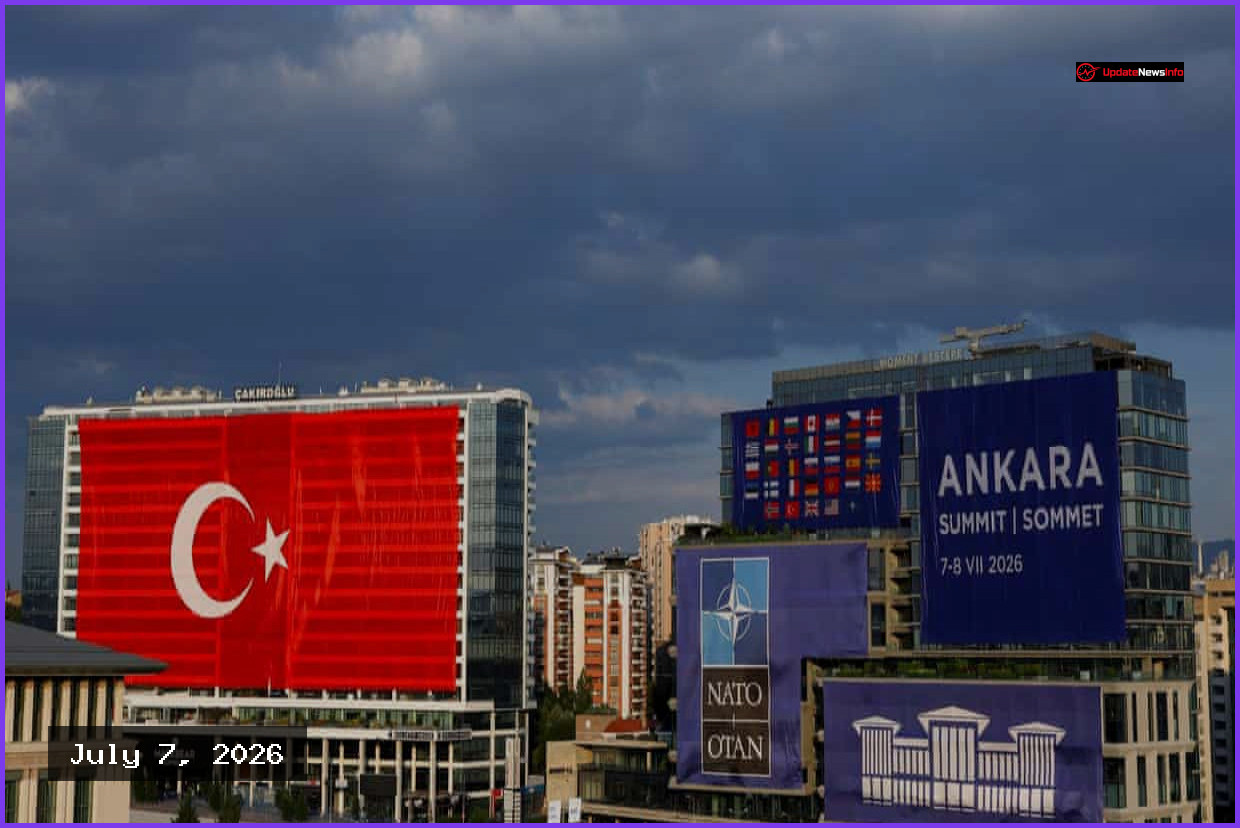
Nato leaders are set to gather in Ankara on Tuesday for a crucial two-day summit, following a turbulent six months marked by tensions with the US over issues like Iran and Greenland. The meeting of the 32 member states comes as the United States continues to exert significant pressure on its allies to boost defence spending, with the other 31 members hoping to mollify an unpredictable Donald Trump.
On Monday, Nato Secretary General Mark Rutte called upon allies to present “clear, concrete and credible plans” to achieve the organization’s spending targets. He emphasized that “President Trump fully expects that all allies will step up immediately and get on the path to 5% and do it with urgency.” In an effort to demonstrate their commitment to defence spending pledges, Nato members are also expected to unveil tens of billions in new arms contracts at an industry forum held concurrently with the summit.
The summit in the Turkish capital is anticipated to agree on a largely symbolic commitment of €70bn (£60bn) in military aid to Ukraine for this year and next. This figure primarily reflects existing pledges to a nation that currently has no direct pathway to joining Nato. Rutte, during a visit to London last week, reiterated the focus on tangible results, stating, “It’s not about keeping anyone happy, it is about delivering. And what Donald Trump expects, of course, is delivery.”
Last month, during a meeting with Trump in the Oval Office, Rutte presented large cardboard panels illustrating the cumulative defence spending by non-US Nato members since Trump first took office in 2017. He highlighted a chart referencing “the Trump trillion,” representing the total amount spent on defence by European members and Canada. This elementary communication aimed to show, in Rutte’s words, that Trump “is successful in terms of getting the Europeans to spend more.” However, with transatlantic relations already at a low point and the US keen on ensuring the 3.5% commitment is honored, a diplomatically harmonious summit remains uncertain.
Trump further underscored his concerns on Friday, posting a graphic on his Truth Social platform that displayed Nato members’ defence budgets. The graphic contrasted a substantial US spend of $999m (£747m) with smaller figures from European states, including the UK and France. Introducing the graphic, Trump wrote, “Ridiculous for the U.S.A. to continue along this one-sided path when the relationship is not reciprocal.”
Since the beginning of this year, Trump has continued to strain relations with US allies. He threatened to take control of Greenland from Nato member Denmark and failed to consult European leaders before the US and Israel launched an economically disastrous attack on Iran. He later complained when these allies did not permit US jets to bomb Iran from their territory. Further spats have occurred with Britain, after Keir Starmer refused full participation in the Iran bombing, and with Italy’s Giorgia Meloni, whom Trump bizarrely accused of being obsessed with him on Monday. Relations are also strained with Canada’s Mark Carney, following Trump’s extraordinary suggestion of the US taking over its northern neighbour.
The US is also planning to reduce the number of troops and materiel assigned to Europe in the event of a conflict with Russia, including a one-third cut in F-15 and F-16 jets. Last month, US Defence Secretary Pete Hegseth announced a further review of US forces in Europe, threatening to disproportionately cut numbers in countries spending the least on defence. Despite these tensions, the large US delegation of 1,400 people, including those responsible for standard protocol like handling Trump’s toilet waste to prevent intelligence analysis, is seen as a relief, given Trump’s past flirtations with the idea of leaving Nato, such as at the 2018 summit.
Behind the scenes, there has been a significant effort to “Trump-proof” the outcomes in Ankara. Oana Lungescu, a former Nato spokesperson, anticipates that the final summit communique, the jointly agreed diplomatic text, will be concise, “probably a one pager,” and will “restate some of those fundamentals” that define the alliance’s purpose. The final draft text, still awaiting approval from the assembled leaders, explicitly reaffirms an “ironclad commitment” to Nato’s crucial Article 5, which considers an attack on one member state an attack on all. The perceived necessity to openly restate this provision highlights the fraught nature of 2026 so far.
General Alexus Grynkewich, the senior US and Nato commander in Europe, announced last week that European allies had “largely filled the gaps” that would result from reductions in US troops during a war. While substantial, Europe’s efforts are not a like-for-like replacement, particularly due to a lack of long-range bombers, though cruise missiles may offer an alternative. Trump’s agenda in Turkey offers a clue to the leaders’ chemistry; aside from attending one Nato leaders’ meeting on Wednesday and a summit dinner at Recep Tayyip Erdoğan’s presidential palace on Tuesday night, his only confirmed bilateral meetings are with Syria’s president Ahmed al-Sharaa, a war leader he admires, and Ukraine’s Volodymyr Zelenskyy.
Success in Ankara is unlikely to be measured by diplomatic pledges alone. When asked about her vision for a positive summit, Lungescu suggested “no angry outbursts from president Trump,” followed by “a reaffirmation of alliance unity” and “a lot more money” allocated for defence contracts and Ukraine.