US President Donald Trump arrived in Ankara, Turkey, on Tuesday, July 7, 2026, for a two-day NATO summit, where he made headlines by reiterating his demand for the United States to control Greenland and announcing the lifting of sanctions against Turkey. The summit aims to address the military alliance’s future and persuade Trump that member countries are actively increasing their military capabilities, especially as American focus shifts from European defense to Asia.
During a meeting with Turkish President Recep Tayyip Erdogan in Ankara, President Trump called the semiautonomous island of Greenland “an important part” for the United States. He repeated the false claim that it is surrounded by Chinese and Russian ships and asserted he would not let Greenland be threatened. “That should be controlled by the United States, not by Denmark,” Trump told reporters, a statement that contrasts with NATO’s founding principle that its 32 members defend each other’s territory and do not threaten to seize it.
Separately, President Trump announced the U.S. would lift sanctions on Turkey, which were imposed after Ankara’s 2019 purchase of a Russian S-400 missile defense system. This acquisition led to Turkey’s expulsion from the F-35 fighter jet program and sparked years of tensions, despite the warm personal relationship between Trump and Erdogan. The removal of sanctions, issued under the Countering America’s Adversaries Through Sanctions Act, is intended to ease the process for Turkey to potentially rejoin the F-35 program, a top goal for President Erdogan.
“We’re going to be taking the sanctions off, OK?” Trump stated, adding that Secretary of State Marco Rubio, Treasury Secretary Scott Bessent, and Defense Secretary Pete Hegseth were working on the issue. He indicated that selling F-35s to Turkey was “something certainly we’d consider” given their relationship, remarking that “Turkey’s been, in many ways, much more loyal than other countries that we think would be loyal.” Erdogan expressed hope for the F-35 sale, praising Trump for always standing by his word.
The two leaders showcased their fondness for each other, with Erdogan greeting Trump with an elaborate ceremony involving military officials on horseback and jets emitting red, white, and blue smoke overhead. When asked about the strength of their relationship, Trump cited “a chemistry that works between us,” noting, “Sometimes you get along with the toughest people, like him.”
However, Turkey’s potential access to U.S. F-35s faces opposition. Israeli Prime Minister Benjamin Netanyahu urged Trump not to sell the fighter jets, warning it would endanger Israel. “This is not a force for peace and stability,” Netanyahu said on CNN, predicting “aggression its wake.” U.S. lawmakers also oppose Turkey having the F-35s as long as the Russian missile defense system remains in its possession, and U.S. law still restricts Turkey from purchasing the jets if it owns the S-400s, even if sanctions are lifted.
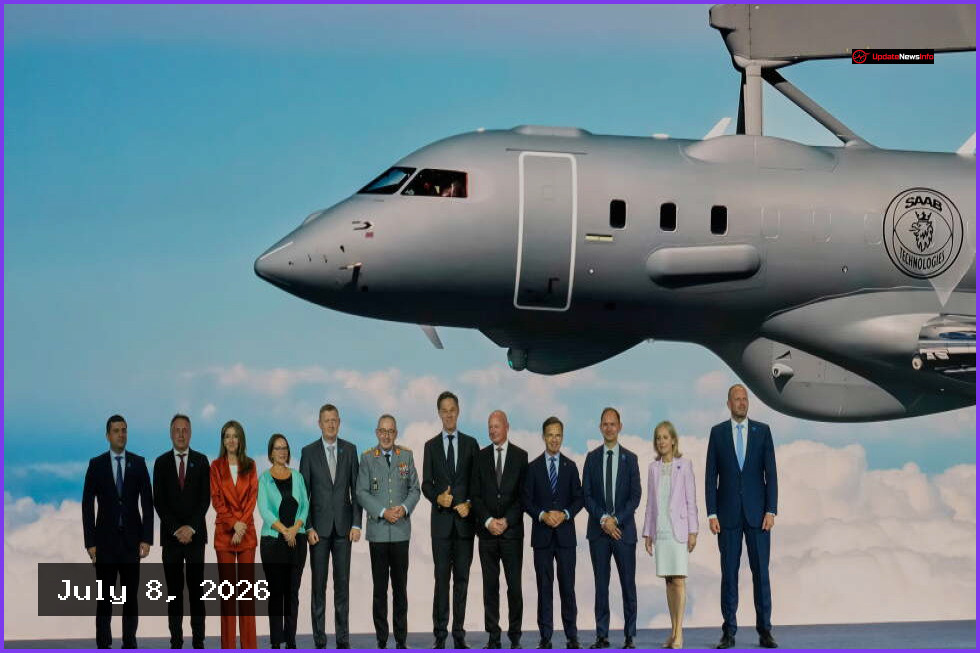
Earlier in the day, NATO showcased military projects worth billions of dollars at a forum billed as NATO’s “big reveal,” accompanied by techno music. NATO Secretary General Mark Rutte called the investment “money well spent” and a clear effort to satisfy President Trump’s longstanding complaint about European allies not spending enough on their own defense. While NATO does not own weapons, it operates 14 AWACS early warning radar surveillance planes, which are approximately 50 years old, alongside newer surveillance drones.
Rutte, who had previously told reporters that “we will announce tens of billions in new contracts,” presided over announcements that included a multinational effort by 15 nations to buy air-to-air refueling and transport planes from Airbus. Additionally, a four-country effort was announced to purchase as many as five new Triton surveillance drones. Some of these projects will be funded through a European Union system of cheap loans for defense purposes, comprising up to $170 billion raised on capital markets. However, no specific dollar figures were given for the new contracts at Tuesday’s event, and some displayed projects had been agreed upon long ago.
Separately, Ukrainian President Volodymyr Zelenskyy made a fresh appeal for his country to be allowed to join the alliance, highlighting Ukraine’s highly experienced armed forces and their potential to boost NATO’s defense capabilities. He emphasized Ukraine’s ability to strike deep inside Russia, targeting oil refineries and other energy sites, and claimed Ukraine’s armed forces are “eliminating” an average of 30,000 Russian troops every month. Zelenskyy, who is set to meet with Trump on Wednesday in Ankara, stated, “Frankly we take no pride in this,” noting that the war with Russia, now in its fifth year, is one “we did not seek but one we are forced to fight.”
Concern is mounting among some European countries that Russia might be preparing a hybrid attack—a combination of conventional warfare with tactics like cyberattacks—on the continent, as Russian President Vladimir Putin struggles to secure victory in Ukraine. However, a senior NATO official, speaking anonymously on the summit’s sidelines, assured reporters that despite some “reckless” actions by Russia, including airspace violations over Poland, Romania, and Estonia, the alliance has successfully deterred Moscow from any potential attack on a member country.
Meanwhile, thousands of protestors from leftist parties, syndicates, and women’s groups marched in central Istanbul on Tuesday against the NATO summit. Police also detained protestors during a demonstration outside the summit venue in Ankara.
US President Donald Trump heads to Ankara, Turkey, on Monday evening for the annual NATO summit. Last year, he pushed alliance allies to spend more on defense. This year, his mission is to try to enforce those pledges. (AP Video: Nathan Ellgren)
Representatives from 15 nations announced a multinational effort to buy air-to-air refueling and transport planes from Airbus. Then Rutte announced a four-country effort to purchase as many as five new Triton surveillance drones.