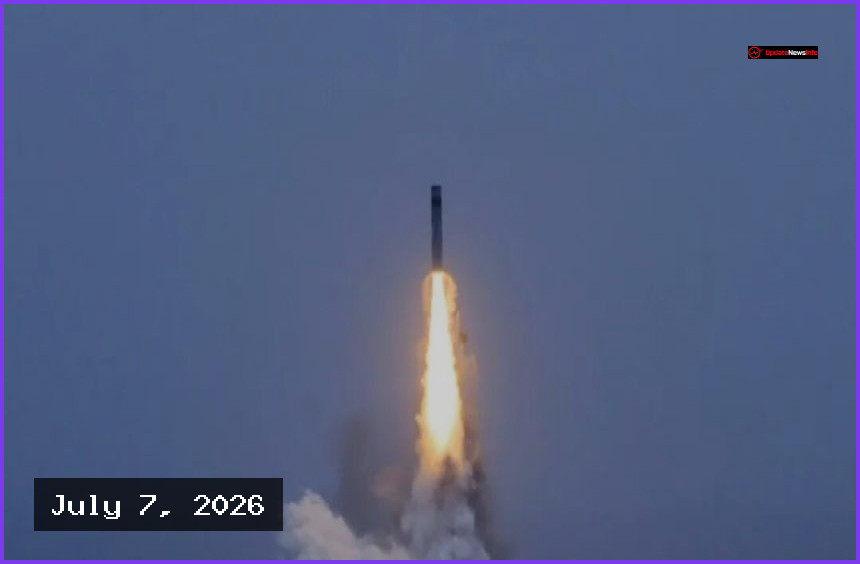
China conducted a rare submarine-launched ballistic missile (SLBM) test in the Pacific Ocean on Monday, drawing sharp criticism from New Zealand and Australia, who condemned the action as a threat to regional peace and stability. The United States, Japan, and Taiwan also voiced significant concerns over the launch.
Senior Capt. Wang Xuemeng, a spokesperson for the People’s Liberation Army Navy (PLA Navy), confirmed that a PLA Navy submarine “launched a strategic missile carrying a dummy warhead toward relevant high seas of the Pacific Ocean, which landed precisely within the designated waters.” Wang stated that the test was a “routine part of China’s annual military training schedule,” adding that “relevant nations” were informed in advance and the operation adhered to international law, “targeting no specific country or objective.”
A regional source familiar with the matter told CNN that the missile traversed the exclusive economic zones (EEZs) of the Federated States of Micronesia, Nauru, Kiribati, and Tuvalu, ultimately landing near the EEZ border of either Kiribati or Tuvalu. The US State Department monitored the launch, describing it as a nuclear-capable but unarmed “intercontinental-range ballistic missile.”
While Beijing did not disclose the specific type of missile tested, the PLA Navy operates two types of SLBMs: the JL-2 and the JL-3. Missile experts note that the JL-3 possesses sufficient range to reach the continental United States from waters off China’s coast, including the South China Sea. The US State Department expressed “great concern” over “Beijing’s rapid and opaque nuclear weapons buildup,” urging China “to engage in meaningful arms control discussions.”
New Zealand’s Minister of Foreign Affairs, Winston Peters, stated on Monday that China fired the missile into the South Pacific Nuclear Free Zone, which was established in 1986 by the Treaty of Rarotonga. China signed protocols II and III of this pact in 1987, which prohibit the use or threat of nuclear weapons and nuclear testing within the zone, respectively. Peters, who was informed of the plans earlier that day, called it an “unwelcome and concerning development,” emphasizing that New Zealand and other Pacific neighbors “have no interest in China using the South Pacific as a testing site for missile capability.”
Australian Foreign Minister Penny Wong echoed these sentiments, labeling the test “destabilizing to the region.” Wong highlighted that the test must be seen “in the context of a rapid military build-up by China, which is lacking in the transparency and reassurance as to intent that the region expects.” A Japanese government statement also conveyed “serious concerns regarding China’s increasingly active military activities” and called on Beijing to reconsider such ballistic missile testing.
The self-ruled island of Taiwan, which Beijing claims and has vowed to “reunify” with by force if necessary, also criticized the launch. Presidential spokesperson Karen Kuo remarked that Beijing’s actions had “caused unease” in the region and further underscored “China’s increasingly obvious ambitions for expansion in the Western Pacific.” Peters recalled a similar incident in 2024 when the PLA test-launched an intercontinental ballistic missile in the region, asserting that the region “should not sit by and allow such tests to become normalized or routine.”
China’s main ballistic-missile submarine is the Type 094, also known as the Jin class, with six vessels in operation. Beijing rarely reports its missile tests; however, according to the Missile Defense Project at the Center for Strategic and International Studies (CSIS), the JL-3 was first tested in 2018 and again in 2019.
While China’s tests draw criticism, missile tests are routine for nuclear powers. The US Navy, for instance, conducted four tests of its Trident submarine-launched ballistic missile off Florida last September. India tested an SLBM in December, and Russia conducted a similar test last October.
China has been expanding its nuclear-powered submarine fleet as part of a broader enhancement of its nuclear forces. The US Defense Department reported in December 2025 that the PLA views such tests as “an option for medium-to-high intensity nuclear deterrence operations.” The report also noted that China typically conducts missile tests within its own borders, such as the December 2024 launch of several ICBMs in quick succession from a training base in the country’s west, demonstrating an ability to rapidly launch multiple silo-based ICBMs. China’s last ICBM test into the open Pacific was in September 2024, when it fired a DF-31B nuclear-capable missile from Hainan Island near French Polynesia, marking its first such open-ocean test in 44 years.
CNN’s Steven Jiang, Todd Symons, Hilary Whiteman, Yumi Asada, Wayne Chang and Sylvie Zhuang contributed to this report.
Scan the QR code to download the CNN app from the Apple Store.