The North Atlantic Treaty Organization’s summit began in Turkey on Tuesday, with President Trump set to press NATO allies to increase their defense spending to 5% of their gross domestic product. This push comes as the United States is considering a partial withdrawal of its assets from Europe and amid other complex discussions within the 32-country alliance.
President Trump arrived in Ankara, Turkey, shortly before 7 a.m. ET, or 2 p.m. local time. The summit’s location in Turkey is significant, as Mr. Trump has cultivated stronger ties with Turkish President Recep Tayyip Erdoğan, despite occasional strains with other European nations. Turkey, a NATO member since 1952, presents a complex dynamic due to its economic relationship with Russia and human rights concerns.
This summit has been described by Secretary of State Marco Rubio as potentially the most important in NATO’s history. Mr. Trump has consistently voiced frustration over the defense spending levels of many NATO members and their reliance on U.S. military capabilities. At the 2025 NATO summit, allies committed to reaching a 5% GDP defense spending target by 2035, a goal largely influenced by Mr. Trump’s advocacy, up from the previous 2% target.
U.S. Ambassador to NATO Matt Whitaker emphasized that the U.S. goal is to shift the burden of conventional defense in Europe to its allies. “The United States remains a proud NATO member, and I continue to show up every single day doing the important work at the alliance on behalf of President Trump, but we have responsibilities elsewhere in the world, as the world’s only superpower,” Whitaker stated, highlighting the strategic shift.
Whitaker noted that while countries like Poland, the Nordic nations, and the Baltic states are leading in defense investments, and Germany is on track for 2029, many others are lagging. President Trump expects all allies to accelerate their progress towards the 5% goal. The U.S. currently spends approximately 3% of its GDP on defense.
The expectation of increased defense spending by European nations aligns with a planned reduction in the U.S. military footprint in Europe. The Pentagon has announced plans to withdraw roughly 5,000 U.S. troops from Germany, along with reductions in equipment. A senior U.S. official, speaking anonymously, explained that this posture adjustment is driven by national security strategies focused on burden-shifting, enabling European allies to manage regional threats more effectively and allowing the U.S. to focus on other global priorities.
Adding another layer of complexity to the summit is President Trump’s continued interest in acquiring Greenland, a semi-autonomous territory of Denmark, a NATO member. Both Greenland and Denmark have strongly opposed this idea, which has also caused unease among other Scandinavian countries and much of Europe. While military action to acquire Greenland is reportedly not on the table, the U.S. administration views it as a strategic move for regional defense, though alternative solutions are being explored in cooperation with allies.
The summit may also be affected by a recent public spat between President Trump and Italian Prime Minister Giorgia Meloni. Once favored by the president, Meloni has fallen out of his good graces, with Mr. Trump publicly criticizing her support on issues like the Strait of Hormuz and Iran. This has led to diplomatic friction, including the cancellation of a planned visit by Italy’s foreign minister and Mr. Trump posting a provocative image of himself and Meloni with the caption, “RESTRAINING ORDER NEEDED.” The security of the Strait of Hormuz remains a critical issue for European allies heavily reliant on Middle Eastern oil.
Mr. Trump has offered harsher words for NATO members that he believes aren’t carrying their weight. Earlier this year, the president criticized Spain for opting out of the 5% commitment, threatening to “cut off all trade” with the country.
U.S.-Iran talks during the fragile ceasefire are on pause for the multi-day funeral of Iran’s late Supreme Leader Ali Khamenei, killed in the initial strikes.
Updated on: July 7, 2026 / 7:11 AM EDT / CBS News
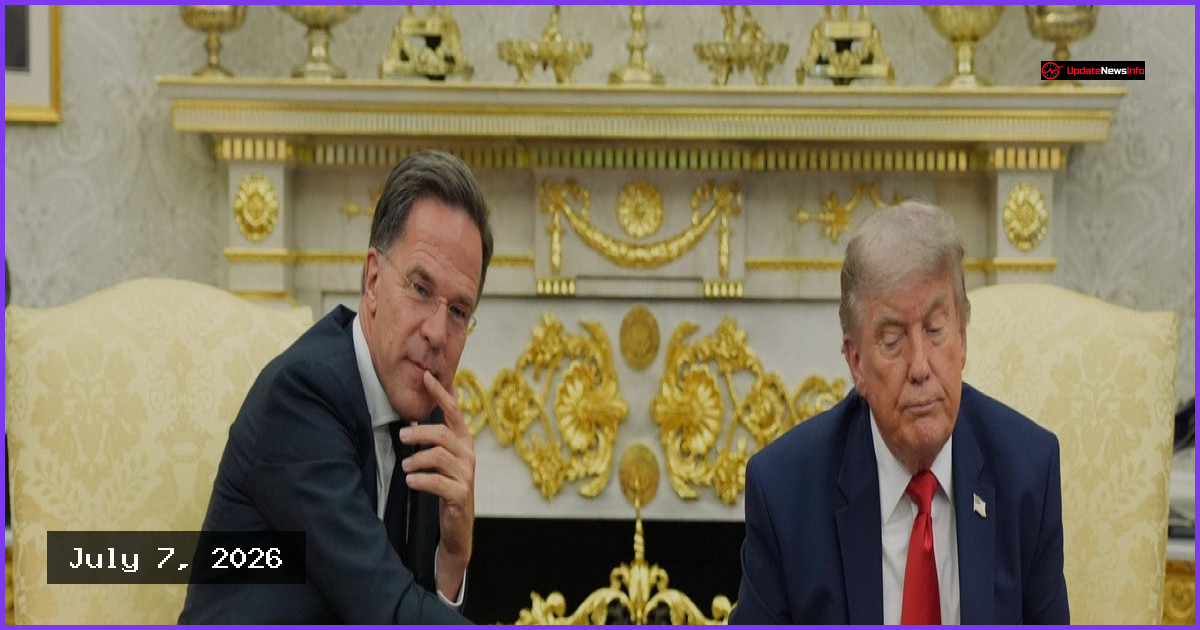
NATO Secretary General Mark Rutte met with Mr. Trump at the White House last month ahead of the summit.