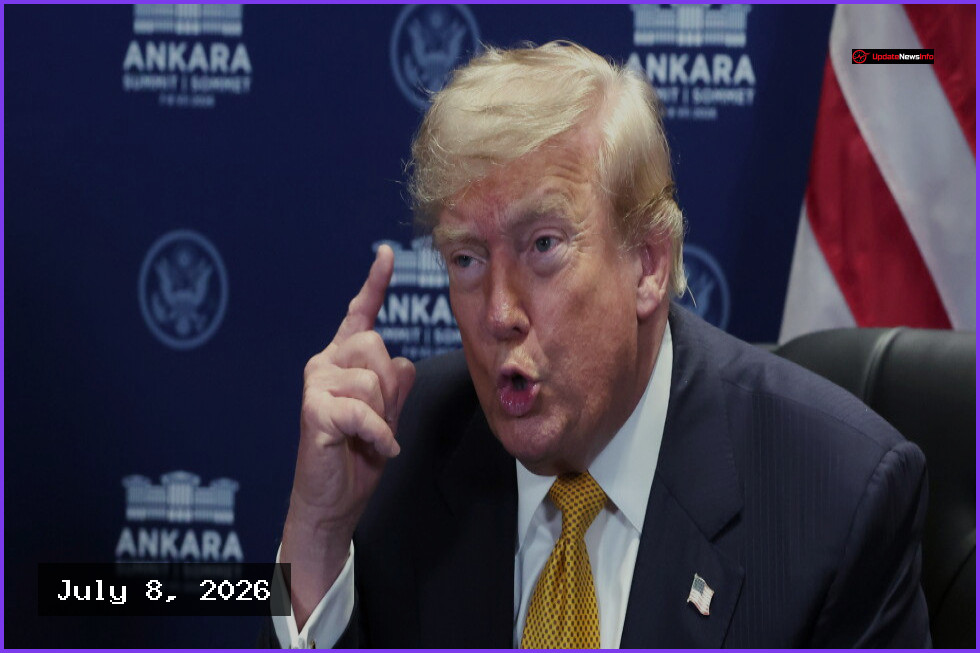
U.S. President Donald Trump announced Wednesday, July 8, 2026, that the United States will grant Ukraine a license to manufacture Patriot air defense systems, a significant development for Kyiv as the war with Russia enters its fifth year. The announcement came during a meeting with Ukrainian President Volodymyr Zelenskyy on the sidelines of a two-day NATO summit in Ankara, Turkey.
“We’ll give them the right to make Patriots. We’ll show them how to do it,” Trump stated, expressing confidence that Ukraine could produce the systems “pretty quickly.” Patriot systems are known for being expensive, in high demand, and requiring a long production time. President Zelenskyy has consistently sought more of these systems for years, and more recently, a license to enable domestic production. Trump praised Zelenskyy for doing “an amazing job” and being “very effective” in the ongoing conflict.
However, Trump’s interactions at the summit were not entirely cordial with all NATO partners. He voiced dissatisfaction with the alliance for opposing his efforts to take control of Greenland and for not supporting the U.S. war in Iran. Trump reopened old wounds as he arrived at the meeting of 32 NATO leaders by reiterating his insistence that the United States should control Greenland, a semiautonomous Danish territory, stating it is “very important” for the U.S. and needed “for protection of the world, not just the United States.”
In response, Denmark’s Prime Minister Mette Frederiksen affirmed her country’s readiness to “defend every inch of NATO including our own territory” in the event of an attack, relying on allies to uphold their mutual defense commitments.
Regarding Iran, Trump’s comments followed U.S. strikes on the country in reaction to attacks on three ships in the Strait of Hormuz. When questioned about the status of the interim agreement with Iran, Trump declared, “For me, I think it’s over,” adding, “It’s just a waste of time dealing with them.” Despite this, he confirmed he would allow talks to continue.
NATO Secretary-General Mark Rutte worked to ease tensions, crediting Trump for recent increases in defense spending by NATO allies. Rutte encouraged Trump to “Grab the win. It’s there.” He also praised the U.S. strikes on Iran, telling Trump, “I think what you did last night was absolutely necessary. It was a very strong response, and I’m with you on this.” Rutte highlighted the “Trump Trillion” – the $1.2 trillion added to defense spending by European allies and Canada since Trump took office in 2017. He noted that the Trump administration expects Europeans and Canadians to match U.S. spending levels.
Last year, allies agreed to invest 5% of their gross domestic product on defense, allocating 3.5% to defense budgets and 1.5% to infrastructure for faster troop and equipment movement. However, figures released by NATO on Tuesday indicated that Slovenia, Belgium, Spain, and the Czech Republic have struggled to meet the alliance’s previous target of 2% of GDP. Trump criticized some European countries for not participating in the Iran campaign, specifically calling Spain “a terrible partner in NATO” and renewing threats to cut off trade.
The U.S. president envisions a leaner “NATO 3.0,” where Europe assumes greater responsibility for its own security, including Ukraine, with conventional weapons, while America maintains its nuclear umbrella. The Pentagon has initiated a six-month review of the U.S. military presence in Europe, leaving allies seeking clarity on the extent of potential troop reductions.
Ukrainian President Zelenskyy made a fresh appeal Tuesday, July 7, 2026, for Ukraine’s inclusion in the alliance, emphasizing that Ukrainian armed forces are highly experienced and would enhance NATO’s defense capabilities. He highlighted Ukraine’s adaptability, its ability to strike deep inside Russia, and its claim of eliminating an average of 30,000 Russian troops each month.
Following Wednesday’s summit, NATO leaders pledged $80 billion to Ukraine to support its defense needs this year and next, acknowledging “the long-term threat Russia poses to Euro-Atlantic security.” Concern is growing among countries bordering Russia that Moscow might be preparing a hybrid attack on the continent as President Vladimir Putin struggles to secure victory in Ukraine.
In another significant meeting, Trump also met with Syrian President Ahmad al-Sharaa, a former insurgent who led the offensive that unseated autocrat Bashar Assad in December 2024. Despite al-Sharaa’s past as an al-Qaida fighter, he has garnered Trump’s backing in his efforts to rebuild Syria and restore its fractured ties with the West. When asked about removing Syria from the U.S. list of state sponsors of terrorism, Trump responded, “I think I will. Why wouldn’t I? He’s done a great job.”
The president’s renewed interest in Greenland could put at risk the entire future of NATO, which was founded in 1949 to counter the threat to European security posed by the Soviet Union during the Cold War.
Associated Press journalists Collin Binkley and Michelle L. Price in Washington contributed.