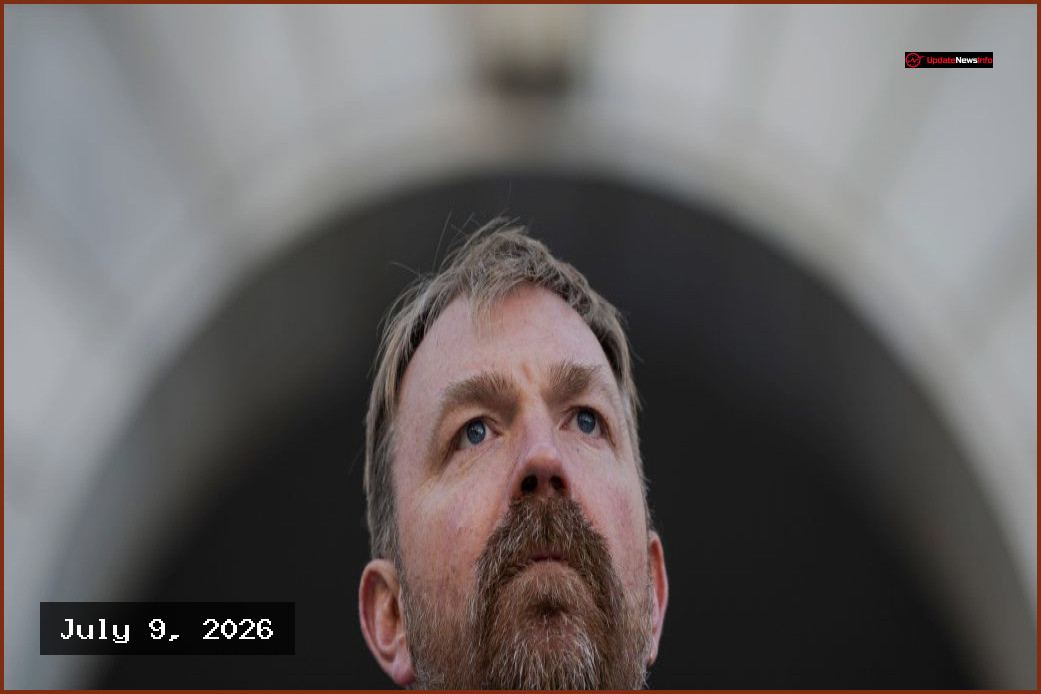
Maine Democratic Senate nominee Graham Platner announced Wednesday that he is suspending his campaign, a decision that follows a woman’s allegation of rape and comes amid broader accusations of unsettling behavior. Platner, who denies the allegations, also criticized the Democratic establishment, claiming they used the accusations to undermine his campaign. His withdrawal clears the path for the party to select a new candidate to challenge Republican Sen. Susan Collins in one of the most closely watched contests of November’s midterm elections.
Platner’s decision follows an allegation made by Jenny Racicot, who told CNN and Politico that he raped her nearly five years ago while he was heavily intoxicated and they were in a casual dating relationship. Racicot recounted an incident in 2021 where Platner, despite her request for him not to come, showed up drunk at her house and forcibly had sex with her, ignoring her repeated demands to stop. During the incident, a sewing cabinet was knocked over, inadvertently leaving a needle stuck in her leg. Racicot, who broke off contact with Platner soon after, said she did not report the incident to authorities at the time but affirmed to CNN, when asked if she now considered it rape, “By definition yes, absolutely yes.”
In an 11-minute video posted on X, Platner stated, “We believe that for the movement to continue it can’t be me — and for that reason we are suspending campaign operations,” adding his intention to file paperwork to officially withdraw.
A significant portion of Platner’s video was dedicated to railing against what he called the Democratic Party establishment. He claimed they were using the allegations of sexual assault and dating violence, which he vehemently denied, to undermine him and his political movement.
“It’s not the false allegations though that have brought us to where we are. It’s the fact that they are being used by the political establishment to put structural pressure on us. We live in a political system that is not built for normal people. It is a system built structurally to make sure that movements like ours cannot flourish,” Platner asserted. He further described the “brutal political reality” where those in power were using the allegations as “an excuse to take away all of the things that we need to run a campaign,” including the ability to fundraise and access voter data.
Platner emphasized that while his name might be on the ballot, “that ballot line belongs to the people of Maine, and on November 3, it needs to belong to the people of Maine, and the next Democratic senator for Maine needs to belong to the people of Maine.” As the video message was released Wednesday evening, Platner simultaneously delivered the news to his campaign staff via a video call, where a participant told CNN he remained calm, though his voice cracked a few times, and several younger staffers showed visible emotion.
Platner faced Maine’s July 13 deadline for general election candidates to withdraw from the ballot. His departure leaves the state Democratic Party with two weeks to put forward a replacement candidate.
The Maine Senate race is crucial for Democrats’ aspirations of securing a Senate majority in November’s midterm elections, requiring a net gain of four seats, many of which would need to come from wins in traditionally Republican states. Despite well-funded Democrats having previously fallen short against Collins, the party believes a favorable national environment, evidenced by former Vice President Kamala Harris winning Maine by nearly 7 percentage points in 2024, could bolster their chances this year.
Platner’s support among Democrats had significantly eroded earlier this week following Jenny Racicot’s detailed account. In a video released Monday, Platner had described the allegations as “troubling, serious and false,” yet acknowledged they could make it more difficult to defeat Collins. He stated, “Regardless of the inaccuracy of the reporting, but mindful of the political reality it will inflict, we are taking the time to reflect on the best path forward for the state that I love, the people that I love, the movement I belong to, and the goal of defeating Susan Collins.” Shortly after the allegations were reported, many Democrats, including independent Sen. Bernie Sanders of Vermont, one of his closest allies in Congress, called for his withdrawal from the race.
Controversies have shadowed Platner’s campaign since its early days. He had a skull and crossbones chest tattoo with Nazi associations, which Platner claimed he was unaware of until recently, though a former girlfriend had described it as a Nazi symbol months before he said he learned its meaning. Platner stated in October that he had the tattoo covered up.
CNN’s KFile also reported on deleted social media posts where Platner had called himself a “communist,” dismissed “all” police as “bastards,” and asserted that rural White Americans “actually are” racist and stupid. He has since disavowed these posts, explaining they were made during a period of disillusionment and anger that he expressed online.
Last month, The New York Times published a report detailing separate allegations of unsettling behavior toward women Platner had dated. Platner disputed claims of physical intimidation and labeled the most serious allegations as false and politically motivated. More recently, another ex-girlfriend, Lyndsey Fifield, described her alleged mistreatment by Platner to CNN on Tuesday, claiming he repeatedly grabbed her, at times leaving bruises, and once blocked her inside a bedroom more than a decade ago. Platner’s campaign dismissed Fifield’s allegations as “categorically false” and attributed them to “a person with a well-documented political agenda.”
Platner, an oyster farmer and political newcomer, became the presumptive nominee in April, ahead of Maine’s June primary, after two-term Gov. Janet Mills withdrew from the Democratic race. However, some groups continued polling other Democrats against Collins even after Platner secured the primary nomination.
The Maine Democratic Party on Wednesday approved a plan to hold a nominating convention to select a new nominee in the event of Platner’s withdrawal. Charlie Dingman, chair of the Maine Democratic Party, along with two other party leaders, stated, “Today, the Maine Democratic Party held a meeting with over 100 state committee members who voted to hold a nominating convention to choose a new nominee if there is a vacancy to fill. We will announce the full timeline, details for how the nomination process will move forward, information about how to participate, and requirements for candidates soon. We will keep the public informed throughout the process – transparency is of the utmost importance.”
Devon Murphy-Anderson, executive director of the state party, expressed frustration Wednesday night that Platner had not withdrawn sooner, noting her team worked with legal counsel to navigate the narrow timeline for selecting a nominee. Murphy-Anderson differentiated her criticism of Platner from his supporters, emphasizing their vital role in the party. She clarified that the Maine Democratic Party, specifically its chair in consultation with the 16 county chairs, is the sole entity legally empowered to make decisions regarding this process, despite any external guidance, including from Senate Majority Leader Chuck Schumer or the Democratic Senate Campaign Committee. A new nominee must be submitted to Secretary of State Shenna Bellows by 5:00 p.m. on July 27. The Democratic Senate Campaign Committee announced Wednesday night it was launching a fund to raise money for the new nominee.
Potential candidates to replace Platner include three individuals who lost in this year’s gubernatorial primary: Nirav Shah, former director of the Maine Center for Disease Control and Prevention; Secretary of State Shenna Bellows, known for her progressive supporters; and former state Sen. Troy Jackson, a logger endorsed by Sanders in the governor’s race who had campaigned with Platner.
Shah, who placed second in the Democratic gubernatorial primary, posted on X that “this has been a difficult week for Maine, and Graham Platner made the right decision in stepping aside.” Jackson quickly declared his intent to run, writing on X, “there is a powerful movement of working class people in the state of Maine” and adding, “I’m in.” Dan Kleban, a brewery owner who ended his Senate campaign last year to endorse Mills, formally declared his candidacy on Wednesday, stating, “I’m glad that Graham Platner has ended his campaign. For too long, this race has not been about Susan Collins’ repeated failures to do what’s right for Maine.” Another possible candidate is state Rep. Valli Geiger, whom Platner had called prior to his withdrawal to encourage her to consider running if he stepped down, though a source told CNN earlier Wednesday that Platner had not made any decision on endorsing.
Voters in Maine have expressed concerns in recent days about the process of replacing Platner and how the scramble could affect Democrats’ chances of defeating Collins in the November election. Frederic Fahey, a Democratic voter in Portland who supported Platner in the primary, remarked, “It’s getting late in the game. They’d have to find a good candidate who could come up to speed really fast and then move forward. I think even under the best circumstances that would be very difficult.”
CNN’s Kaanita Iyer, Allison Gordon, Jake Tapper, David Wright, Andrew Kaczynski and Patrick Svitek contributed to this report.
Scan the QR code to download the CNN app from the Apple Store.