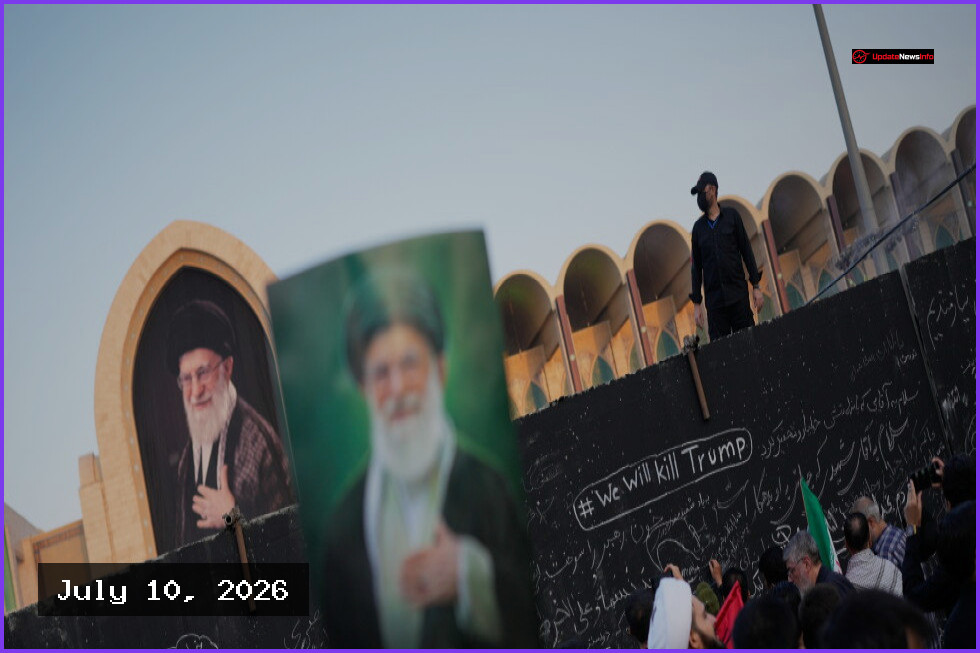
Following days of extensive funeral ceremonies across Iran, Supreme Leader Ayatollah Ali Khamenei was laid to rest early Friday, concluding a period of national mourning that has underscored the deep societal and political divisions within the country. Khamenei, who governed Iran for over three decades, died on February 28 after being killed in Israeli strikes at the outset of the war.
His passing has brought to the surface a stark polarization within Iranian society, a divide so profound that it extends even among opponents of the Islamic Republic. A tech worker in his mid-30s, who grew up in a traditional family in Qom but later abandoned clerical rule, described the situation from Tehran, stating, “A gap has opened up in homes across the country that is really remarkable.” He, like others interviewed, spoke anonymously due to security concerns.
The funeral processions, which saw his coffin transported through Tehran and other cities, including a final stage in Mashhad on Thursday, July 9, 2026, drew tens of thousands of supporters. Images aired on state television early Tuesday showed crowds walking toward Jamkaran Mosque near Qom for a service. These massive turnouts were seen as a powerful display by the hard-liners at the core of the Islamic Republic, who revered Khamenei as a martyr and a staunch defender of clerical rule against the West and Israel. Some mourners, echoing ultra-hardline sentiments, called for the killing of U.S. President Donald Trump in revenge. Hossein Akbari, a 60-year-old mourner in Tehran, articulated this resolve, saying, “Our goal is to prove to the world that we will not submit to oppression and tyranny, and that we will avenge the blood of our leader.”
However, beneath this outward show of strength, decades of bloody repression, international sanctions, and economic mismanagement have fostered deep veins of discontent. These grievances have intensified since authorities killed thousands of anti-government protesters in January.
Khamenei assumed leadership in 1989 following the death of Ayatollah Ruhollah Khomeini, the charismatic ideologue who had spearheaded the overthrow of the U.S.-allied shah a decade prior. Under Khamenei’s guidance, Iran defied sanctions to advance its nuclear program, expand its missile arsenal, and cultivate a network of militant allies across the region, all under the banner of resisting the West.
Domestically, he solidified hard-line clerical rule by largely neutralizing the reform movement and granting immense military, political, and economic power to the Revolutionary Guard. As younger Iranians increasingly sought liberalization, Khamenei maintained strict control over personal lives and dress codes.
A critical turning point in his rule occurred in 2009 with the brutal repression of protests sparked by allegations of vote-rigging in the presidential elections, which resulted in dozens of deaths. This event, according to an Iranian activist and former political prisoner, generated widespread hopelessness.
Subsequent years saw repeated eruptions of protests met with violent crackdowns, with January’s demonstrations being the deadliest. Security forces killed thousands to crush nationwide protests that initially focused on economic woes but quickly escalated into calls for Khamenei’s overthrow. The sister of a protester killed on January 9 in Tehran summarized Khamenei’s legacy in one word: injustice.
For working-class families, Iran’s economy has only worsened since the war began, with surging unemployment and prices. The protester’s sister lamented, “Workers can barely afford to buy bread, everything is so expensive.” She added, “Since my sister died, mentally, financially, our life has fallen apart. All we do is look at photos and videos of my sister and cry. What do we have left?” A 33-year-old Tehran resident, who also participated in the January protests and lost his tech job, highlighted the struggle for basic survival, stating, “All of us, frankly, are just trying to stay alive and all of our struggle is taken up with meeting basic needs like rent and food.”
A quiet form of dissent emerged during the recent holy period of Ashoura, traditionally marked by funeral-style marches honoring a 7th-century Shiite saint. Social media videos showed some Iranians joining these processions with photos of family members killed in the January crackdown.
The deep chasm in Iranian society also creates rifts among opponents of the theocracy, with some hoping for a swift overthrow while others see potential for gradual change. The protester’s sister noted, “The space for dialogue is very closed, and I don’t mean only the government, I mean the people.”
Ali Rabiei, a senior aide to Iran’s reformist President Masoud Pezeshkian, acknowledged last month that Iran was “severely polarized” between hard-core supporters and those desiring its downfall. However, he suggested, as reported by state news agency IRNA, that a significant portion of society exists between these “two poles” that the government could leverage for change within the system.
Despite this, turnout in Iran’s last presidential elections dropped to some of the lowest levels ever, signaling that millions hoping for change saw no utility in voting. Nevertheless, the hard-line candidate still garnered 13.5 million votes, while Pezeshkian, the reformist, received 16.3 million.
Rebin Rahmani, a Kurdish activist and former political prisoner now living in Paris, criticized the theocracy under Khamenei for lacking solutions to multiplying political and economic problems beyond further repression. Rahmani, a director at the Kurdish Human Rights Network, warned, “Its insistence on iron-fisted, security-driven approaches will only trigger further unrest,” noting that protests are “reigniting every few years with renewed force.”
Looking ahead, Pezeshkian and other pragmatists within the system aim to use talks with the U.S. to lift sanctions and rebuild the economy. They appear to have the backing of Khamenei’s son and potential successor, Ayatollah Mojtaba Khamenei, who, though still in hiding, has lent tentative support to such talks in a written statement.
Ali Vaez, Iran director at the International Crisis Group, suggested that peacetime might prove the true test of the elder Khamenei’s legacy. He noted that while “Wartime gave the system a degree of cohesion under shared duress,” the underlying “governance challenges remain just as stark.”
A woman weeps at the Imam Khomeini Mosalla Grand Mosque during funeral ceremonies for the slain Iranian Supreme Leader Ayatollah Ali Khamenei and members of his family in Tehran, Iran, Sunday, July 5, 2026. (AP Photo/Altaf Qadri)
The truck carrying the coffins of the slain Iranian Supreme Leader Ayatollah Ali Khamenei and members of his family makes its way through mourners during the funeral procession toward Azadi Tower in Tehran, Iran, Monday, July 6, 2026. (AP Photo/Vahid Salemi)