Torrential rains brought by Typhoon Maysak have caused devastating floods in Hengzhou, a southern Chinese city of approximately one million residents, resulting in the deaths of 39 people, according to state media. The disaster has also unleashed a nightmarish scenario: an invasion of hundreds of snakes, many of them venomous, now loose in the community.
Around 900 snakes are estimated to be on the loose, with one woman tragically dying after being bitten by a snake, possibly a cobra, suspected to have escaped from one of the flooded reptile farms in the area. State media reports indicate that at least several other people have also suffered snakebites.
Videos shared by concerned residents depict serpents navigating the flooded streets, their heads ominously raised above the water.
Chinese authorities initially downplayed the threat but have since escalated their response, issuing warnings to villagers to avoid the slithery new arrivals. Efforts are underway to mobilize snake catchers, increase antivenom stocks, and prepare hospital staff for a potential surge in snakebite cases.
However, villagers reported that the woman who died from a snakebite could not receive timely help due to roads being cut off by the flooding, making rapid access to medical care impossible.
Mr. Zhu, a member of a civilian snake-catching team in Hengzhou, informed state-owned Beijing News that his team of seven or eight people had been working non-stop for two days. They managed to capture between 2,000 and 3,000 animals, primarily common rat snakes, a figure even higher than initial escape estimates.
Zhu explained that snakes often seek refuge in concealed spots like house corners after floods, and villagers would alert the team upon sightings.
The captured snakes are then handed over to professionals for release back into the wild. “We caught two or three thousand in two days – we’ve basically cleared them all out,” Zhu stated.
The floods have also led to the escape of other animals. At the privately owned Guigang Zoo in the region, two zebras, one humpback ox, three miniature horses, and two donkeys were among those that got loose. The zoo owner, Yin Feifei, recounted to local media Hongxing News that staff risked their lives to secure predator cages as floodwaters rose, though three lions tragically drowned.
Yin emphasized, “We could not allow predators to escape during the flood and create an additional public safety risk.” The zoo issued an emergency notice on Wednesday night, warning the public that some escaped animals, including ostriches, emus, and raccoons, could become aggressive when frightened, urging people to report any sightings.
Beyond the escaped zoo animals, the agricultural sector has also suffered immense losses, with over 16,000 pigs washed away by the floodwaters, according to Chinese local media Shangyou News. Online videos showed heavy machinery being used to retrieve pigs from the floodwaters.
Hengzhou, located in the southeast of the Guangxi region, is situated on a relatively flat central plain surrounded by mountains and over 660 rivers. The city is renowned as China’s “jasmine capital,” where the fragrant flower, used for tea, has been cultivated for 500 years.
In recent decades, Hengzhou and the broader Guangxi region, which borders Vietnam and hosts a diverse mix of minority groups, have also become significant hubs for snake breeding.
By 2020, Guangxi was home to nearly 20 million snakes across more than 14,000 breeding farms, as reported by Guangxi Daily. Nowadays, while local people have a long tradition of catching snakes for food, most snakes are now bred for pharmaceutical and biomedical applications. Common species bred include cobras, which have deadly bites, and non-venomous common rat snakes.
This important industry for Hengzhou now presents a critical problem for local authorities. The local government issued guidelines to residents on Wednesday, suggesting people avoid nighttime outdoor activities and stay away from grass and ponds where snakes might seek food and shelter.
State news agency Xinhua reported that most snakes prefer cool, damp environments and generally do not attack humans unprovoked.
Xinhua also suggested that snakes are repelled by pungent odors, recommending snake-repellent powder at home entrances. Outdoors, people should avoid known snake areas or use a stick to beat undergrowth to deter snakes. Local hospitals have confirmed sufficient antivenom serum stocks to manage the crisis, provided victims receive it in time.
As floodwaters begin to recede, the duration of the threat posed by hundreds of escaped snakes remains uncertain, as does whether enough will be captured to significantly reduce the risk to the public.
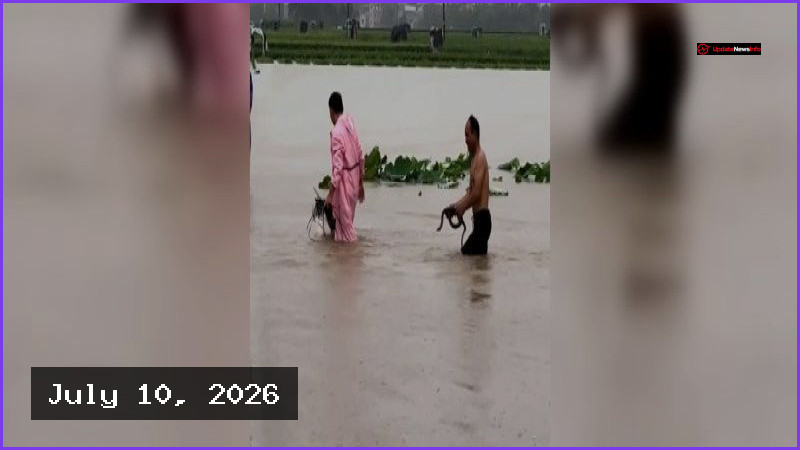
Video posted by state media shows a man chasing after a snake swimming in floodwaters as others stand by, ready to pounce with nets. Ultimately, a man in a bright pink raincoat attempts to dive on the snake before it’s snatched from the water by another man.
Scan the QR code to download the CNN app from the Apple Store.