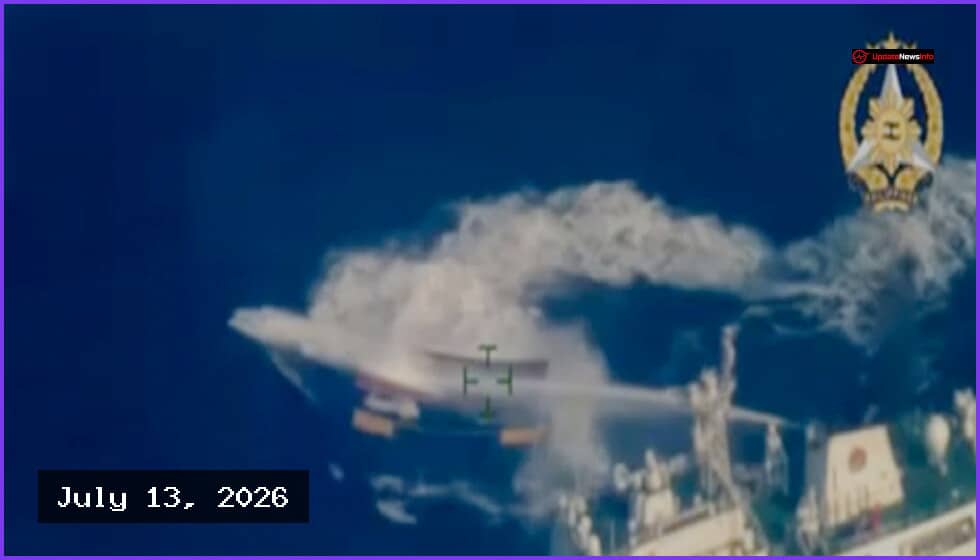
A coalition of 14 nations, including the United States, the United Kingdom, and several Asian and Western partners, formally reasserted on Sunday that China’s expansive territorial claims in the South China Sea lack legal basis. In an image provided by the Armed Forces of the Philippines, a Chinese coast guard ship uses a water cannon on a Philippine resupply vessel, Unaizah May 4, as it approaches Second Thomas Shoal, locally called Ayungin shoal, on March 23, 2024. This collective declaration commemorates the July 12, 2016, arbitration ruling issued by a tribunal in The Hague, which determined the decision is final and legally binding under the United Nations Convention on the Law of the Sea (UNCLOS).
The joint statement from the 14 nations, which also includes the Philippines, Japan, Australia, New Zealand, Canada, Germany, Italy, Estonia, Latvia, Lithuania, Romania, and Slovenia, explicitly rejects destabilizing actions that threaten regional security. In a separate statement, the 27-nation European Union reaffirmed the ruling as a landmark decision for the peaceful settlement of maritime disputes. The signatory countries emphasized their strong opposition to the use of coast guard, military, and maritime militia forces to harass or obstruct lawful operations, noting that such coercion endangers personnel and fishermen.
The 2016 tribunal, established under the 1982 U.N. convention—a treaty ratified by over 170 parties including China and the Philippines—ruled that Beijing had no legal basis for claiming historic rights to resources in the area. China, which refused to participate in the arbitration initiated by the Philippines in 2013, responded on Sunday by reiterating its stance that the ruling is null, void, and holds no binding force. Beijing maintains that it will never accept any claims or solutions imposed through such third-party settlements.
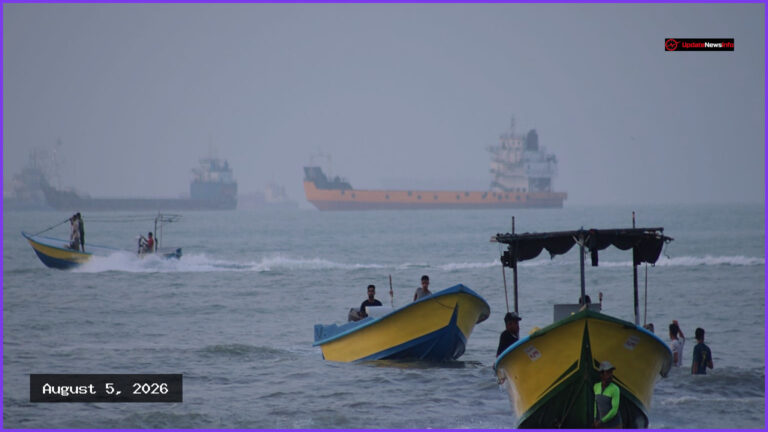
Tensions in the region have escalated significantly in recent years, with frequent standoffs involving Chinese forces against Philippine and Vietnamese vessels. Beijing has been accused of employing dangerous maneuvers, including the use of water cannons, military-grade lasers, and aggressive blocking tactics. While the United States has repeatedly urged China to comply with the 2016 award, the former Biden and current Trump administrations have both warned that Washington remains obligated to defend the Philippines, its oldest treaty ally in Asia, in the event of an armed attack on Filipino forces, vessels, or aircraft in the disputed waters.