Five years after a catastrophic flood devastated Germany's Ahr Valley, the region remains a vast construction site as authorities work to fortify the area against future extreme weather events. The disaster, which occurred on the night of July 14, 2021, remains the worst in living memory for the country. It claimed 135 lives, with the majority of casualties occurring in the town of Bad Neuenahr-Ahrweiler, where 80% of the town was inundated and billions of euros in damage were inflicted on infrastructure and homes.
Alexandra Wiemer, a resident who narrowly escaped the rising waters at 10:30 p.m. that night, recalls water rushing from every direction as the Ahr river—which usually flows gently from the mountains to the Rhine—burst its banks. The region had been hit by a month's worth of rainfall in just two days, creating a torrent that swept away trees, cars, and houses, effectively destroying 16 bridges. The river, which stretches more than 85 kilometers (53 miles), turned from a trickle into a destructive force that tore down infrastructure as it surged toward the Rhine.
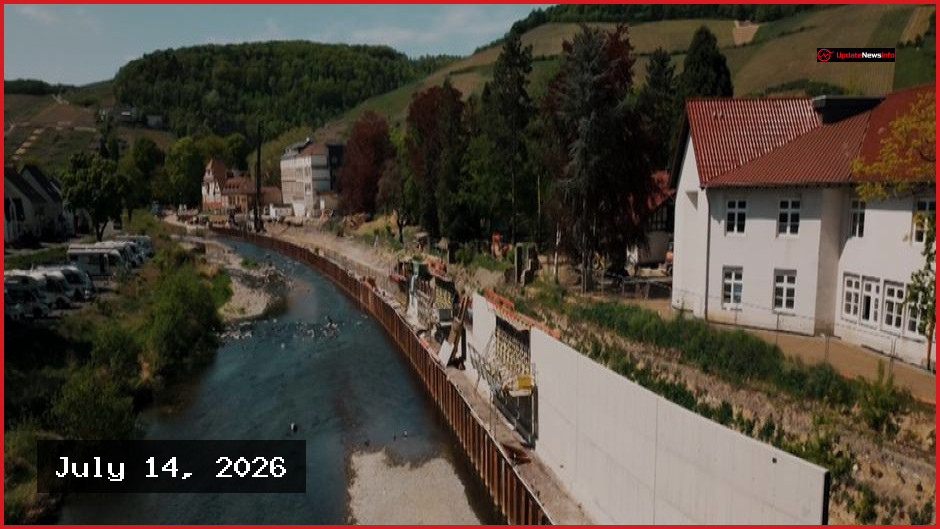
Today, several billion euros in state and federal funding are being funneled into reconstruction. In Bad Neuenahr-Ahrweiler, a new 480-meter-long retaining wall is under construction to protect the historic old town, specifically where the water previously breached the medieval town wall. Hermann-Josef Pelgrim, managing director of the local reconstruction and development corporation, describes the wall as a solid structure featuring bored piles 1.20 meters in diameter driven 15 meters deep. Other safety measures are more subtle but equally effective, such as a new fire station built on underground stilts to prevent collapse and the integration of green spaces with underground drainage trenches to absorb and redirect heavy rainfall.
The 16 bridges destroyed in 2021 are being redesigned. The remains of a five-arch medieval bridge will be left standing as a memorial, while its replacement will feature just one wide arch to allow water and debris to pass safely underneath. Pelgrim explains that the new bridge is engineered not to collapse under any circumstances, even during extreme flooding. However, he notes that preventing future disasters requires a broader, cross-community effort that addresses water flow from upstream, as the responsibility lies with those further up the river.
Historical maps from 220 years ago show the Ahr river once meandered freely across the valley floor in several branches. As human settlement increased, the river was channeled and development encroached on its banks, leaving flood waters with nowhere to go except into built-up and agricultural areas. The town of Altenburg, located a few kilometers upstream, serves as a stark example; water levels there reached more than 7 meters, compared to the regular 70 centimeters, leaving only the top floors of houses visible in aerial photographs from the time.
Waterway restoration coordinator Bruno Büchele is working to return the Ahr to its natural state by reclaiming riverside plots from farmers and private owners to create floodplains, which will be planted with shrubs, trees, and bushes. However, experts acknowledge that technical retention measures are also necessary. Currently, 17 new dams, some as high as 25 meters, are being planned for the Ahr and its tributaries at a projected cost of more than €1.5 billion. These projects follow the success of existing dams near the village of Adenau, which held 40 million liters of water during the 2021 event and prevented disaster in that village. Similar plans proposed after a 1910 flood were previously abandoned in favor of other projects, such as the construction of the Nürburgring racing circuit.
For residents like Wiemer, life continues in the valley, though with increased personal caution. She has since moved to a new home equipped with flood barriers and a stack of sandbags kept near her basement windows. Despite the trauma of 2021, she remains committed to her community. "Because it's nice to live by the water," she says, "and because I'm not afraid. Period."