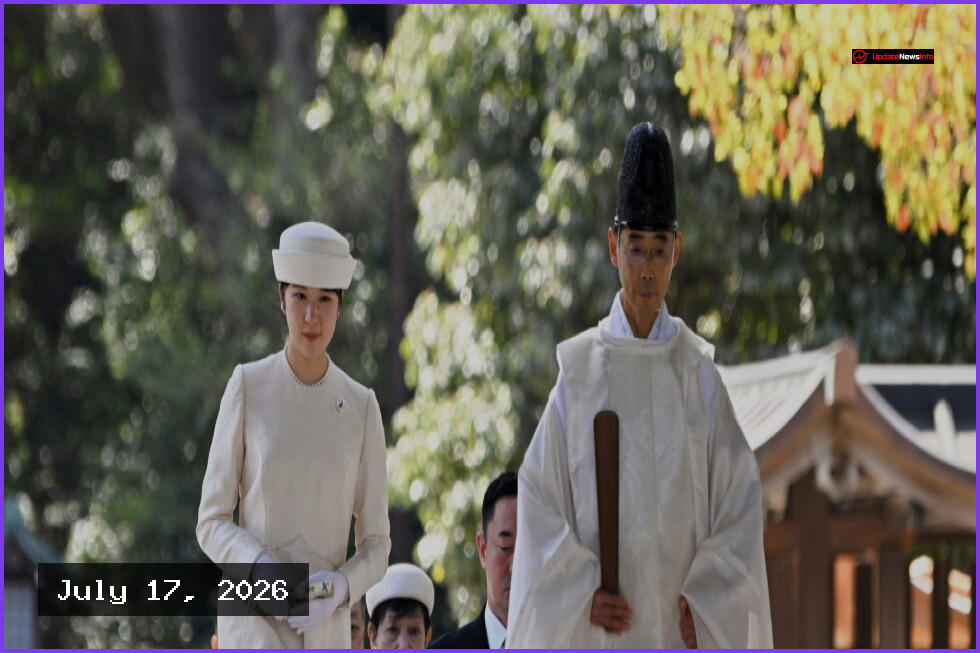
Japan’s parliament has enacted a significant revision to the 19th-century Imperial House Law, formally enshrining the principle of male-only succession to the Chrysanthemum Throne. The legislation, passed on Friday, insists that only paternal-lineage men can become emperor, a decision that has drawn criticism and sparked concerns about the future of the imperial family, which is already facing a dwindling number of members.
The revisions aim to solidify the male bloodline by introducing measures such as allowing the adoption of distant male relatives from former imperial branch families to father future heirs. This provision effectively sidelines Emperor Naruhito’s daughter, Princess Aiko. Additionally, the new law permits princesses to retain their royal status and continue their duties even after marrying commoners, a departure from previous norms.
Prime Minister Sanae Takaichi and other conservative lawmakers have defended the measures, asserting that the male bloodline is “the only source of the emperor’s authority and legitimacy.” Takaichi expressed her deep emotion following the enactment, stating, “I’m deeply moved.”
However, royal watchers and experts express fears that the insistence on male succession could jeopardize the 1,500-year-old hereditary institution. Hideya Kawanishi, an expert on monarchy at Nagoya University, described the move as “a declaration to prevent female monarchs … and to defend the male lineage at all costs.” He added, “They cannot say it’s male chauvinism, so they call it tradition.”
The current Imperial House Law already stipulates that while an emperor’s mother can be a commoner, only boys born to men with royal blood can inherit the throne. The revision seeks to reinforce this by allowing adoption, a measure that has drawn sharp criticism. Feminist scholar Chizuko Ueno, referring to Takaichi, wrote that it is “very ironic that the first female prime minister herself is the leading proponent of the obsession with male succession.” Ueno further criticized the measures, stating they “treat male royals as stallions and put female royals under pressure as ‘childbearing machines’ to produce male offspring.”
The Imperial Household Agency stated that it “will do everything it can appropriately to support smooth activity for the Imperial Family members in line with (the revisions), while fully taking into consideration their feelings.”
Historically, Japan has seen eight female monarchs, the last being Empress Gosakuramachi, who reigned from 1762 to 1770. The paternal-line male succession was first formalized in the 1890 Imperial House Law during a period when Japan promoted patriarchal systems. This principle was largely carried over into the current 1947 version of the law.
The recent revisions have prompted protests from some Japanese citizens who view the government’s efforts as an attempt to prevent Princess Aiko from ruling and to legitimize discrimination against women and a patriarchal system. Princess Aiko, the daughter of Emperor Naruhito and Empress Masako, is popular among the public.
The shrinking imperial family is a significant concern. Emperor Naruhito’s direct male heirs are his brother, Crown Prince Akishino (60), who reportedly feels he would be too old to serve, and Akishino’s son, Prince Hisahito (19). Naruhito’s uncle, Prince Hitachi (90), is third in line. The potential for adoption of distant male relatives, who renounced their royal status in 1947 primarily due to postwar financial burdens, is seen by some as an extraordinary effort to ensure male succession.
These potential adoptees would be at least 36 generations removed from Emperor Naruhito, with their lineage splitting from a common male ancestor 600 years ago, according to Imperial Household Agency official Yoshimi Ogata. Cartoonist Yoshinori Kobayashi questioned the logic, asking, “Who wants the son of an adoptee who nobody knows to be emperor instead of Aiko?”
Critics also point to the difficulty of enticing former royals to rejoin the imperial family, described as “an enclave without human rights,” where individuals cannot choose their jobs or homes and face severe constraints. Asahiro Kuni, 81, whose family renounced its royal status when he was three, expressed doubt that anyone would volunteer. “I imagine many people, by age 15, have some idea about their future. It’s cruel to tell them … to change the course of their life.” Kuni, a former engineer, stated he would advise his family to decline such an offer, emphasizing the immense sacrifice required.
The pressure to produce male heirs is expected to be immense for Prince Hisahito, potential adoptees, and their future wives, according to Kawanishi. Some observers, like sushi chain founder Junichiro Tsujimaru (78), question why women cannot serve as emperor, given the emperor’s symbolic role. Yoshio Iwase (78) believes Princess Aiko is the legitimate successor, noting the historical precedent of female emperors.
There is also concern that the government’s push for male succession may undermine the legacy of former Emperor Akihito. Akihito, who abdicated in 2019, worked to make the monarchy more accessible to the public and made amends for victims of World War II. He reportedly supports Princess Aiko’s succession and, in remarks interpreted as support for female monarchs, highlighted the significant role female royals play and the monarchy's duty to work for the people's happiness.
Emperor Naruhito himself expressed hope in June that discussions about the measures would reach a conclusion that “will gain understanding of the people,” a comment seen by palace watchers as indicating nuanced displeasure.
In a separate development on Friday, Japan also enacted a controversial new law prohibiting the desecration of its national flag, a legislative push by Takaichi that opponents view as an attempt to stifle criticism.
A government proposal in 2005 to allow female monarchs was scrapped following Hisahito’s birth.
“I wonder if anyone would raise a hand,” 81-year-old Asahiro Kuni, whose family renounced its royal status when he was 3, told TBS television. “I imagine many people, by age 15, have some idea about their future. It’s cruel to tell them … to change the course of their life.”