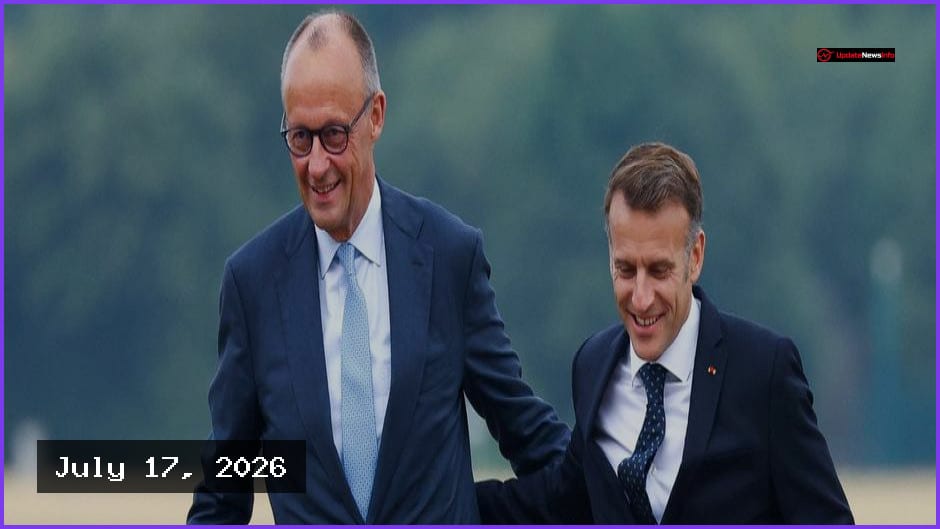
Chancellor Friedrich Merz and President Emmanuel Macron dedicated this week to showcasing a deeply unified Franco-German partnership, holding a total of four meetings alongside several joint ministerial sessions. This display of unity is widely viewed as a strategic response to the shared fear that the next French president could be nationalist Marine Le Pen. The intensity of their engagement this week marks a high point in the bilateral relationship, underscored by highly symbolic gestures and substantive policy discussions.
The venue chosen for their meeting on Friday was particularly significant: Augustusburg Palace in Brühl, western Germany. This location holds deep historical weight, as it was where President Charles de Gaulle and Chancellor Konrad Adenauer laid the foundation for the modern Franco-German partnership in 1962. Further emphasizing this renewed closeness, Chancellor Merz participated in the parade on France's National Day, July 14, in Paris. This appearance was notable as the first time a German chancellor had attended the event since Angela Merkel in 2019. German government spokesperson Steffen Meyer addressed the visit beforehand, describing it as a personal honor for the chancellor. Meyer also dismissed ongoing speculation regarding a cooling of relations between the two leaders, stating, "There is absolutely no question of a cooling of relations; on the contrary, the relationship is very good, and we are continuing to work to ensure that it stays that way."
Despite these public displays of harmony, experts caution that the relationship remains complex and demanding. Stefan Seidendorf, deputy director of the German-French Institute in Ludwigsburg, noted that the period since Merz took office has revealed significant differences between the two nations. "This cooperation is not a sure thing — rather, it requires hard work," Seidendorf told DW. These differences are evident in areas such as energy policy, where Germany’s phase-out of nuclear power contrasts sharply with France's pro-nuclear stance, as well as in ongoing debates regarding European fiscal policy.
Nevertheless, cooperation is intensifying in the realm of nuclear deterrence. There is a growing perception in Berlin that the United States' nuclear protection is becoming increasingly unreliable. Consequently, for the first time ever, German troops are expected to participate in a French nuclear exercise this fall. This year's Bastille Day parade, the largest since Macron took office in 2017, was held under the theme of "Europe's strategic awakening." Through this theme, Macron aimed to signal strong support for continued aid to Ukraine and to foster greater European self-confidence in the face of the United States under Donald Trump.
Regarding the ongoing war in Ukraine, Germany has now agreed to participate in the first military exercises of the so-called "coalition of the willing." This group, consisting of approximately 35 countries, aims to support Ukraine in the event of a ceasefire with Russia, with the first exercises scheduled to take place in Poland. This commitment follows a period of initial hesitation from the German government.
Recent weeks have also seen negative developments in Franco-German relations, particularly concerning the failure of major defense projects. The joint FCAS fighter jet project has been officially scrapped, and the MGCS tank project appears to be in jeopardy, with the German company Rheinmetall calling the project into question. Looming over these challenges is the political future of France. In early July, right-wing populist Marine Le Pen announced her candidacy for the presidential election in the spring of 2027, a race in which Macron is no longer eligible to run. While Le Pen has lost to Macron in two previous runoffs, some polls suggest she now has a genuine chance of winning. The German government views a potential Le Pen victory as a nightmare, fearing her commitment to nationalism over European integration.
Jacob Ross, a France expert at the German Council on Foreign Relations, warned that a Le Pen victory would cause an immediate loss of trust in government administrations and political cooperation, leading to a breakdown in many areas where collaboration currently functions organically. However, Ross does not believe this would necessarily end the Franco-German Friendship Treaty. He suggested it would serve as a severe stress test for the treaty and European integration, though he did not rule out the possibility that a certain pragmatism might take hold if the National Rally were forced to assume the responsibilities of government. Stefan Seidendorf added that because the relationship extends far beyond politics into business, civil society, and student exchanges, preparations are already underway in Berlin for such a worst-case scenario.