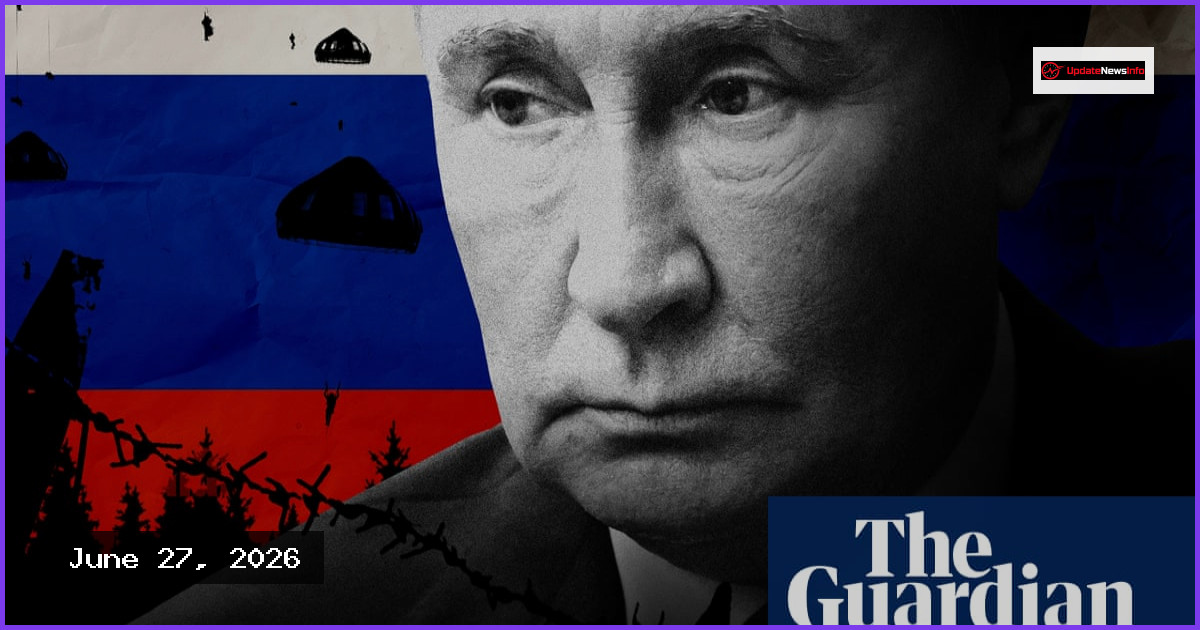
A nightmare scenario has occupied the minds of eastern European leaders with increasing intensity since Donald Trump began his second term in the White House: what happens if Russia attacks and the United States refuses to join the fight? When the question arises publicly, the answers remain evasive. In mid-May, during a gathering in Tallinn, US undersecretary of state Thomas DiNanno was directly asked if American forces would fight to defend the Baltic states if Russia invaded. He responded with a meandering explanation that conspicuously avoided the word “yes.”
Politicians in the region typically attempt to maintain a facade of stability in public, insisting that Washington’s commitment to Nato remains robust despite the alarming rhetoric from the Trump administration. “We shouldn’t pour fuel on the fire,” is a common sentiment expressed by ministers across the eastern flank, where geographic proximity to Russia intensifies security anxieties. However, others acknowledge the strain in the relationship, with former Lithuanian defence minister Dovilė Šakalienė comparing the alliance to a “dysfunctional family where divorce is not an option.” In private, leaders are now openly questioning how they might respond if the US failed to show up, and whether Vladimir Putin might view this internal unease as an opportune moment to test the alliance’s resolve.
This shift in sentiment—from cautious approval of Trump’s demands for higher European defence spending to profound doubts regarding US commitment—has unfolded over the 18 months since he reclaimed the presidency. Eastern Europe, which has been fiercely pro-American since the collapse of communism, joined Nato in 1999 and 2004, and these nations have relied on US security guarantees as a cornerstone of their defense. Now, they face the unsettling possibility of abandonment by their primary ally. One senior official described the mood as “bemused disillusionment,” comparing the situation to watching a beloved father figure act in an incomprehensible, erratic manner.
The first clear warning came in February 2025, less than a month into Trump’s second term, when US defence secretary Pete Hegseth visited Nato headquarters in Brussels. He told allies that with China on the rise, European security was no longer a priority for Washington. Hegseth insisted that Europe must pay for its own defence, claiming that “values” are not enough to deter aggression. This was followed by a brief but alarming halt in intelligence-sharing with Ukraine, which left leaders like Polish Prime Minister Donald Tusk feeling as though the ground were shifting beneath their feet. Even after the cutoff was reversed, the incident demonstrated that established diplomatic boundaries no longer existed.
Subsequent months saw leaders like Mark Rutte, the Dutch secretary general of Nato, working to keep Trump engaged. During a summit in The Hague, member states committed to raising defence spending to 5% of gross domestic product by 2035—a level already neared by Poland and the Baltic states. While Rutte’s efforts to keep Trump satisfied were effective, they were often viewed as distasteful, with some officials calling his behavior “cringe.” Yet, the problem remains that Trump’s promises are often undermined by his unpredictable social media posts. As Artis Pabriks, a former Latvian defence and foreign minister, noted regarding the change from the administration’s 1.0 era, communication has become nearly impossible: “We can’t get to deliver our message, we cannot predict, we cannot talk.”
Tensions reached a high point in September when 20 Russian drones entered Polish airspace. While US commander Alexus Grynkewich helped coordinate with Polish officials to shoot down the drones using Dutch F-35s and Polish F-16s, Trump downplayed the incident as a series of “mistakes.” Polish foreign minister Radosław Sikorski publicly rebuked this, stating that 19 drones straying off course over seven hours was impossible to believe as an accident. Further instability followed when Trump threatened to annex Greenland from Denmark, and later, when the US suddenly canceled a deployment of 4,000 troops to Poland, only to reverse the decision later based on personal political ties.
As leaders prepare for the upcoming Nato summit in Ankara, the alliance remains under pressure. Hegseth recently announced a six-month review of US force posture, threatening to lower financial contributions if others do not meet targets. While eastern flank countries generally meet these goals, the combative tone threatens the foundations of the alliance. For now, most leaders continue to avoid public confrontation with Trump, fearing it would only accelerate US withdrawal. As Dr. Kristi Raik, an Estonian thinktank leader, pointed out, this self-censorship is the highest she has seen since the Soviet period. Ultimately, as long as Trump is in the White House, the alliance remains in a state of ambiguity, which Jana Puglierin describes as “Schrödinger’s Nato”—a relationship whose true status will remain unknown until the moment it is finally tested on the battlefield.