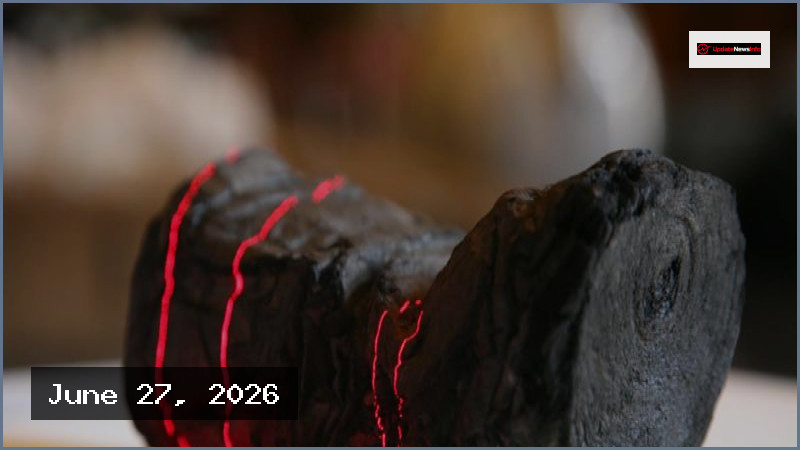
A papyrus scroll that was scorched and carbonized during the eruption of Mount Vesuvius nearly 2,000 years ago has been virtually unrolled and partially deciphered with the aid of artificial intelligence. Known as PHerc. 1667, the scroll is among hundreds originating from the Roman town of Herculaneum. The town was buried under volcanic debris during the 79 AD eruption, and these artifacts are now the focus of the Vesuvius Challenge, a project aimed at decoding texts without the risk of physically unrolling the fragile remains.
These scrolls were preserved in a villa, believed to be the residence of Julius Caesar’s father-in-law, until an Italian farmer discovered them in the 18th century. This collection remains the only large-scale library known to have survived from classical antiquity. Because the scrolls are carbonized and fragile, past attempts by scholars to open them via weights, chemicals, gases, and pulverization often resulted in their destruction. To solve this, Brent Seales, a professor of computer science at the University of Kentucky, teamed up with entrepreneurs Nat Friedman and Daniel Gross in 2023 to launch the Vesuvius Challenge, inviting researchers globally to use virtual unwrapping techniques.
Virtual unwrapping involves CT scanning the coiled, warped papyrus before using advanced artificial intelligence trained to identify ink. During a recent conference in Naples, Italy, researchers announced a major breakthrough: for the first time, they successfully unwrapped an entire scroll, revealing almost 1.5 meters (4.9 feet) of text across 20 columns. Brent Seales stated that after years of interdisciplinary work involving imaging and AI, these texts are finally readable. Federica Nicolardi, an assistant professor of papyrology at the University of Naples Federico II, led the team in creating machine learning models to interpret the contents. Nicolardi noted that in the 1980s, this specific scroll was deemed unreadable and assigned a readability score of zero, but virtual unwrapping has enabled the team to track sustained arguments.
The artifact is approximately 8 centimeters (3.2 inches) in height and 2 centimeters (0.8 inches) in diameter. While it was mostly intact when discovered, previous efforts to unfurl it had damaged the scroll. Handwriting analysis suggests the document dates from the second century BC or possibly the late third century BC. The text appears to be a philosophical exploration of arts, ethics, and human behavior, likely reflecting Stoic thought. It discusses the Stoic concept of “horme,” or impulse, warning that failing to regulate one’s behavior can lead to harmful passions. The text also highlights “phronesis,” or practical wisdom, and includes the passage: “We will inquire into something, but we will not grasp it, if in some way we depart from ourselves and from our own nature.”
In addition to PHerc. 1667, the team identified text within the charred layers of another scroll, PHerc. 139. Researchers decoded the words “Philodemus, On Gods, Book 8,” proving that the Greek philosopher’s series on the gods consisted of at least eight books, rather than just the one previously known. These findings build upon earlier milestones from the Vesuvius Challenge, such as the 2023 deciphering of the scroll “On Vices” (PHerc. 172) and the initial decoding of a full word using AI. Seales believes the project has reached a turning point where, beyond imaging and machine learning, experts are now needed to edit and understand the recovered texts.