A significant historical dispute has reignited, posing a threat to the vital wartime alliance between Ukraine and Poland, one of its most dedicated supporters. Poland asserts it is taking a firm stance regarding a bloody massacre, while Ukraine views this as an unnecessary affront to a nation fighting for its survival.
The conflict between Warsaw and Kyiv emerges as Europe renews efforts with the United States to pressure Moscow into ending the war. Officials on the continent have warned that the tensions between these neighbors could play into the hands of President Vladimir Putin.
The dispute escalated into a full-blown crisis when President Karol Nawrocki decided earlier this month to strip Ukrainian President Volodymyr Zelenskyy of Poland’s highest honor. This led to Zelenskyy skipping a significant wartime conference in Poland that commenced on Thursday.
At the heart of the disagreement is the Ukrainian Insurgent Army (UPA). Poland accuses the UPA of carrying out mass killings during World War II. Conversely, some in Ukraine regard the UPA as nationalist heroes for their resistance against both Soviet and Nazi forces. Zelenskyy’s decision to name a military unit after the UPA provoked outrage in Warsaw, which had already begun to show signs of war fatigue due to the influx of refugees and the economic strain of supporting Ukraine’s defense.
The timing of this dispute risks sidelining Poland and excluding it from the Ukraine peace process, according to Ukrainian lawmaker Mykola Kniazhytskyi. Kniazhytskyi, who co-chairs the Ukraine-Poland Interparliamentary Group, spoke with NBC News by phone from a conference in Gdansk focused on postwar reconstruction.
“Obviously, there is nothing good about this,” he stated.
Nawrocki stated in a detailed release last week that the decision to revoke Zelenskyy’s honor was not directed against the Ukrainian people and that Poland’s support would continue. He added, “because we know that Russian aggression poses a threat to the security of Poland and all of Europe.”
Poles welcomed millions of Ukrainian refugees fleeing Russia’s invasion in early 2022. Poland, a NATO member, has consistently provided military support to Ukraine and advocated for its deeper integration into the European community. However, Nawrocki believes that Ukraine’s path toward E.U. membership necessitates a “willingness to honestly confront the difficult chapters of its own history.”
A prominent opposition leader in Poland’s right-wing political spectrum went further, urging the government to block Ukraine’s accession to the European Union, just weeks after the initial phase of membership talks received approval.
Warsaw serves as a critical logistical hub for Western weapons destined for Ukraine and acts as an important mediator in Ukraine’s dealings with Europe. A shift away from this role “will lead to a lot of problems for Ukraine,” Kniazhytskyi commented.
Both sides accuse each other of exploiting the issue for domestic political gain. Polish officials suggest Zelenskyy aims to divert attention from corruption scandals, while the Ukrainian leader has implied that his counterpart in Warsaw is focused on upcoming elections.
However, Nawrocki maintains that he cannot overlook historical injustices simply because they are currently inconvenient.
“Facts are not subject to negotiation; they do not change with political circumstances or necessities,” Nawrocki asserted.
Poland contends that UPA members massacred approximately 100,000 Polish villagers in the Volhynia region, which is now part of northwestern Ukraine, between 1943 and 1945. Poland officially recognizes these events as genocide. Thousands of Ukrainians also perished in retaliatory killings.
Zbigniew Wojnowski, a historian at the University of Oxford specializing in Ukrainian and Soviet history, described the UPA’s actions in Volhynia as “very brutal ethnic cleansing.” He explained that the perception of the group in contemporary Ukraine is largely shaped by subsequent events—the protracted and difficult struggle against the Soviets that extended into the 1950s. Wojnowski noted, “It’s highlighted in Ukrainian public memory as a way of boosting morale in the current war against Russia.”
The Ukrainian Institute of National Remembrance, an entity overseen by Ukraine’s prime minister, does not categorize the killings as massacres. Instead, it refers to them as a “tragic page” in the shared history of both nations and part of the “Ukrainian-Polish confrontation.”
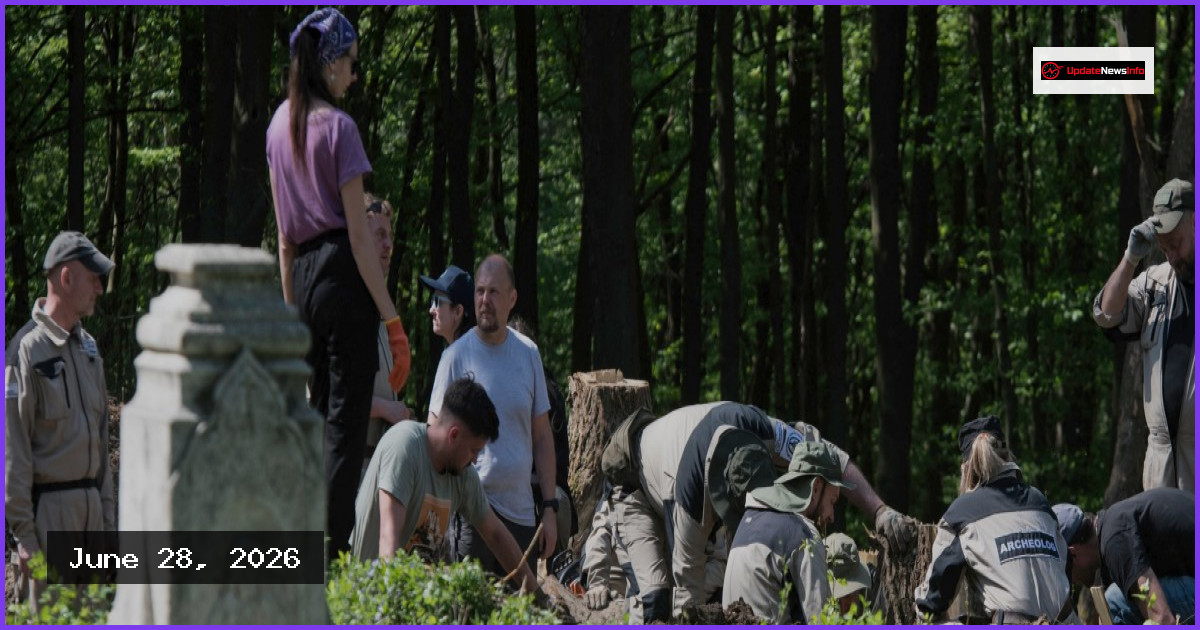
Wojnowski suggested that these conflicting interpretations stem from the “unprocessed trauma” of the massacres for both Poles and Ukrainians. He added that despite ongoing exhumation efforts to honor the victims, the full scope and political context preceding the killings are not well understood by either side, contributing to these persistent divisions.
When asked if Ukraine and Poland were no longer friends, Zelenskyy responded to Ukrainian television earlier this week, stating, “Ukraine and Poland cannot be anything but partners and friends because we are neighbors.” He affirmed that Ukraine is open about its history and pointed out that Ukrainian soldiers are currently defending Poland against Russia, not the other way around.
Zelenskyy mentioned that the soldiers themselves requested he rename their unit in honor of the “heroes of UPA,” and he fully supported their request. The day after Nawrocki announced his decision to revoke the Polish honor, Zelenskyy shared images of the blue-ribboned award, adorned with an encrusted eagle, being returned to Poland.
Polish Prime Minister Donald Tusk, a political opponent of Nawrocki and a strong supporter of Kyiv, has urged both leaders to “calm emotions” and avoid escalating tensions. “The front line runs elsewhere,” Tusk posted on X.
“There is only one happy observer in this type of situation, and that’s the aggressor in Ukraine, so we shouldn’t be playing into their hands,” said Paula Pinho, a spokesperson for the European Commission.
Moscow has long characterized UPA fighters as murderers and Nazi collaborators. Russia has also falsely accused Zelenskyy of inheriting this legacy and claimed his government is overrun by Nazis, using this as a pretext for its full-scale invasion.
When questioned by NBC News about the feud, Kremlin spokesman Dmitry Peskov echoed this rhetoric, stating that “Nazis are glorified” in Ukraine. “The Poles are very unhappy about that on the one hand. On the other hand, they are planning to rebuild Ukraine that glorifies those Nazis. It is a paradoxical situation,” Peskov remarked.
Russian war proponents have celebrated the dispute online, while Foreign Ministry spokeswoman Maria Zakharova mockingly referred to it as a shameful episode for both Poland and Ukraine, involving a “shower of awards” being returned to Warsaw.
Lawmaker Kniazhytskyi stated unequivocally that Russia is weaponizing this spat. “Unfortunately, it relies on the unpreparedness of both Polish and Ukrainian societies to tell themselves and their neighbors all the truth about what happened.”