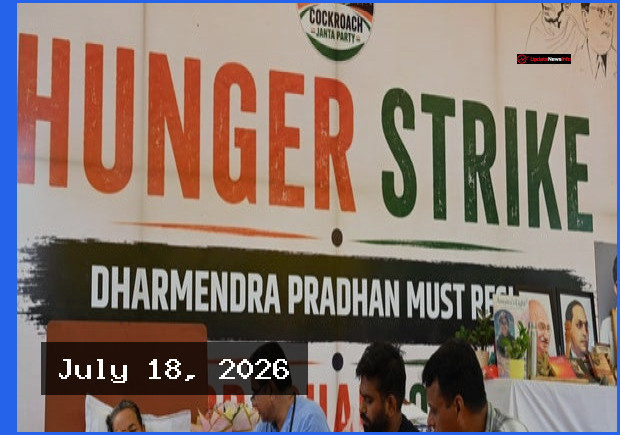
Concerns are growing for the health of prominent Indian education activist Sonam Wangchuk, who has been on a hunger strike for 20 days, surviving only on salt water amidst sweltering heat. The 59-year-old activist has joined a sit-in protest organized by the satirical Cockroach Janta Party (CJP) to demand significant reforms in India's education system.
Wangchuk's protest and hunger strike were initiated following the cancellation of a crucial entrance exam for aspiring doctors due to a paper leak, which affected millions of students. Doctors attending to Wangchuk have warned that his condition has become critical, with a loss of approximately 21 pounds and the potential for organ damage if the strike continues.
The Delhi High Court has intervened, requesting the government to monitor Wangchuk's health closely and provide necessary medical treatment. The protest site, Jantar Mantar, Delhi's designated space for demonstrations, has seen the CJP, which began as an online satirical movement, launch its first real-world protest.
The CJP's origins trace back to May, stemming from a satirical response to remarks allegedly made by the country's chief justice, Surya Kant, who was reported to have referred to unemployed youth as "cockroaches" and "parasites." While Delhi Police have granted permits for demonstrations at Jantar Mantar, they have denied permits elsewhere to prevent disruptions.
As of Friday, July 17, 2026, the government had not yet engaged with the protesters or addressed their demands, which include the resignation of Federal Education Minister Dharmendra Pradhan and systemic changes to ensure transparency in national medical and engineering exams. Wangchuk, along with Abhijeet Dipke, the CJP founder and a Boston University student leading the protest, plans to march towards the Indian parliament on July 20 with other demonstrators.
Wangchuk, known for his work in Ladakh, has stated his resolve to continue the fast. "I am weak from the outside but very strong inside… I will stay alive till July 20 at any cost. If you don't come and July 20 is not successful, I will come back as a ghost," he told fellow protesters on Friday. He began his fast on June 28.
Leaders from India's opposition, the Indian National Congress (INC), have urged Prime Minister Narendra Modi's government to engage with the protesters. Congress leader Kumari Selja highlighted that repeated exam paper leaks and insufficient action have eroded student confidence in the examination system. Sanjay Raut, a Member of Parliament from the Shiv Sena party, criticized the government's perceived insensitivity, questioning if such reports reached the Prime Minister, Home Minister, or President Droupadi Murmu.
Bollywood celebrities, including Aamir Khan and Sonakshi Sinha, have voiced support for Wangchuk and expressed concern over his health. Sinha shared a video on Instagram, questioning the lack of response and dialogue, asking, "When is it going to be enough? Will you get up when this man dies? And whose responsibility will that be?"
Wangchuk is a recognized engineer and activist from Ladakh, known for developing artificial glaciers, or "ice stupas," to aid irrigation. He was instrumental in pushing for regional education reforms in Ladakh and received the Ramon Magsaysay Award in 2018 for his contributions to education and climate change efforts.
This is not Wangchuk's first hunger strike. In 2024, he undertook two previous fasts: one for 21 days demanding legal protection for Ladakh's ecosystem and tribal lands, and another seeking statehood for the region. Previously, he was detained under the National Security Act (NSA) during a protest for Ladakh's statehood and spent 170 days in jail before his release in March.