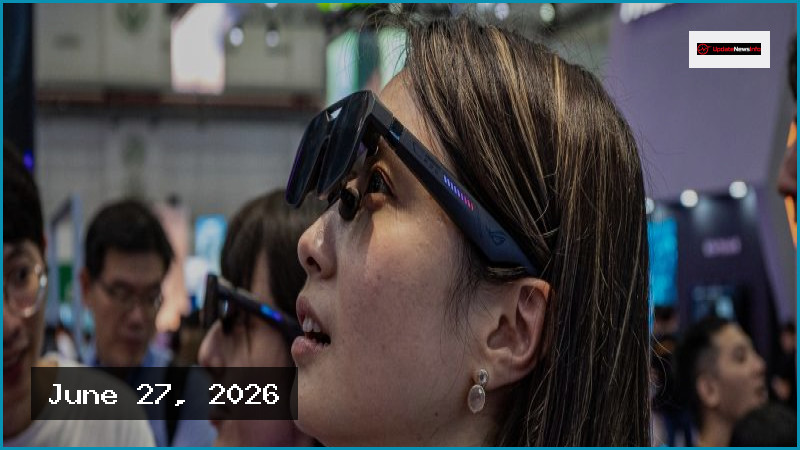
Throughout the history of formal education, students have sought various ways to gain an edge during tests, from concealing notes to copying from peers. However, as pressure for top grades intensifies, a new generation of learners is utilizing AI-integrated smart glasses to bypass traditional security measures. In East Asia, where academic performance is intrinsically linked to career prospects and social mobility, schools and administrators are urgently trying to address this technological threat.
Recent instances in South Korea highlight this emerging challenge, as individuals were caught using these devices twice last month during English language proficiency tests. Similarly, a student attempting an entrance exam for a prestigious medical program in Taiwan was discovered when proctors noticed the suspect staring fixedly at the test papers, an inspection revealing that the frames of their glasses were emitting heat.
While the use of wearable technology in cheating is not a brand-new phenomenon, the increasing affordability and sophistication of AI-enabled devices are forcing a shift in how educational institutions handle evaluation. Authorities are currently scaling up screening protocols. During China’s recent annual college entrance exam, which draws over 10 million participants, officials mandated the inspection of all eyewear. Simultaneously, officials in the United Kingdom have warned that such wearable devices, including earpieces, pose a rising risk to examination integrity.
South Korean officials are now consulting with the Education Ministry regarding new preventive measures, as these devices are already strictly prohibited in testing centers. In Taiwan, the institution involved in the recent cheating case is currently updating its standard operating procedures. Experts warn that reported incidents likely represent only a fraction of actual cases. Thomas Corbin, a lecturer at Australia’s Deakin University, emphasized that as these gadgets become slimmer and more discreet, they threaten the very reliability of modern testing.
The growth of the wearable AI market, with millions of units sold annually, suggests that this technology is rapidly moving into the mainstream. A controlled experiment conducted by Assistant Professor Meng Zili at the Hong Kong University of Science and Technology demonstrated just how effective these tools can be. By allowing an AI model to analyze exam questions, the glasses enabled a student-like performance that placed the test result in the top five of a 100-student class, far exceeding the average score of 72.
Professors like Zhang Jun and Kong Siu Cheung argue that while the disruption is significant, banning technology is not a sustainable long-term solution. Instead, they suggest that educational systems must evolve to focus on developing students’ critical thinking and metacognition. The consensus among these experts is that education needs to adapt to a world where AI is readily available, rather than simply attempting to block its presence in the classroom.