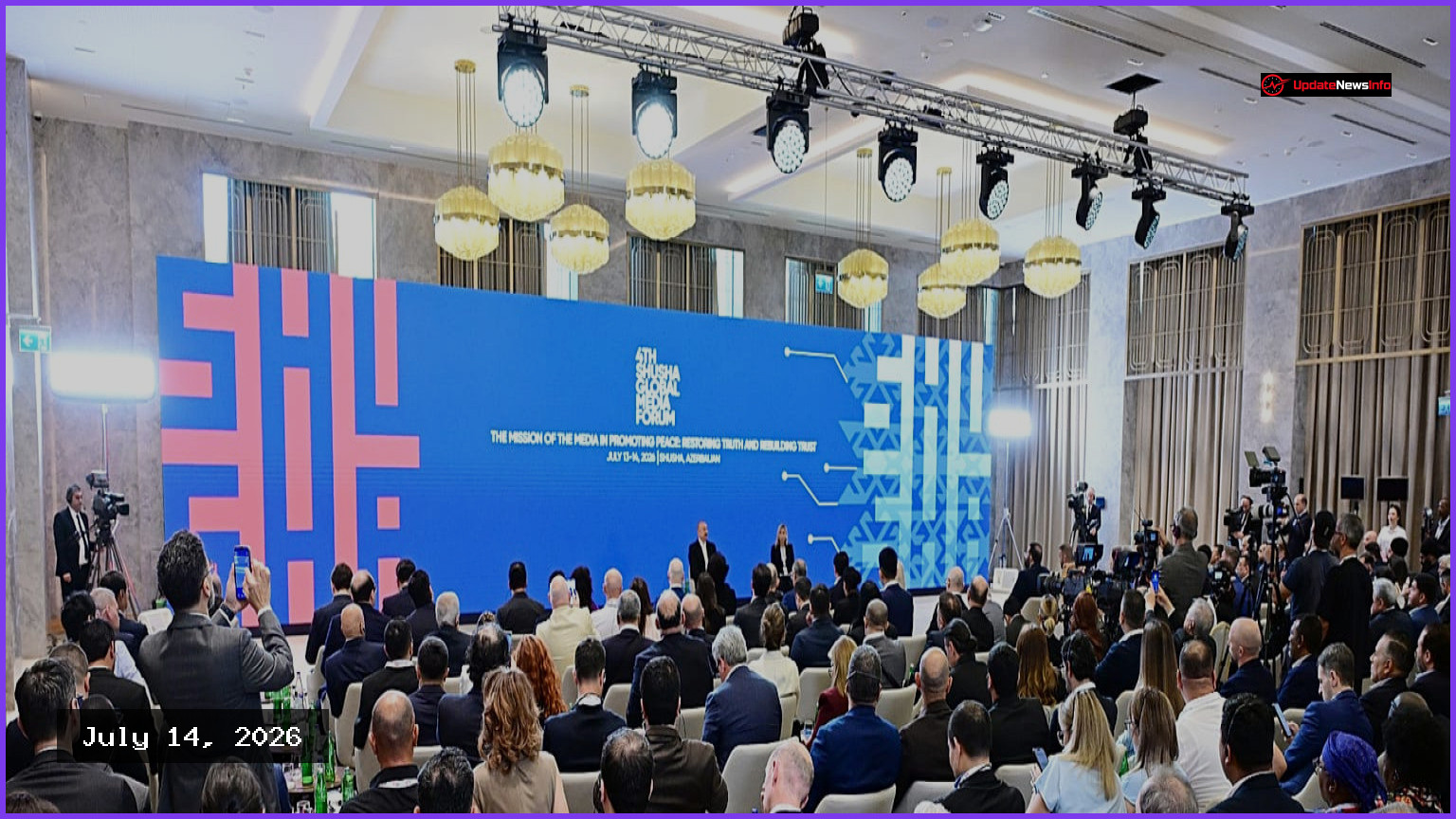
Azerbaijan is situated between two of the world’s most active war zones, yet President Ilham Aliyev told an audience of global media professionals on Monday that he remains convinced peace is achievable. During his opening remarks at the Shusha Global Media Forum, Aliyev stated, “We believe peace is possible.” He argued that for peace to be lasting, it must be fair, just, and strictly based on international law rather than the personal ambitions or agendas of specific actors.
Addressing the regional climate, he issued an appeal for restraint, urging neighbors to act responsibly, normalize relations, and avoid further escalation of current conflicts.
Beyond regional security, Aliyev highlighted the growing strategic importance of Azerbaijan’s transport and connectivity corridors. He noted that instability in the Middle East has rendered these routes increasingly attractive to international partners. This connectivity is tied to Azerbaijan's expanding energy strategy, which now includes supplying natural gas to Germany and Austria as of this year.
According to the President, Azerbaijan currently provides pipeline gas to 16 countries, 14 of which are located in Europe, with ongoing negotiations to supply additional European Union member states. He claimed, “We are number one in the world with this geography of supplying gas by pipeline.”
However, Aliyev cautioned that future growth depends on significant investment in transport infrastructure and greater certainty from European partners. He emphasized the necessity of long-term contracts to justify the large-scale investments required to increase production.
He questioned the viability of such investments if European partners might abruptly terminate agreements, stating, “If at a certain point we will be told that, ‘Thank you, goodbye, we don’t need you guys any longer,’ then what are we going to do?”
The President also addressed Azerbaijan's relationship with the Parliamentary Assembly, confirming that the nation is considering leaving the structure. He noted that the organization’s secretary general had personally requested he reconsider, but Aliyev maintained that Azerbaijan would only return if its delegation’s voting rights were restored.
“We have not taken any wrong steps,” he asserted, adding that the organization must acknowledge its unjust decision and step back.
The forum, held under the theme “The Mission of the Media in Promoting Peace: Restoring Truth and Rebuilding Trust,” also featured perspectives from various international figures. Sohail Mahmood, Secretary General of the D-8 Organisation for Economic Cooperation, stressed that reporting with responsibility is increasingly vital, noting that “credibility remains uppermost in people’s minds” as audiences navigate a crowded information environment.
Dr. Zaid AlNawaiseh, Secretary General of Jordan’s Ministry of Government Communication, characterized the media as “soft power” and an essential instrument of diplomacy. He argued that the media must act as a bridge to peace, with a mission to shed light on the truth.
Disinformation was a recurring theme throughout the event, with experts and policymakers debating the challenges of navigating truth in the 21st century. Leon Cook, founder of the London-based strategic communications consultancy Atticus Partners, described disinformation as the key challenge of the era, noting that media serves as both a problem and a solution.
The Shusha Global Media Forum continues until Tuesday, with participants discussing how journalism can respond to conflict, counter the influence of artificial intelligence, and rebuild public confidence in an era where information is a critical element of international affairs.
Drawing on Azerbaijan’s own experience, he said lasting peace could only be achieved through respect for international law.