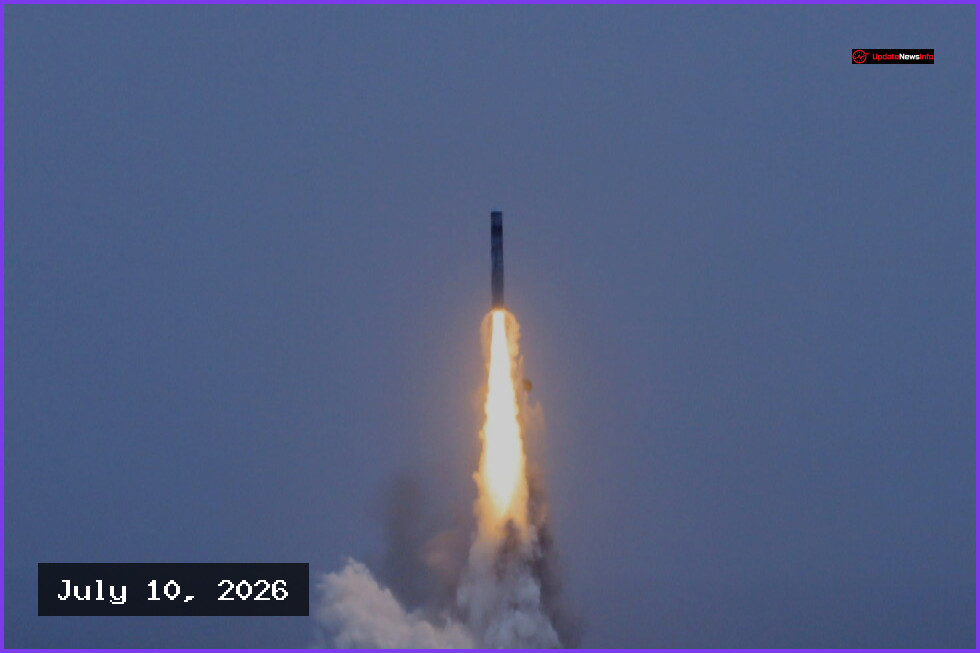
China conducted a rare test of a nuclear-capable weapons system on Monday, July 6, 2026, launching a ballistic missile into the South Pacific Ocean. This event, which drew international rebuke, is largely interpreted by experts as a significant message directed at the United States.
The test, originating from a nuclear-powered submarine, served as a demonstration of the sea-based component of China’s nuclear triad capability, which encompasses land, sea, and air-based nuclear systems. According to Tong Zhao, a senior fellow with the Nuclear Policy Program at the Carnegie Endowment for International Peace, the launch underscored that the People’s Liberation Army (PLA) is evolving into a formidable military force with robust strategic nuclear capabilities. Dominic Meagher, a research fellow at the Crawford School of Public Policy in Australia, added that the test also showcased China’s second-strike capability, indicating its ability to retaliate even after an initial attack.
This launch follows a similar missile test in international Pacific waters two years prior. Beijing stated that the recent launch was part of its annual exercises, suggesting that such tests may occur again. K. Tristan Tang, a Nonresident Fellow at the National Bureau of Asian Research, described it as a systematic rather than an isolated event. The missile testing coincides with China’s accelerated efforts to build more nuclear-powered submarines, outpacing the U.S. in the past five years, as reported by the International Institute for Strategic Studies.
The use of international waters, particularly those protected by treaties prohibiting nuclear testing, sparked criticism from regional countries. The South Pacific Ocean is a contested area, valued for its strategic importance, fisheries, and mineral resources. For Pacific nations, nuclear testing evokes painful historical memories, recalling environmental contamination and health issues like cancers and birth defects caused by past nuclear detonations by the U.S., the U.K., and France in the region.
Monday’s missile landed within the South Pacific Nuclear Free Zone, established by the 1986 Rarotonga accord, which bans nuclear weapons in the region. China ratified the protocols in 1987, committing not to test nuclear weapons within the zone or threaten their use against signatory nations. While U.S. forces also conduct nuclear missile testing in the Pacific, they reportedly avoid this treaty area.
Solomon Islands Prime Minister Matthew Wale, speaking in Honiara on Tuesday, expressed his disapproval, stating, “China is a good friend of Solomon Islands, but this is not something a friend does. This is not … good in our region.” Australia and New Zealand voiced concerns over insufficient prior notice, while Japan criticized the lack of transparency. Australian Prime Minister Albanese, also in Honiara for talks, condemned the launch as “a provocative act by China which does destabilize the region,” highlighting the concern over the very short notice.
China’s Defense Ministry, in a statement issued Tuesday, defended its actions, asserting that it provided appropriate advance notice to relevant countries, demonstrating the Chinese military’s openness and transparency. Experts note that the Hague Code of Conduct, which recommends at least 24 hours’ notice for ballistic missile launches, is not legally binding, and China is not a member.
Speculation persists regarding the specific missile type. Taiwan’s National Security Council stated on Wednesday that it was a JL-2 missile launched from waters off Guangdong, a southern Chinese province. However, Chinese state media, citing military experts like Shao Yonglin, suggested it was likely a JL-3, a newer missile with a longer range capable of striking targets across the Pacific. As China’s military power grows, experts like Tong Zhao argue it should face the same international scrutiny and standards applied to countries such as the U.S., U.K., and France.
Spectators wave Chinese flags as military vehicles carrying JL-2 submarine-launched missiles roll during a parade to commemorate the 70th anniversary of the founding of Communist China in Beijing, Oct. 1, 2019. (AP Photo/Mark Schiefelbein, File)
Much speculation remains around what was fired and when.