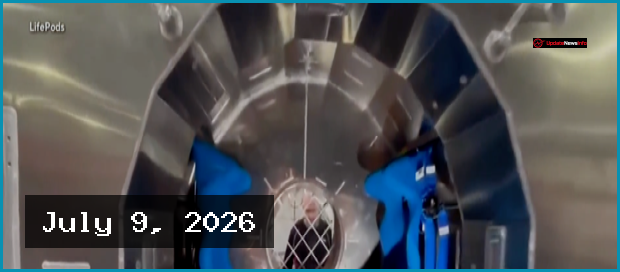
A French startup company, LifePods, recently debuted a prototype for a survival device engineered to protect individuals during tsunamis and severe flooding events, as reported on July 9, 2026, at 9:36 AM EDT. The prototype, known as the W-01, was unveiled at a technology conference held in Paris earlier this month. According to the company, the device serves as a last-chance refuge intended for situations where traditional evacuation is no longer viable.
CEO Cedric Choffat noted that the inspiration for the project stemmed from the aftermath of historic disasters, including the 2004 Indian Ocean tsunami and the 2011 tsunami off the coast of Japan. Choffat emphasized that despite improvements in forecasting and emergency preparedness, events like the 2025 central Texas floods demonstrate a continuing need for innovative life-saving solutions. He described the W-01 as a floating fortress capable of holding up to four adults and four children, though he noted the interior space is quite compact.
The capsule is equipped with safety harnesses and includes space beneath its seats for essential supplies such as food, water, and medicine. It can broadcast an emergency distress signal and supports the installation of a GPS tracker to assist rescuers. Unlike static bunkers, the W-01 is described as rapidly deployable and suitable for air transport, making it easy to install in high-risk zones. The design relies on passive hydrodynamics, utilizing buoyancy and a specific shape to navigate through water without the need for mechanical steering or motors.
Constructed with a marine-grade double-aluminum shell and a foam core, the pod is built to withstand impacts from floating debris like trees, vehicles, or building materials. While the company has released an AI-generated video demonstrating the concept, the W-01 has yet to undergo real-world testing. Future plans include harbor trials to verify buoyancy, followed by towing tests in the ocean to assess performance against waves.
LifePods expects the device to be commercially available next year with a price point of $45,000 per unit. Choffat indicated that the target market is primarily institutional, with interest from government agencies, civil protection groups, and private security firms. While U.S. discussions remain in early stages, the company sees significant potential due to the rising frequency of hurricanes and coastal storm surges. Additionally, the startup is currently working on land-based survival pods designed for earthquake protection and defense against explosions or armed attacks.