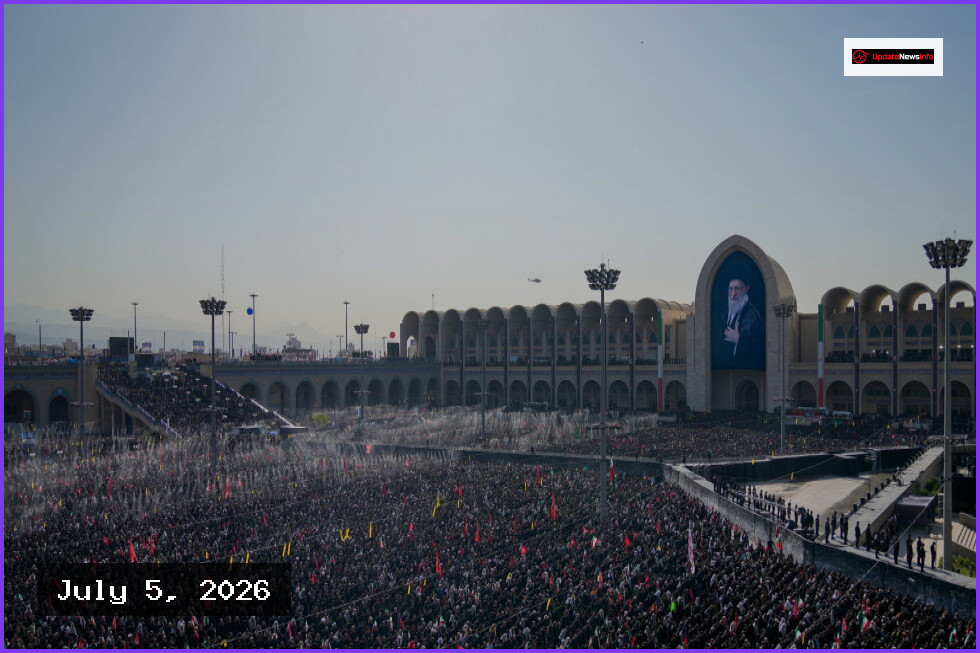
High-ranking Iranian officials and the brothers of the country’s newly appointed supreme leader emerged in public on Sunday to participate in funeral prayers for the late Ayatollah Ali Khamenei. The gathering in Tehran attracted hundreds of thousands of mourners, signaling a shift in the security environment that would have been considered impossible during the initial stages of the war. On February 28, the 86-year-old Ayatollah, along with family members and other key officials, was killed in airstrikes that marked the beginning of the ongoing conflict.
Ayatollah Jafar Sobhani, a 97-year-old Shiite cleric, presided over the prayers held at the Grand Mosalla. Among those in attendance were the late leader’s sons—Masoud, Meysam, and Mostafa—who had not been seen since the war began. Other prominent figures present included President Masoud Pezeshkian, Parliament speaker Mohammad Bagher Qalibaf, and Esmail Qaani, commander of the Revolutionary Guard’s Quds Force. General Ahmad Vahidi, the head of the Revolutionary Guard, was also spotted among the crowd, escorted by plainclothes security personnel.
Despite the public appearance of these officials, Iran’s new supreme leader, Ayatollah Mojtaba Khamenei, remains out of sight. He is reportedly in hiding after sustaining injuries during the same airstrike that killed his father. Israel has issued threats against him as he leads a theocratic government currently engaged in negotiations with the United States regarding a permanent end to the war and the management of traffic through the Strait of Hormuz, which has severely impacted global energy supplies.
The funeral event was marked by aggressive rhetoric, with posters and graffiti throughout the Grand Mosalla calling for the deaths of U.S. President Donald Trump and Israeli Prime Minister Benjamin Netanyahu. During the proceedings, poet Mohammad Rasouli directly questioned why the U.S. president remained alive, drawing cheers from the crowd. These sentiments were echoed by mourners like 29-year-old Gholamreza Sabooni, who expressed a desire for retaliation against the American leader.
Simultaneously, in Washington, D.C., President Trump addressed the 250th anniversary of America’s founding, touting military successes in regions including Iran and Venezuela. U.S. federal authorities have long monitored Iranian threats against Trump, which escalated following the 2020 killing of Gen. Qassem Soleimani. Iran has consistently denied plotting against the former president, though hard-line propaganda has frequently depicted him as a target.
Mourning ceremonies are scheduled to continue throughout the week, with the casket expected to be transported through Tehran on Monday before being moved to other cities in Iran and Iraq. The funeral will conclude on Thursday with the burial at the Imam Reza shrine in Mashhad, the late leader’s birthplace. While formal negotiations to end the war are currently paused, the significant turnout at the funeral is seen as a potential leverage point for Iran as it seeks to address international concerns and respond to the ongoing threat of further Israeli strikes.