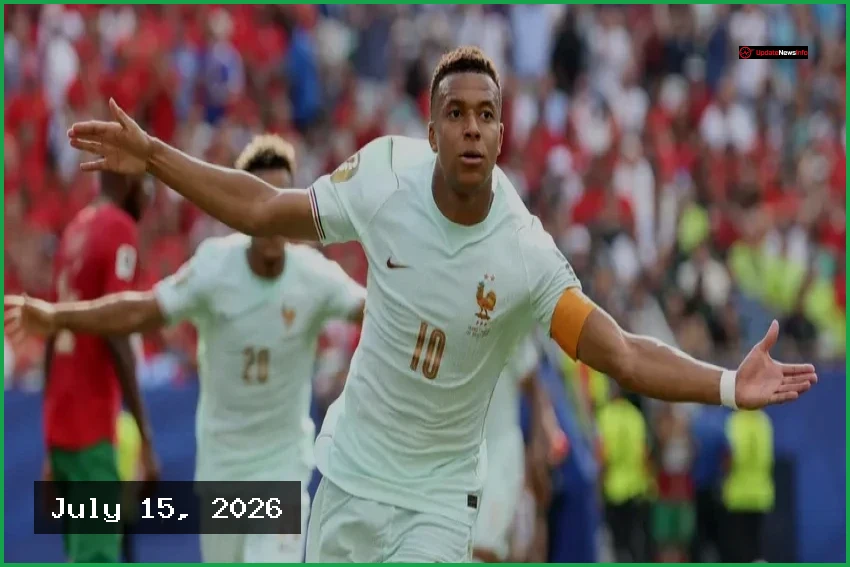
France’s most impressive achievement in 2026 is not found in its traditional exports of wine, cheese, or luxury leather goods, but rather in the exceptional quality and quantity of its football talent. The national team’s third successive appearance in a World Cup semi-final, scheduled for tonight in Dallas against Spain, confirms a trend that has been building for years.
While elite footballers once emerged from the streets of England, Scotland, or the favelas of Brazil, they are now increasingly bred on the playing fields of French provincial towns and the artificial grass pitches of the multi-racial banlieues, or inner suburbs, of French cities.
The scale of this production is significant. There are 99 French-born players participating in the 2026 World Cup, including 23 within the French squad itself. Furthermore, the depth of this talent pool is evident in the English Premier League, where 242 French players competed last year, a figure surpassed only by England’s own domestic contribution to its top clubs.
Additionally, 76 French-born players are representing the nations of their families’ origins at this World Cup, including Morocco, Algeria, Tunisia, and Senegal. This has sparked debates regarding player loyalty, similar to the criticism directed at the talented play-maker Michael Olise, a French national born in London who chose to represent France.
Despite this success, the team frequently faces racist scrutiny. A recent example includes comments from former Spanish Prime Minister Mariano Rajoy, who claimed the French team was of a “very high level…without French players.” This assessment is factually flawed; all 26 players in the current squad hold French nationality, and all but three were born in France, making the current roster more French by birthplace than the 1998 World Cup-winning team.
Other instances of prejudice include Paraguayan senator Celeste Amarilla, who recently insulted Kylian Mbappé by calling him a “colonised Cameroonian” who was “pretending to be French” and was raised “around chimpanzees and coconuts.” In reality, Mbappé was born in Paris and attended private school, where he notably learned to play the flute.
Similarly, Senegal parliament speaker Ousmane Sonku framed the June 16th match between France and Senegal as a political event where “Africa will have beaten Africa.”
These attitudes are not confined to international figures. Some French citizens have expressed that they no longer support the national team because it is “too black.” Historically, this obsession with skin color is not new; before the 1998 triumph, Jean-Marie Le Pen complained that the team was “imported” and lacked knowledge of the national anthem, though he shifted his stance following their victory.
Conversely, there is a different reality on the ground, as seen in rural Normandy this summer, where countless young boys and girls are proudly wearing jerseys bearing the names of stars like Mbappé or Ousmane Dembélé.
The societal impact of this multi-racial team remains complex. While the 1998 “White, Brown and Black” team was celebrated for its positive influence on race relations, the subsequent years saw Jean-Marie Le Pen reach the second round of the presidential election, and the banlieues have experienced recurring riots at roughly five-year intervals.
The inner suburbs, often characterized by poverty, violence, poor housing, drug-trafficking, and Islamic extremism, are rarely discussed in a positive light. However, they are also sites of immense energy, courage, and creativity.
The success of French football is rooted in accessible, affordable sports facilities and the tireless efforts of amateur coaches working with children. By encouraging rather than denigrating the diverse qualities offered by migrants and their descendants, France has cultivated a surplus of talent.
While sport alone cannot resolve the deep-seated problems of the banlieues, the success of Les Bleus represents the positive potential of “France beyond the Boulevard Périphérique.” The question remains: what is French football doing right that the rest of the nation might observe and imitate?
A couple of weeks ago, after France beat Paraguay in the Round of 32, a Paraguayan senator, Celeste Amarilla called the French striker Kylian Mbappé, a “colonised Cameroonian” who was “pretending to be French” but was brought up “around chimpanzees and coconuts”.
On the other hand, in rural Normandy this summer I have lost count of the number of small white boys and girls wearing shirts which proclaim them to be “Mbappé 10” or “Dembélé 7”.