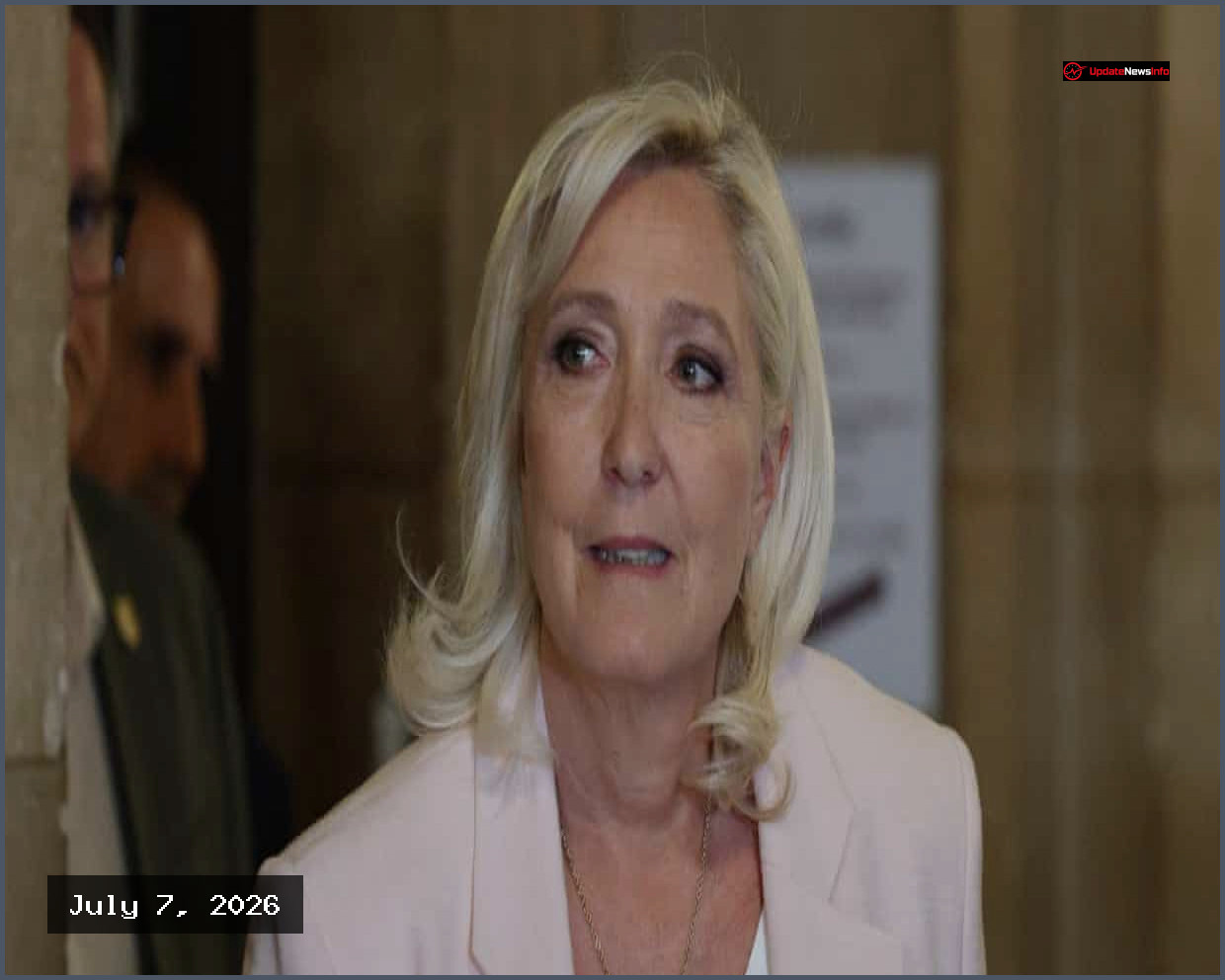
A French appeals court has cast fresh uncertainty over Marine Le Pen’s ambitions for the 2027 presidential election by sentencing her to wear an electronic monitoring tag, despite reducing her ban on running for public office. The Paris court of appeal upheld the 57-year-old far-right leader’s conviction for embezzling European Parliament funds but shortened her period of ineligibility to 15 months, with the remaining 30 months suspended.
While the reduced ban technically leaves a narrow window for Le Pen to run, the court’s full sentence presents a major obstacle. However, the court also handed Le Pen a three-year jail term, with two years suspended and one year in which she must wear an electronic ankle tag for monitoring. This could make a presidential campaign politically and logistically difficult. Le Pen, who leads the anti-immigration National Rally (RN) party, had previously stated in an interview that she would not run if her movements were restricted. “If I’m allowed to be a candidate but am effectively prevented from campaigning freely, then you understand that wouldn’t be possible,” she remarked last week.
Following the verdict, Le Pen’s immediate plans remained uncertain. The far-right figurehead, who appeared in court with allies from her party’s parliament group, is expected to consider her position and make an announcement later on Tuesday, possibly on TV news, whether she will run for France’s highest office next spring. The precise terms of her electronic monitoring will be decided by a different judge at a later date. If Le Pen chooses not to run, her 30-year-old protégé Jordan Bardella, who currently manages the daily operations of the RN, is poised to step in. Le Pen has previously promised to support Bardella with “energy, confidence and conviction,” declaring, “We never give up.” Recent polls indicate that Bardella, who also leads the Patriots for Europe group in the European Parliament, could reach the final runoff, with some polls showing his support surpassing Le Pen’s.
Should Le Pen decline to run, it would mark the first French presidential election in nearly three decades without a member of the Le Pen family on the ballot. Either Marine Le Pen or her father, Jean-Marie Le Pen, who reached the final runoff in 2002, has contested every race. Marine Le Pen had hoped to launch her fourth presidential bid next spring, following the conclusion of Emmanuel Macron’s second term. Macron defeated her in the final runoffs of both 2017 and 2022, though she secured over 41% of the vote in their last matchup.
The appeal court’s ruling stems from a massive fake-jobs scheme orchestrated by Le Pen between 2004 and 2016. The Paris court ruled that she played a central role in embezzling €4.8 million (£4.2 million) of European Parliament funds to pay party staff in Paris for the Front National (now the National Rally). State prosecutors described it as a highly organized, “centralized” and nearly “industrial” system where money meant for Brussels- or Strasbourg-based assistants was systematically diverted to domestic party workers who had no connection to European parliamentary work. Alongside her custodial sentence, Le Pen was fined €100,000 (£85,000).
Le Pen was initially barred from public office for five years with immediate effect following a trial last March. She appealed that ruling, insisting during her retrial that no systematic misuse of funds occurred and that her party did “not have the feeling of having committed the slightest crime.” The original trial saw 24 party members convicted, with Le Pen and 10 others appealing. Her initial sentence sparked outrage among international populists, with Donald Trump labeling it a “witch-hunt” by “European leftists.” Commenting on the legal battle, Le Pen told La Tribune Dimanche: “There was a time when you could take a bullet. Now you can take a judicial bullet. In reality, that means your death.”
During the appeal, state prosecutor Thierry Ramonatxo strongly criticized Le Pen for publicly attacking the judiciary. After her first trial, Le Pen had decried a “tyranny of judges” attempting to block her presidential bid. Ramonatxo argued that judges merely apply democratically enacted laws, warning that her rhetoric was dangerous and had exposed judges to death threats. He stated that accusing the court of a “tyranny of judges,” a “violation of the state of law,” or “political assassination” has no place in democratic judicial debate and serves only to discredit the entire legal system.