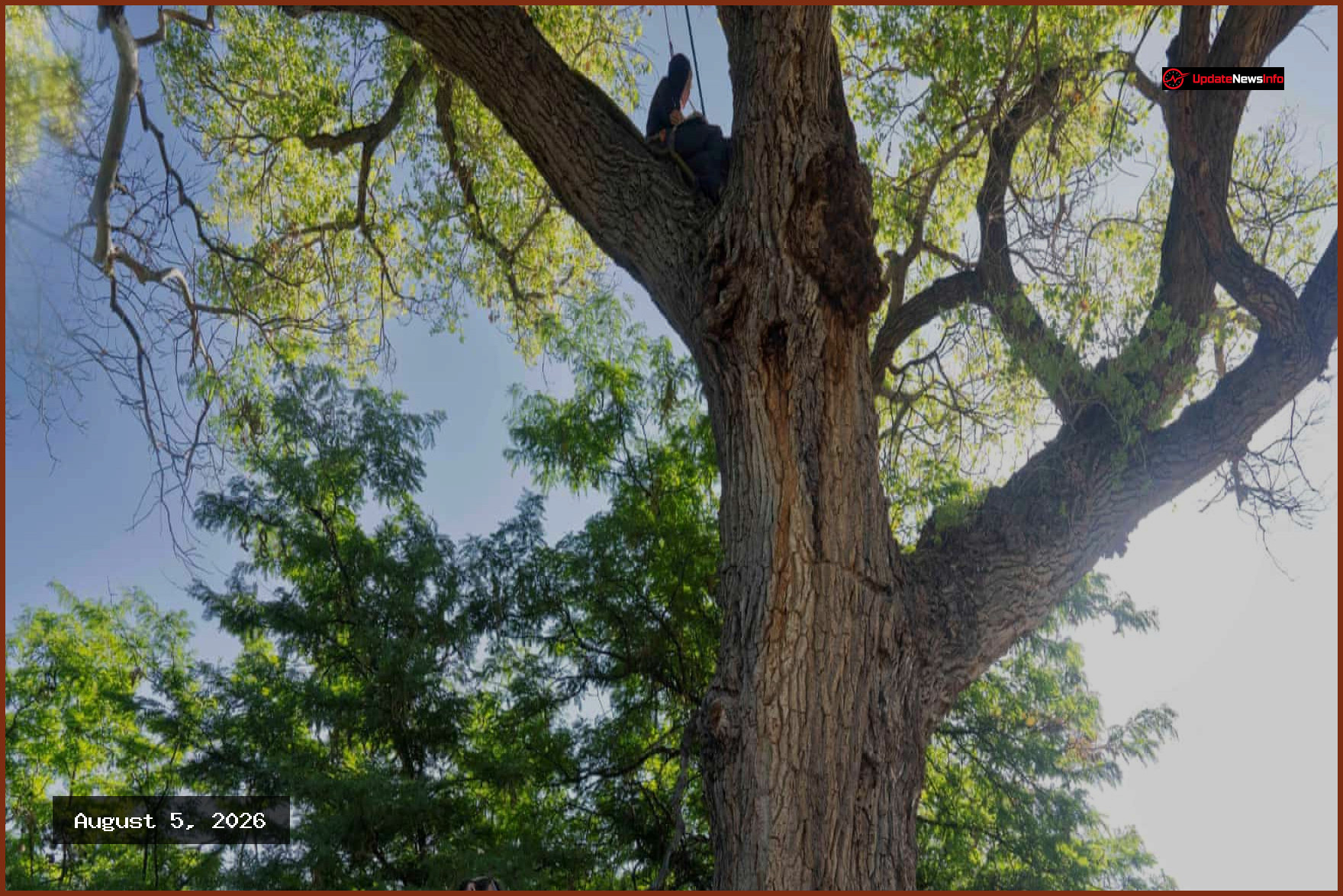
In the remote town of Lochiel, Arizona, a group of demonstrators is staging a continuous "tree sit" to prevent the destruction of an ancient cottonwood grove. The protest, which intensified last week, aims to stop federal contractors from clearing the trees to make way for a 30ft, double-layer border wall along the boundary with Sonora, Mexico.
On 27 July, contractors employed by Fisher Sand and Gravel used excavators to destroy three of the largest cottonwood trees in the area. The remaining group, which now includes several dozen people, is focused on protecting a single, towering cottonwood estimated to be over 200 years old. Protesters describe the tree as a symbol of the area's ecological importance, with activist Kate Scott referring to it as the "Statue of Liberty" for the region.
The group maintains a rotating presence, with one individual stationed on a platform high in the tree at all times, supported by others camping on nearby private land with the owner's permission. While the demonstration has remained peaceful, one person was arrested by the local sheriff’s department on the day the other trees were felled but was released without charges. Santa Cruz County Sheriff David Hathaway has publicly opposed the wall construction in this region, noting that illegal immigration is virtually nonexistent in the valley.
The site of the protest is a high-elevation prairie that serves as a vital binational wildlife corridor. According to environmental advocates, such as Russ McSpadden of the Center for Biological Diversity, cottonwoods are critical in arid regions, yet 90% of riparian forests in Arizona have already been lost to development and groundwater extraction. The area acts as the headwaters for the Santa Cruz River, representing a rare "ribbon of green" in the desert.
Erick Meza of the Sierra Club, who has been documenting the area for months, had previously sent letters to Customs and Border Protection (CBP) requesting they spare the trees. Although the agency promised in an 18 June letter to avoid cutting trees with active bird nests, protesters claim this was violated. On 4 August, McSpadden reported observing a western yellow-billed cuckoo, a threatened species, in the tree the group is currently protecting.
Construction of the border wall began last year, and contractors are currently blasting in the mountains and drilling wells to support the barrier's base. Federal contractors are exempt from many environmental regulations, including the Endangered Species Act, due to the Real ID Act. Despite the ongoing standoff, it remains unclear how authorities will proceed, as protesters are on private property and the tree itself sits on a federally owned strip of land known as the Roosevelt Reservation. Neither the Department of Homeland Security, CBP, nor Fisher Sand and Gravel responded to requests for comment.
The once idyllic valley, where the movie Oklahoma was filmed, is a high-elevation prairie home to bears and porcupines, and the mountains on either side represent two of the most important binational wildlife corridors in the borderlands. At the beginning of the second Trump administration, the border here was demarcated by hip-high vehicle barriers and barbed wire which animals could easily pass.
“I always remind folks that when we see people doing direct action like this, it’s only because every other system has failed,” Butterfly Hill said. These people are “shining a light” on the devastation and destruction caused by border wall construction, she added.